
About The Author

Gwen is a former Welsh tutor from Powys, Wales. She was raised in a bilingual family speaking both Welsh and English, which gave her a love of languages. She recently graduated from Oxford University and is now studying a Master's in Translation Studies at Cardiff University. She enjoys learning French and Turkish in her free time.


Welsh Word of the Day: Glân (clean / pure)
Today’s Welsh word of the day is glân, which means clean or, more rarely, pure. glân clean, pure Glân starts with a g, so it’s susceptible to y treiglad meddal (the soft mutation) and y treiglad trwynol (the nasal mutation). In practice, though, you’re very unlikely to see an adjective undergo the nasal mutation, and …
Read more

Welsh Word of the Day: Traws (trans / cross)

Today’s Welsh word of the day is traws. This little word has a few different uses, and often appears as a prefix meaning across; it’s very similar to the English prefix trans. traws trans / cross Traws is used as a prefix in words such as trawsblannu (to transplant), trawsgyweirio (to modulate/transpose) and trawstorri (to …

Read more

Welsh Word of the Day: Rhag (against / from)

Today’s Welsh word of the day is rhag. This little word is quite difficult to translate; it can have so many different meanings, including against, before, from and lest. In broad terms, rhag is used when discussing precautions and prevention. You will often see rhag appear where the prefix pre- appears in English. rhag against …

Read more

Welsh Word of the Day: Llif (flood / flow / saw)

Today’s word of the day is llif, a word with many different meanings including flow, flood and even saw! llif flood, flow, current, saw Llif is only susceptible to the soft mutation. Soft mutationlif Nasal mutationN/A Aspirate mutationN/A The gender of llif varies according to its meaning. When llif means flow, current or flood, it …

Read more

8 Welsh Words That Are Similar to Turkish

I’ve been dysgu Twrceg (learning Turkish) for a few years now, and I’ve noticed some surprising similarities between Welsh words and their Turkish counterparts. You might have already guessed, but this is because Turkish and Welsh have both inherited a significant amount of their vocabulary from Lladin (Latin). I’ve put together a list of my …

Read more

Welsh Word of the Day: Adduned (resolution)

Today’s Welsh word of the day is adduned (plural: addunedau), a feminine noun which means resolution. This word is most commonly used in the phrase adduned Blwyddyn Newydd (New Year’s resolution), but adduned can also mean vow, as in addunedau bedydd (baptismal vows) or addunedau priodas (wedding vows). adduned resolution addunedau resolutions The word adduned …

Read more

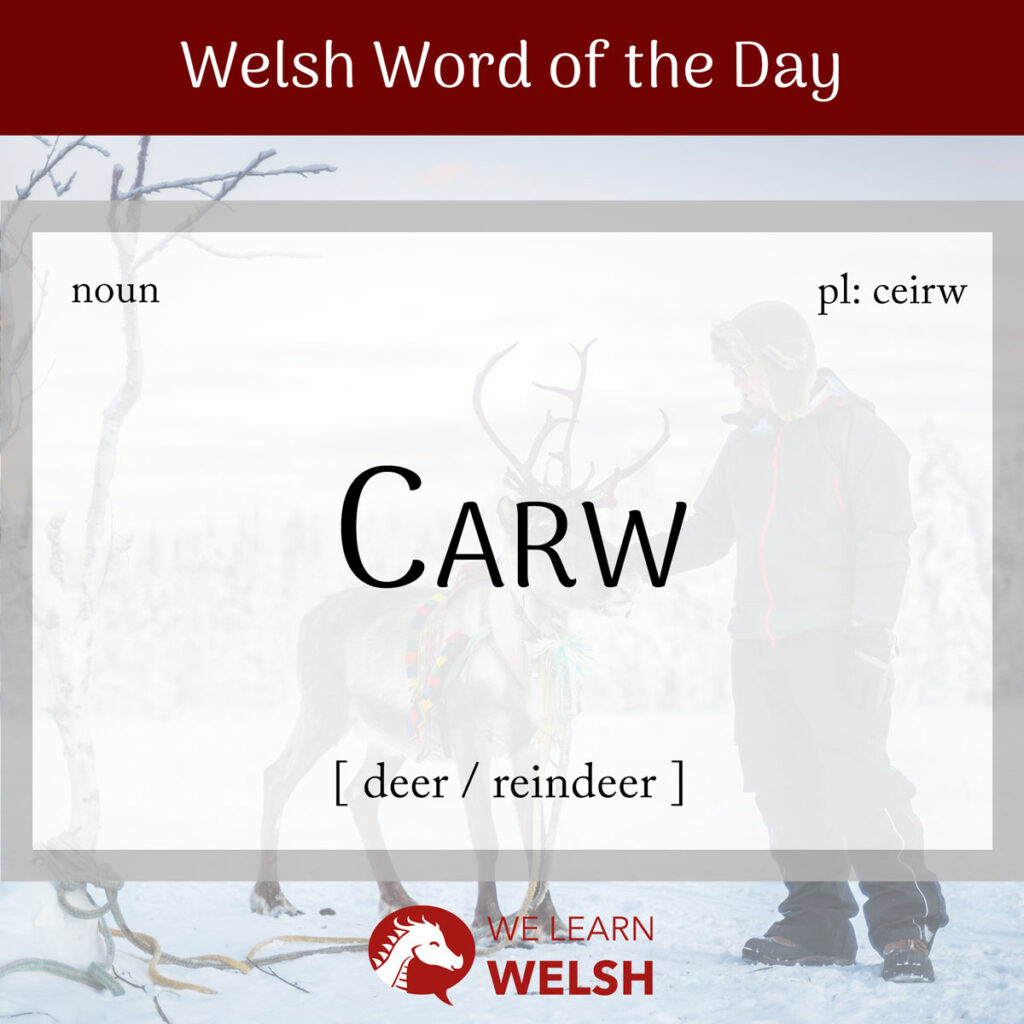
Welsh Word of the Day: Carw (deer / reindeer)

Today’s word of the day is carw (plural: ceirw) which is the Welsh word for deer or reindeer. This is a masculine noun that is susceptible to all three mutations. carw deer / reindeer Soft mutationgarw Nasal mutationngharw Aspirate mutationcharw At this time of year, you’re probably hearing quite a lot about ceirw Siôn Corn …

Read more

Welsh Word of the Day: Siôn Corn (Father Christmas)

Today’s article is all about Siôn Corn (Father Christmas)! The Welsh Santa Claus is named after corn simnai (a chimney-stack) – translated literally into English, he would be called something like John Stack. You may also hear some people borrow the English name Santa Claus directly into Welsh, spelt Santa Clôs. Siôn Corn Father Christmas …

Read more

Welsh Word of the Day: Nadolig (Christmas)

There’s a chill in the air, and colourful lights are twinkling all around town – it must be getting close to Nadolig (Christmas)! Nadolig Christmas Nadolig is probably the most common Welsh term for Christmas, but it’s also common to hear y Nadolig or ‘Dolig for short. If you want to refer to Christmas time …

Read more

How to say “There is” in Welsh

In this article, we’ll be taking a closer look at one of the most common Welsh words: mae. You probably know by now that mae can mean is as in Mae cinio’n barod! (Dinner is ready!) or are as in Mae Elen a Gwilym yn gadael (Elen and Gwilym are leaving). But did you know …

Read more