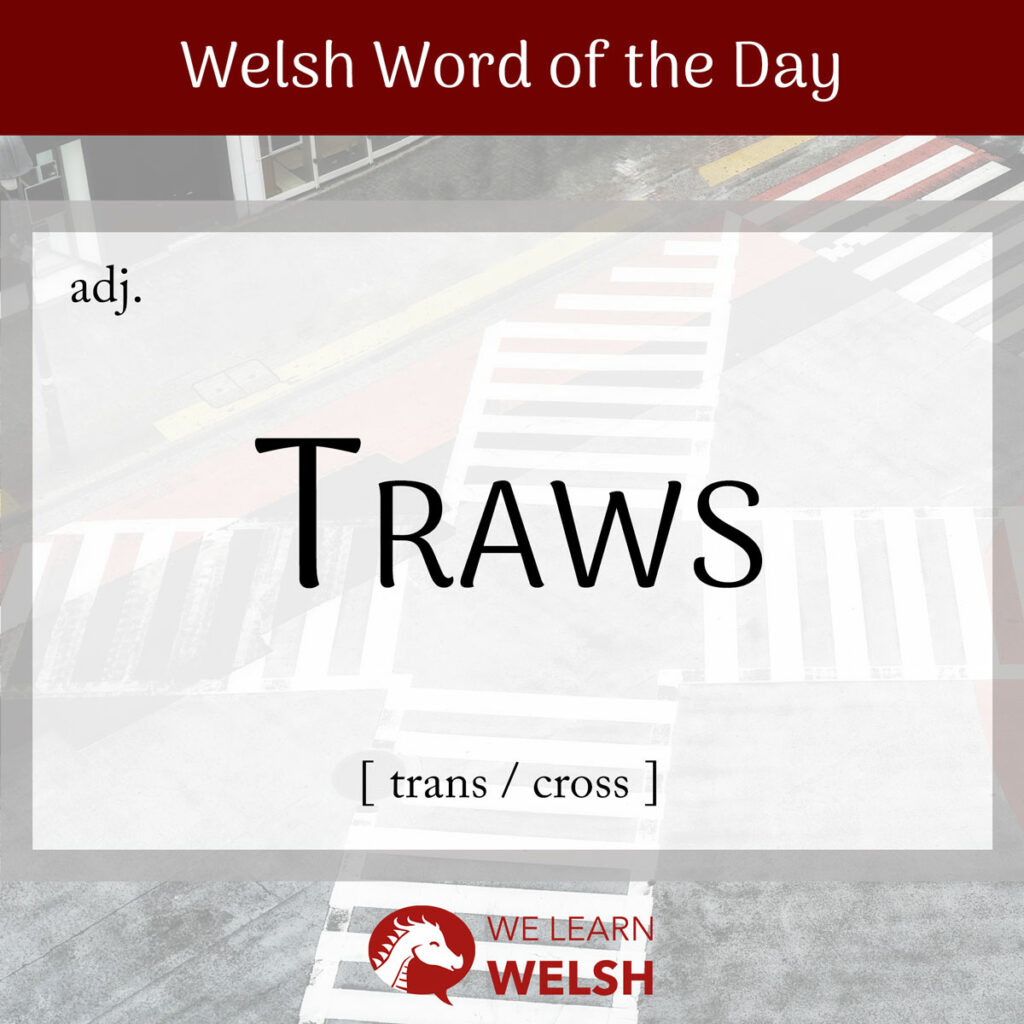
Today’s Welsh word of the day is traws. This little word has a few different uses, and often appears as a prefix meaning across; it’s very similar to the English prefix trans.
traws
trans / cross
Traws is used as a prefix in words such as trawsblannu (to transplant), trawsgyweirio (to modulate/transpose) and trawstorri (to cross-cut). Much like the English trans, traws can be combined with a place name to describe a particular journey – e.g. trawsiwerydd (transatlantic), trawsalpaidd (transalpine).
Traws appears in its softly mutated form in the Welsh phrase for across, ar draws. So, if you want to talk about travelling across the country in Welsh, you’d say teithio ar draws y wlad. When used with a pronoun, traws is also likely to undergo the other two mutations, such as in the following phrases:
Paid torri ar fy nhraws i!
Don’t interrupt me! / Don’t cut me off!
Cerddais i ar ei thraws hi.
I walked across it. (feminine)
You might even hear someone say Dw i’n byw yn Nhraws (I live in Traws), because Traws with a capital T is used as a llysenw (nickname) for the town of Trawsfynydd in Gwynedd.
Soft mutation
draws
Nasal mutation
nhraws
Aspirate mutation
thraws
If you see the word traws used on its own with a lower-case T, there are two main meanings it could have. Firstly, it might mean cross or transverse, such as in the phrase cynghanedd draws. Cynghanedd is a complex system of sound-patterning used in Welsh poetry, and cynghanedd draws involves repeating consonants that appear in the first half of the line. You might think of this as trawsblannu (transplanting) letters from one half of a line to another. If you want a real-world example of cynghanedd, I recommend Aneirin Karadog’s beautiful poem Gweld y Gorwel (Seeing the Horizon), which describes the repetitive life of a recovering drug addict. Have a listen to it here and see if you can hear the patterns.
The second use of traws on its own is as an abbreviation of trawsryweddol (transgender). This is the sense of traws that is used in terms such as hawliau traws (trans rights) and pobl draws (trans people). If a person is traws, their hunaniaeth rhywedd (gender identity) is not the same as the sex they were assigned adeg eu geni (at their birth). For example, dyn traws (a trans man) is someone who was assigned female at birth but is actually a man.
Menyw draws yw fy mam.
My mum is a trans woman.
The opposite of trawsryweddol is cydryweddol (cisgender), where the prefix cyd- as in ynghyd (together) shows that there is no conflict between a person’s gender identity and assigned sex. Unlike traws, cyd is not generally used as an abbreviation; where a shorthand term is needed, Welsh speakers will often opt for the English abbreviation, cis.
Pobl draws often seek out gofal iechyd (healthcare) such as hormonau (hormones) and llawdriniaeth (surgery); these treatments are very effeithiol (effective) and have a regret or reversal rate of less than 1%. The process of changing your enw (name), rhagenwau (pronouns) or corff (body) to match your internal sense of self is known in Welsh as trawsnewid. This word combines traws with the word for change, newid, and can be translated as transition or transformation.
Trawsnewid, along with trawsffurfio and gweddnewid, is also used to describe a transformation brought about by hud a lledrith (magic). This can be seen in the Mabinogi, a collection of chwedlau Cymraeg (Welsh myths). For example, the cymeriad (character) of Ceridwen is a gwrach (witch) who transforms into many anifeiliaid (animals):
- milgi (greyhound)
- dwrgi (otter)
- gwalch (hawk)
- iâr (hen)
Can you think of any other Welsh words beginning with traws?