For a long time, I wasn’t certain that having children – or plant in Welsh – was the right path for me. Even into my mid-30s, the idea felt overwhelming, especially since I still felt, in many ways, like a child myself! But my son has brought such immense joy and meaning into my life that I could never regret that decision. That said, I can say without hesitation that I am perfectly content being one-and-done.
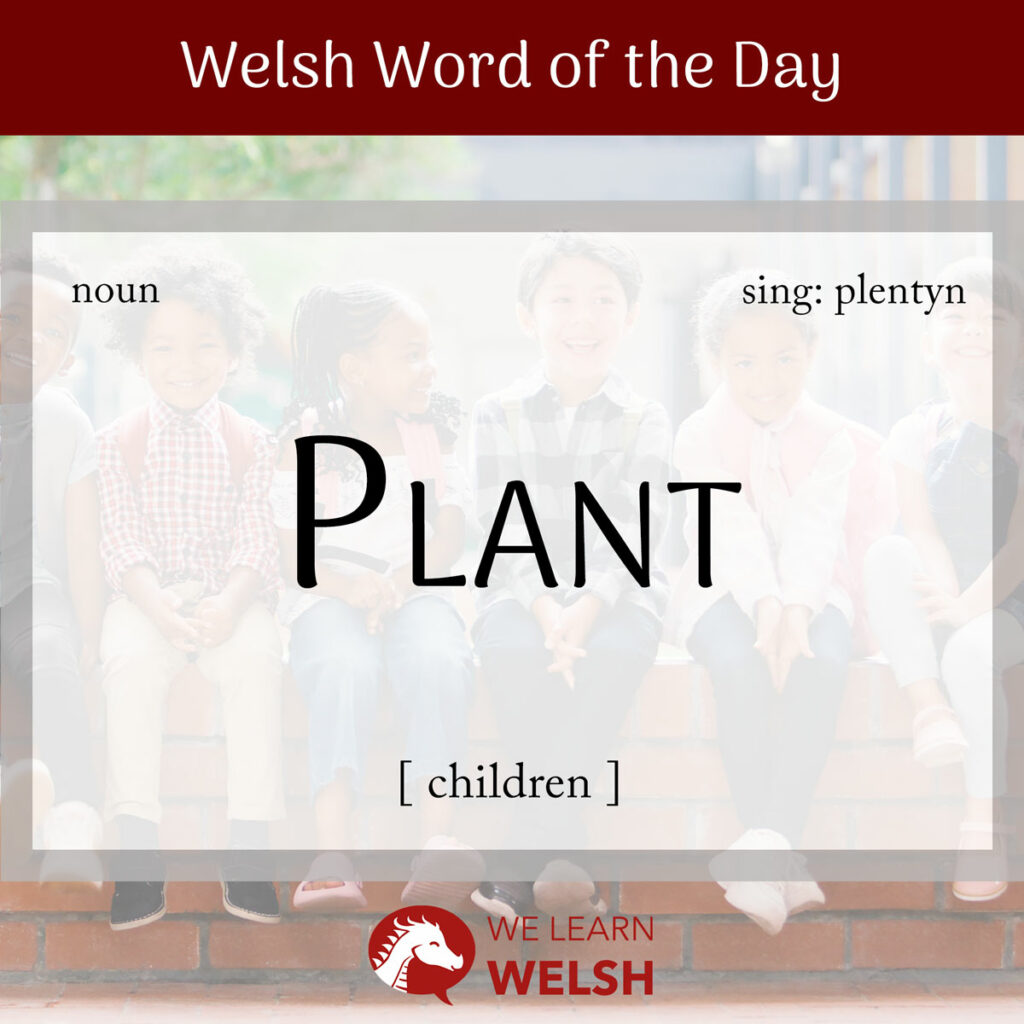
plant
children
According to Geiriadur Prifysgol Cymru, plant ultimately derives from Latin planta, meaning a shoot, sprout, or young plant. It draws comparisons with related Celtic words such as Old Irish cland and Irish clann, which also mean children or offspring, and Breton plantenn, meaning plant. The underlying idea is a shared metaphor of growth, where children are seen as “new shoots” or “plants” that need to be nurtured. Hopefully this analogy will be the hook that will help you remember this word in the future!
The reason I’ve chosen to make plant the focus of this article rather than the singular plentyn is because the singular actually evolved from the plural. This is a common phenomenon in Welsh, where the collective plural is the default dictionary form. Other examples we’ve written about before include coed (woods; coeden = tree) and malwod (snails; malwoden = snail). The -yn and -en endings is used frequently to create singular nouns from plural nouns.
plentyn
child
Given that it starts with the letter p, this word is subject to all three Welsh mutations, making your job as a learner that little bit harder.
Soft mutation
blant
Nasal mutation
mhlant
Aspirate mutation
phlant
Below are some useful terms you might see that contain the word plant:
- plant bedydd = godchildren
- plant bach = little children
- plant amddidad = orphans
- plant yng nghyfraith / gwynion = step-children
- plant ysgol = school children
- plant o fabwysiad = adopted children
- plant maeth = foster children
Mae’r plant hynny’n bod yn ddrwg iawn!
Those children are being very naughty!
Plant y llawr, which literally translates as “children of the floor,” is simply a poetic way of referring to the human race. It appears in the haunting traditional song Bwthyn fy Nain (My grandma’s cottage) in the line:
A phan fo plant y llawr yn methu byw ynghyd
Mae nain yn dedwydd iawn, yn dawel iawn ei byd
And when the human race cannot live together
Grandma is very contented, very quiet
There is a surprising number of terms for illegitimate children in Welsh – far more than for legitimate children, anyway! We have the rather unfortunate sounding plant anllad (wanton children), plant anghyfreithlon (illegal children) and plant pen domen (children at the top of the rubbish heap), the neutral plant cyn priodi (children before marriage) and plant serch (love children), and the poetic plant y dail (children of the leaves), plant llwyn a pherth (children of bush and hedge), plant sgil y drws (next-door children), and plant siawns (children of chance). If you are a Welsh speaker and have encountered a different expression, please let us know!