
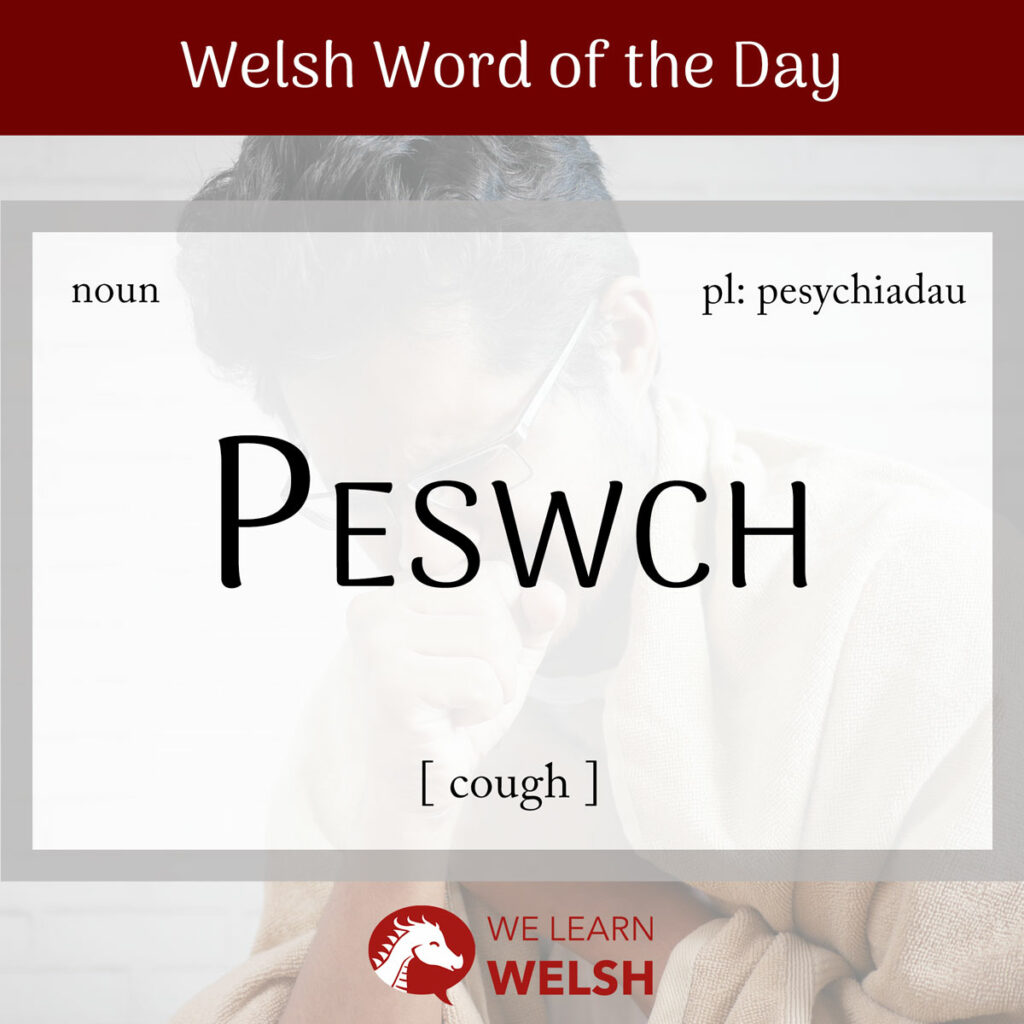
The past two months, I’ve been suffering with what seems like a never-ending peswch, the Welsh word for cough. I’ve been given a cwrs o wrthfiotigau (course of antibiotics), so now it’s just a matter of waiting for them to kick in!
peswch
cough
The plural of this masculine noun is pesychiadau. Notice how the w in peswch has become y in the plural.
pesychiadau
coughs
Given that it starts with the letter p, this word is subject to all three Welsh mutations, making your job as a learner that little bit harder.
Soft mutation
beswch
Nasal mutation
mheswch
Aspirate mutation
pheswch
The kind of peswch that I personally find the most irritating is the peswch sych (dry cough) but with illnesses such as bronchitis, you may experience a peswch o’r frest (chesty cough), along with other symptoms such as:
- blinder = tiredness
- twymyn = a fever
- brest yn dynn = tightness in the chest
- trwyn llawn = stuffy nose
- cur pen/pen tost = headache
- poenau yn y cyhyrau = muscle pain
- dolur gwddf = sore throat
Y Pâs, the official word for whooping cough in Welsh, is a highly contagious bacterial disease that is accompanied by weeks of severe ffitiau pesychu (coughing fits). Interestingly, the word for asthma is hen beswch, which literally translates to “old cough“.
To say that you’ve got a cough, you can use the expressions mae gen i beswch or mae peswch gyda fi, both of which literally translates as “a cough is with me,” or you can use the more traditional expression mae peswch arna i, literally “there is a cough on me“.
Mae peswch arna i ers mis Rhagfyr.
I’ve had a cough since December.
Peswch is the noun, so what is the verb? That would be pesychu, which is the origin of the noun. Pesychu is the combination of pas (another word for cough, and also whooping cough as we saw above) and the verb-forming ending -ychu, similar to -ify or -ise in English, often indicating the act of making, turning into, or doing something.
Another word you might hear for cough in Welsh is hechbes, which either comes from the English heck, or is an onomatopoeic interpretation of the sound one makes while coughing. Some variations on this include hach (north), bech (Banwy Valley), ych (Llanuwchllyn), and wech (Gwaun Valley).
Yet another common verb heard in the north is tagu, which can mean to cough, but is closer in meaning to throttle, strangle or choke.
Mae arna i ofn i ti dagu â’r popcorn ’na…
I’m afraid you’re going to choke on that popcorn…