
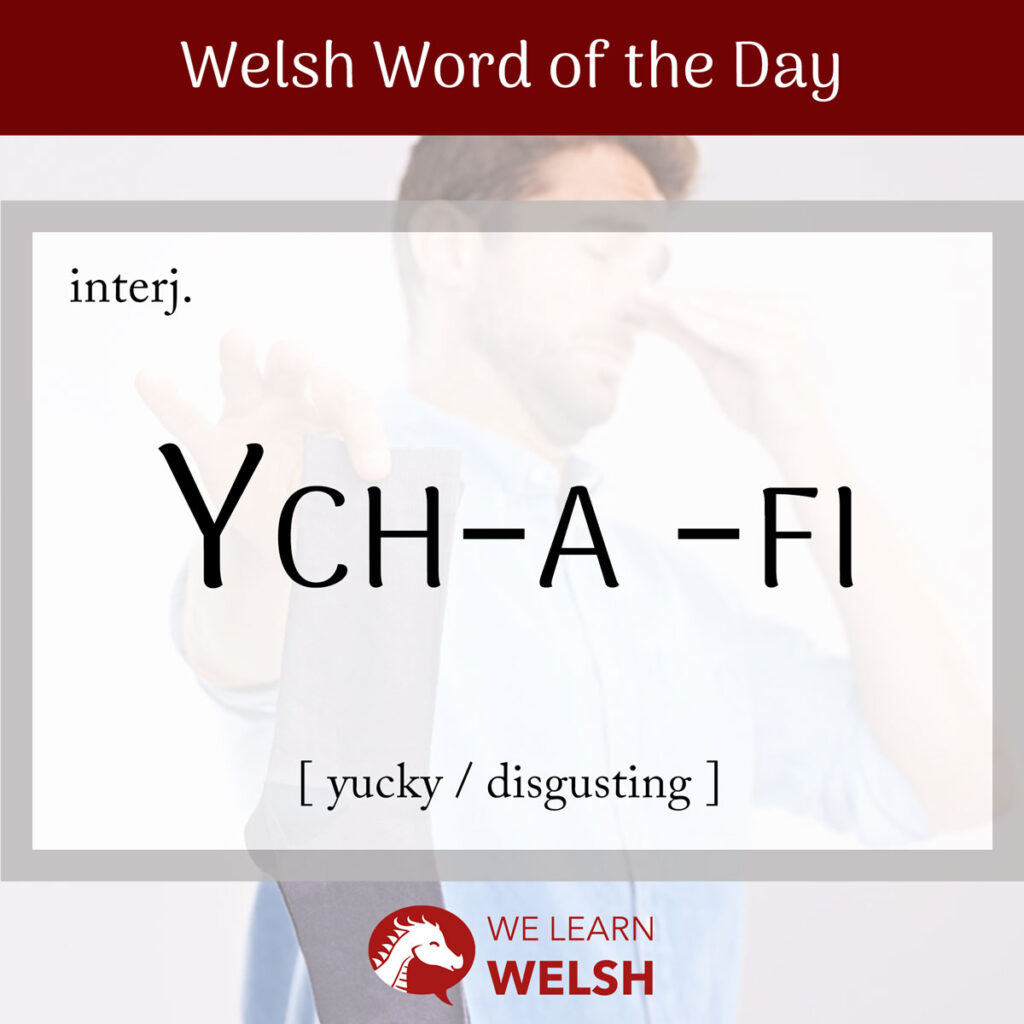
Yes, yes, I know – the pedantic amongst you will be quick to point out that ych-a-fi isn’t a single word but three words combined to form an interjection. It can be translated in any number of ways including yucky, disgusting, horrible – just take your pick! All we really need to know is that it is the go-to expression of disgust in the Welsh language, as far down south as Y Mwmbwls all the way up to the very northern tip of Ynys Môn.
ych-a-fi
yucky
The reason I’ve chosen this word is because, in our Facebook group, it often tops the list of words people remember their rhieni (parents) and neiniau a theidiau (grandparents) saying when they were young. Despite its unpleasant meaning, it carries nostalgic undertones that anyone who has grown up in a Welsh speaking household can appreciate.
Ych-a-fi, mae’r sanau ‘ma’n drewi!
Ugh, these socks stink!
Before we move on, let’s break down the literal translation of ych-a-fi.
Ych should be pretty easy to understand due to its close resemblance to the English words yuck and ugh. However, comparisons have also been made to another word, och, seen in the interjection Och a fi! (Woe is me!), as well as ach-a-fi, an alternative spelling listed in Geiriadur Pryfysgol Cymru.
A is the word for and in Welsh, and fi means me, so what we are literally saying is Yuck and me. It doesn’t make a whole lot of synnwyr (sense), I know, but few idiomatic expressions ever do!
Interestingly, in 2024, ten Welsh words were introduced to the Oxford English Dictionary, and guess what? Ych-a-fi was one of them, presumably because it can be heard in the everyday English discourse of people in Wales. Other words that made it into the dictionary that year include sglods (a slang form of sglodion meaning chips) and Senedd, the word for the Senate. (Source: BBC Wales)
While doing research for this article, I also discovered that ych is also the word for an ox or steer, with the plural being ychen.
Mae’r ych yn bwyta glaswellt y maes.
The ox is eating the grass in the field.
And that’s not all. Ych is also the dialectal way of saying ‘you are‘ (formal / plural) in the south. Note that the y is pronounced as if it were an i.
- Ych chi’n = You are
- Dych chi ddim yn = You are not
- Ych chi’n? = Are you?
Ych chi’n iawn?
Are you ok?