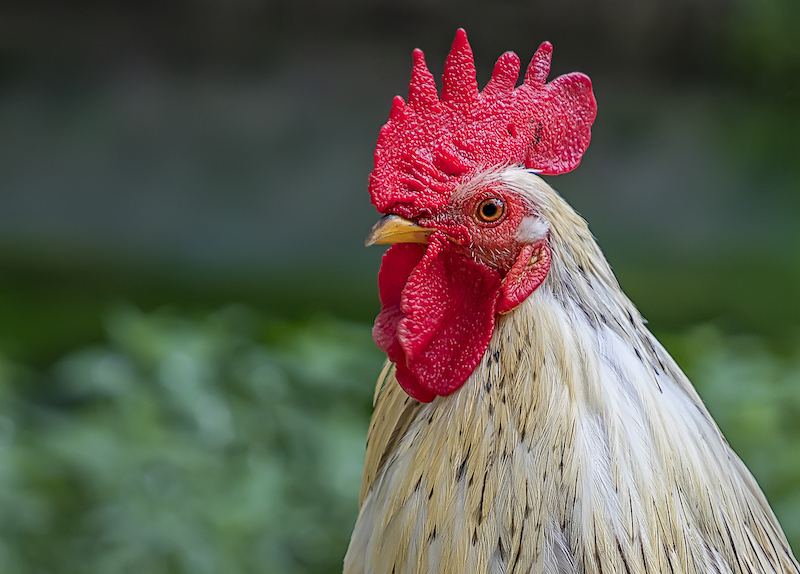
Do you know why the grawnfwyd (cereal) Kelloggs advertises itself with a picture of a ceiliog (cockerel / rooster)? The easy answer is that these adar (birds) are known for waking people in the morning with their canu (usually singing, here crowing), signalling the start of the day and time for brecwast (breakfast).
But it might not be as simple as that – notice the similarity between ‘Kelloggs’ and the word ceiliog itself. One story goes that famous Welsh harpist Nansi Richards met Will Kellogg himself while working and travelling in the US. Based on his surname, she is said to have suggested using the image of a ceiliog to advertise his new grawnfwyd. Who knew?!
Since ceiliog specifically refers to the male of the iâr (chicken) species, it is a masculine noun. The plural is formally ceiliogod but some people do say ceiliogau instead.
ceiliog
cockerel
ceiliogod
cockerels
In parts of Powys, you may also hear the word being pronounced like this, which makes it sound much more similar to the brand name!
And here’s how the word mutates:
Soft mutation
geiliog
Nasal mutation
ngheiliog
Aspirate mutation
cheiliog
Ceiliog can technically refer to the gwryw (male) of any species of aderyn (bird). It can also be used idiomatically, such as for a person who comes across as brave, mischievous and feisty, for ceiliog pen y domen (a cock of the walk), someone over-confident and conceited, or for a hen geiliog (old cockerel), a man who is chwantus (lecherous).
There is even ceiliog dandi / ceiliog tandi (fop / dandy) which refers to a man perceived as overly concerned with fashion and style – these terms are outdated now in both English and Welsh.
Notice that the English word dandy has been changed to tandi in one of the Welsh terms, implying that speakers assumed that dandy was a soft mutation of the original form! This process of ‘back-mutation’ is surprisingly common in Welsh; you can read more about it here.
But you will most often hear ceiliog in the sense of the beloved, though swnllyd (noisy), creature represented on the front of a box of creision ŷd (cornflakes), head of his haid (flock) of ieir (chickens) and cywion (chicks).
Torrodd canu ceiliog y distawrwydd.
The crow of a cockerel broke the silence.
As someone who grew up keeping ieir, I can confirm that ceiliogod do start calling their iconic coc-a-dwdl-dŵ (cock-a-doodle-doo) at or before codiad yr haul (the sunrise), making them a decent stand-in for a cloc larwm (alarm clock).
However, they don’t just leave it at that – in fact, they pretty much don’t stop canu all day. Despite this, many languages, including English and Welsh, use the phrase ar ganiad y ceiliog (at cock’s crow) to convey that something is happening yn y bore bach (in the very early morning, literally in the small morning).
It is probably their noisiness that gives ceiliogod their name in Welsh, since *kalyakos, the root of the word in proto-Celtic, is derived from the proto-Indo-European root *kelh (to call).
Still, that’s not all they’re known for. Another familiar feature of the ceiliog is his prominent crib (crest / comb) and tagell (wattle), the flaps of red skin on top of his head and under his chin. To torri crib ceiliog rhywun (break someone’s cock-crest) means to bring them down a notch.
Mae o fel ceiliog wedi torri ei ben!
He’s running around like a headless chicken! (literally: He’s behaving like a cockerel that broke its head!)
The image of the ceiliog has been used in more ways than just advertising grawnfwyd.
A ceiliog gwynt (weathervane / weathercock, literally wind cockerel) is a device showing in what direction the gwynt (wind) is chwythu (blowing), with points indicating the cardinal directions gogledd (north), de (south), gorllewin (west), and dwyrain (east). They are often adorned with a picture of a ceiliog, whose head will point in the cyfeiriad (direction) of the gwynt.
The name ceiliog itself is also regularly borrowed. One example is the term ceiliog rhedyn, just one of the many Welsh words for a grasshopper – this one literally means cockerel of the ferns.
Another is the wonderful idiom priodas ceiliog ac iâr from sir Benfro (Pembrokeshire), which means wedding of a cockerel and hen, and refers to two people living together like a married couple without actually priodi (marrying).
Since ieir have lived in human domestication for so long, ceiliogod feature repeatedly in folklore and cultural events around the world, from the violent practice of ymladd ceiliogod (cockfighting) to the story of the brenhinsarff / basilisg (basilisk), a terrifying creature that is half ceiliog and half neidr (snake).
Some more positive connotations are offered by the Chinese sidydd (zodiac). If you were born in 1945, 1957, 1969, 1981, 1993, or 2005 (going by the Chinese lunar calendar), you’re officially a ceiliog, meaning you’re hyderus (confident), uchelgeisiol (ambitious), and gweithgar (hard-working). Doesn’t sound bad to me!