
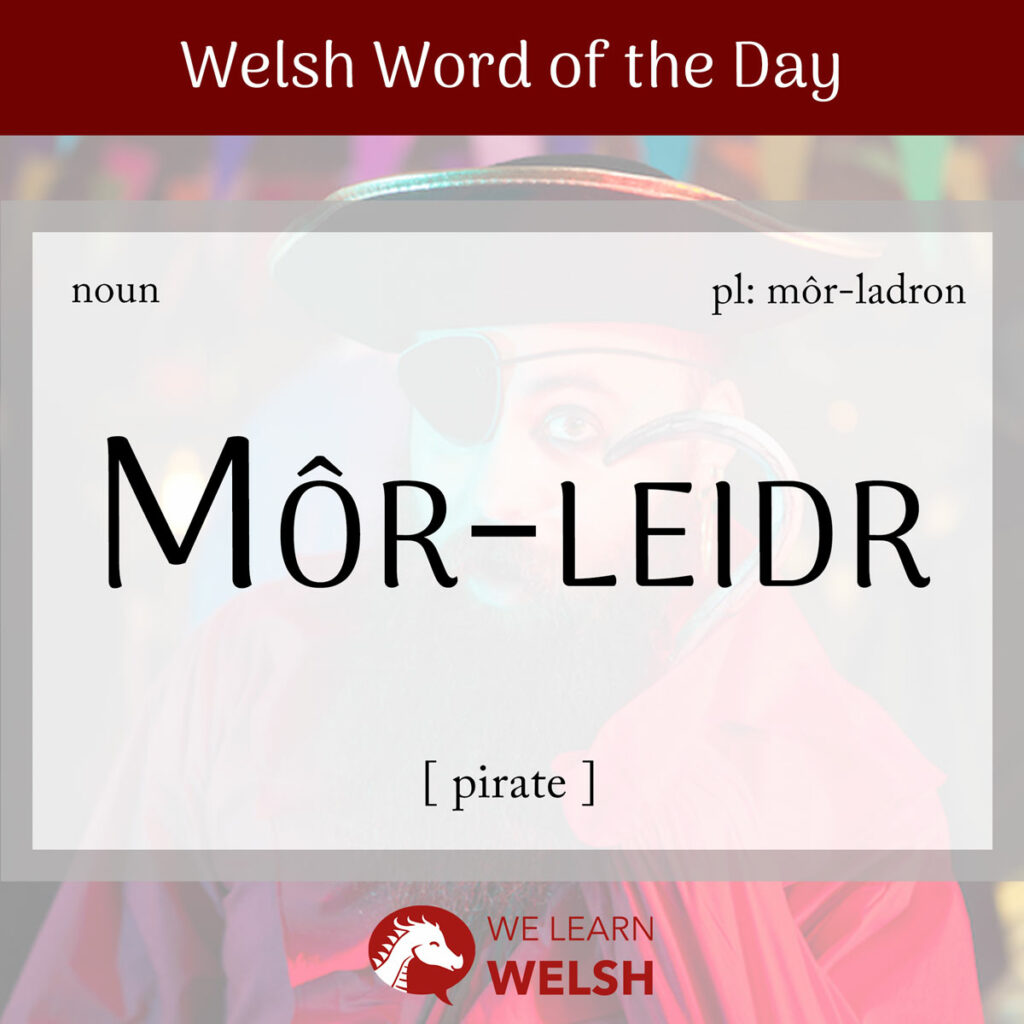
Recently my son has become obsessed with the iconic film Muppet Treasure Island, which is celebrating its 30th anniversary this year. Amser yn hedfan wir! (How time flies!) If you haven’t seen it, it is definitely worth watching for Tim Curry’s performance alone.
The Welsh for pirate is môr-leidr, which is the combination of môr (sea) and leidr (thief). The plural is môr-ladron and it has a cognate in Breton, morlaer. I can’t think of a more suitable name for a swashbuckling buccaneer, to be honest!
môr-leidr
pirate
môr-ladron
pirates
Although môr-leidr is the most widely accepted term, GPC suggests all of the following synonyms: herwr môr, heriwr, herwlongwr, môr-ysbeilwyr, môr-wibwyr, môr-wylliaid and, yes, even just plain old pirat / peirat.
- herwr = outlaw, fugitive
- ysbeiliwr = bandit, robber
- gwibiwr = sprinter
- gwylliad = bandit, brigand
Only one mutation applies to môr-leidr, the soft mutation:
Soft mutation
fôr-leidr
Nasal mutation
N/A
Aspirate mutation
N/A
Mae e eisiau bod yn fôr-leidr.
He wants to be a pirate.
At this point, it’s worth taking a look at some pirate-related vocabulary that you might encounter when talking about these sea-bound scoundrels:
- llong = ship
- cleddyf = sword
- trysor claddedig = buried treasure
- môr = sea
- powdwr gwn / powdwr du = gunpowder
- mwsged = musket
- pistol / llawdryll = pistol
- planc = plank
- patsh = eyepatch
- coes bren / coes glec = wooden leg
Mae’r môr-leidr yn chwilio am drysor claddedig.
The pirate is looking for buried treasure.
A pirate is a person who engages in acts of lladrad (robbery) or trais (violence) at sea, often targeting ships, coastal towns, or trade routes to dwyn (steal) goods, treasure, or valuable cargo. Historically, pirates operated outside the cyfraith (law), living by their own codes and frequently forming loose criwiau (crews) led by a capten (captain).
While we tend to romanticise the image of môr-ladron, depicting them with eye patches, wooden legs, parotiaid (parrots), and llongau (ships), their true identity was that of herwyr (outlaws) who relied on cunning, sgiliau llywio (navigation skills), and sometimes brutal force to survive. And the truth is that môr-ladrad, or piracy, still exists around the globe today, in places including Gulf of Guinea, Gulf of Aden, Arabian Sea, Indian Ocean, Bay of Bengal, just to name a few. Let’s hope we never have the poor fortune of meeting one!