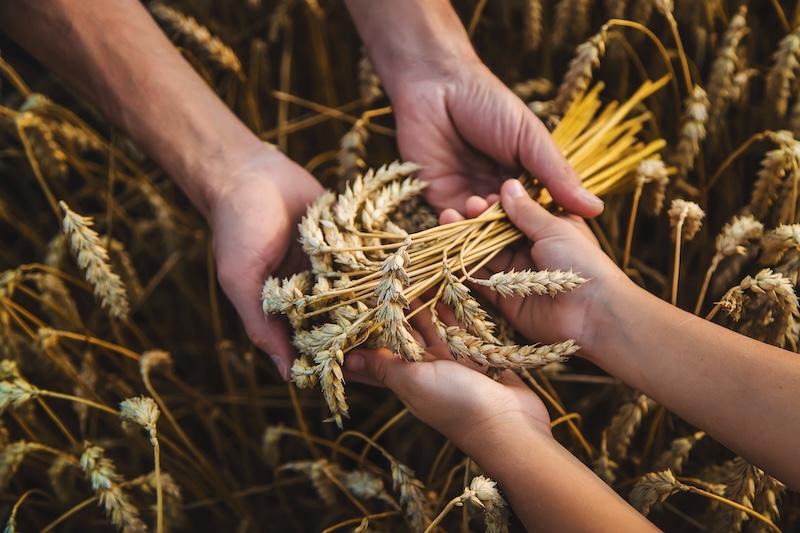
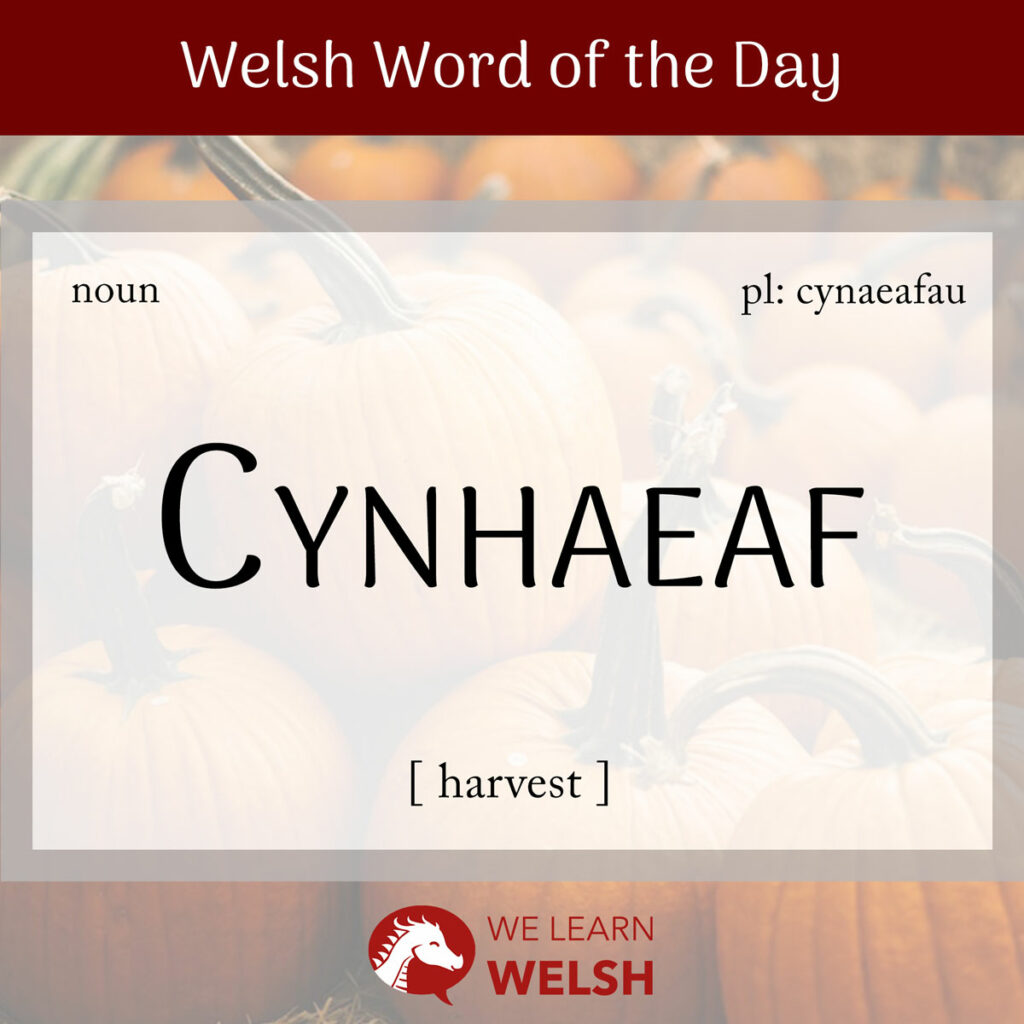
I thought today’s word, cynhaeaf (harvest), would be particularly fitting as we find ourselves well into the tymor yr hydref (autumn season). It gives us a chance to reflect on the summer months, while also giving thanks to our ffermwyr (farmers) for the hard work that goes into bringing in the harvest.
cynhaeaf
harvest
The word cynhaeaf (plural: cynaeafau) dates back to the 13th century according to GPC. Cynhaeaf is a transparent compound, consisting of the words cyn (before) and gaeaf (winter).
cynaeafau
harvests
GPC also notes the comparison with the Cornish kyniaf, a similarity which is unsurprising given the close links between Welsh and Cornish.
Mae’r ffermwyr yn gweithio’n galed yn ystod y cynhaeaf.
The farmers work hard during the harvest.
Soft mutation
gynhaeaf
Nasal mutation
nghynhaeaf
Aspirate mutation
chynhaeaf
- ei gynhaeaf e/fe– his harvest
- dy gynhaeaf – your harvest
- fy nghynhaeaf – my harvest
- ei chynhaeaf hi – her harvest
As cynhaeaf is a masculine noun, it does not undergo a soft mutation following the definite article y or yr. In other words, it remains y cynhaeaf. Similarly, adjectives do not mutate after masculine nouns:
- y cynhaeaf mawr – the big harvest
- y cynhaeaf oer – the cold harvest
- y cynhaeaf ffrwythlon – the fruitful harvest
Historically, gwyliau cynhaeaf (harvest festivals) were celebrated at the start of the harvest season, around the 1st of August. This was known as Lammas, meaning loaf mass. Farmers would bake loaves of bread using the first wheat they had gathered, and these loaves were then be taken to the capel lleol (local church) to be used in a special service yn rhoi diolch (giving thanks) for the cynhaeaf.
This tradition travelled across the pond to Gogledd America (North America), where a very famous dathliad (celebration) was held by the Pilgrims in 1621, marking the dechreuad (beginning) of what we now know as Diolchgarwch (Thanksgiving).
However the modern way of celebrating the harvest festival in British churches began in 1843, in Cornwall, when a vicar named Robert Stephen Hawker invited his parishioners to a special thanksgiving service. The Harvest Festival, as we typically know it today, is celebrated at the diwedd (end) of the tymor cynhaeafu (harvesting season) close to the autumn moon, which usually falls around the middle of mis Medi (September). It is widely associated with the church, where Cristnogion (Christians) give thanks in ysgolion (schools) and capeli (chapels) for the ffrwythau (fruits) and llysiau (vegetables) gathered from the tir (land) throughout the year.
Mae’r cynhaeaf yn dechrau ym mis Medi.
The harvest starts in September.
Rydym yn rhoi diolch yn ystod y cynhaeaf.
We give thanks during the harvest.
So, as yr hydref (autumn) settles in, the tywydd (weather) cools and moods dip a little, what are you diolchgar (thankful) for this year?