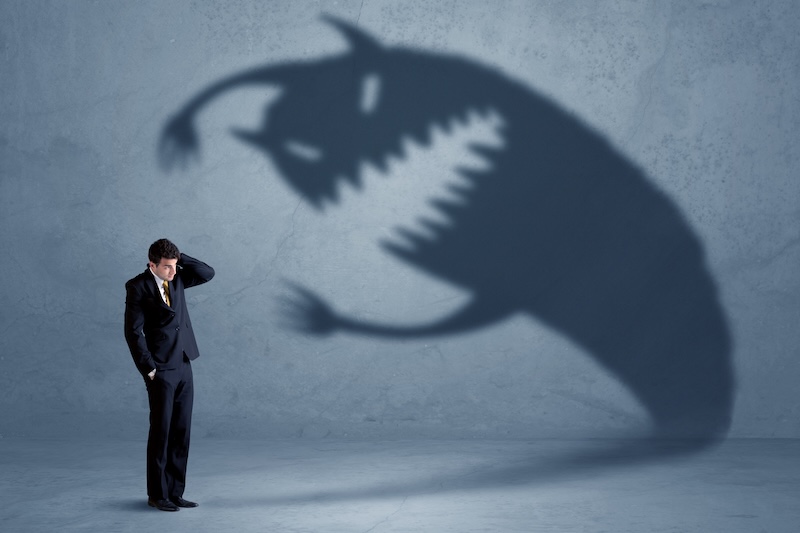
Like many children his age, my young son is terrified of y tywyllwch (the dark), and more specifically, of the creatures that might be lurking there. He doesn’t believe there is an anghenfil under his bed, funnily enough, but he doesn’t dare venture into the upstairs bathroom on his own!
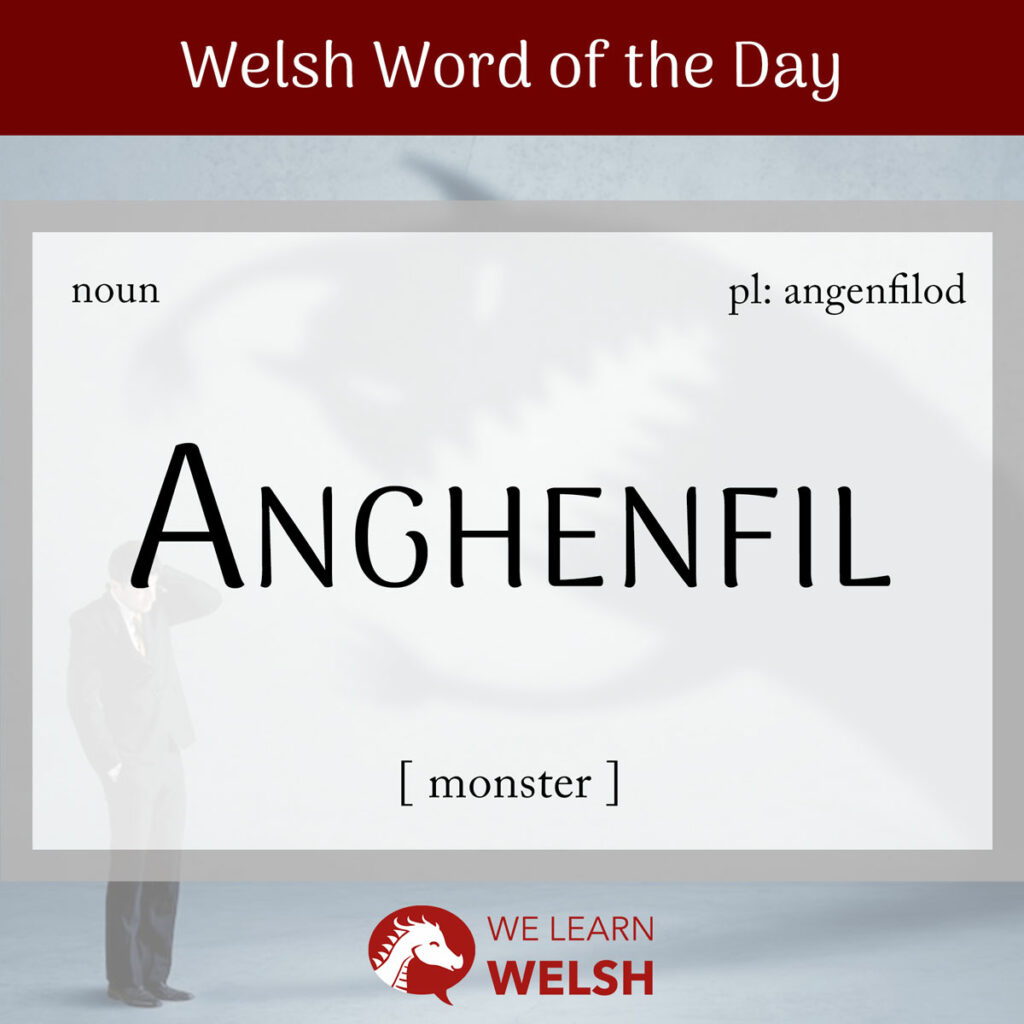
As you’ve probably guessed by now, the Welsh word for monster is anghenfil and it is a masculine noun. According to the GPC, it is likely the combination of angen – whose root is uncertain but may be linked to the Latin ingēns meaning huge or monstrous, or amgen meaning different or other – and mil, meaning animal, beast or creature.
anghenfil
monster
Another proposed origin is the word anghyngel, which means evil / bad angel. I think I like this interpretation just as much as the first!
Welsh words frequently offer many possible plurals and anghenfil is no exception. You have the choice between angenfilod, angenfiloedd and angenfiliaid. Of the three, I’d say that angenfilod is the most common.
angenfilod
monsters
Interestingly, there is also a specific word for a female monster: angenfiles!
Anghenfil becomes hanghenfil after the words eu (their), ein (our), and ei (her), but not after ei (his). This is called h-prosthesis; it’s a bit like a rare kind of mutation. Some people only use h-prosthesis when writing or speaking formally. To be fair, you probably won’t hear hanghenfil all that often anyway, with the exception of phrases like the one below where the children have made their own clay monsters.
Gofynnwch gwestiynau i’ch plant am eu hanghenfilod.
Ask your children questions about their monsters.
There are other words used to describe creatures we might find terrifying. To start, creature is creadur, and what’s interesting is that this word may also be used as a sort of term of endearment meaning poor thing or poor fellow.
Bwystfil, on the other hand, is a wild beast, brute or animal. It too contains mil, but is preceded by bwyst meaning beast or animal. There is also cynfil, which refers to a strange creature in the lowest or highest order of the element of animal life.
Bwbach is the Welsh for the bugbear or bogy, with bwbach (y) brain being the word for scarecrow.
And as it often happens, Welsh has also borrowed the English word, albeit with Welsh pronunciation: monstr or monstiwr.
Mam, mae anghenfil o dan fy ngwely!
Mummy, there’s a monster under my bed!
Finally we come to Afanc, sometimes also called Addanc, a lake monster from Welsh mythology. Descriptors for this anghenfil dŵr (water monster) range from a crocodile, to a *beaver to a platypus, and it is sometimes said to resemble a demon. Some say it dwells in Llyn Llion, others believe it hides in the depths of Llyn Barfog, which happens to be just a few minutes away from where I live. My favourite candidate, though, is Llyn yr Afanc, a lake near Betws-y-coed that was named after the creature.
*The Welsh for beaver is actually afanc!
A few readers may feel that, despite everything covered here, I’ve overlooked the most fearsome monster of all – the mam yng nghyfraith (mother-in-law). For the record, though, mine is very nice!