There’s a popular theory that any medr (skill) can be learnt to the level of an arbenigwr (expert) if you put in 10,000 hours of ymarfer (practice). When I first heard the rhif (number) I thought great, that doesn’t sound like that long – but actually if you ymarfer (practise) something for dwy awr (every day), it would take you 13.7 blynyddoedd (years) to attain!
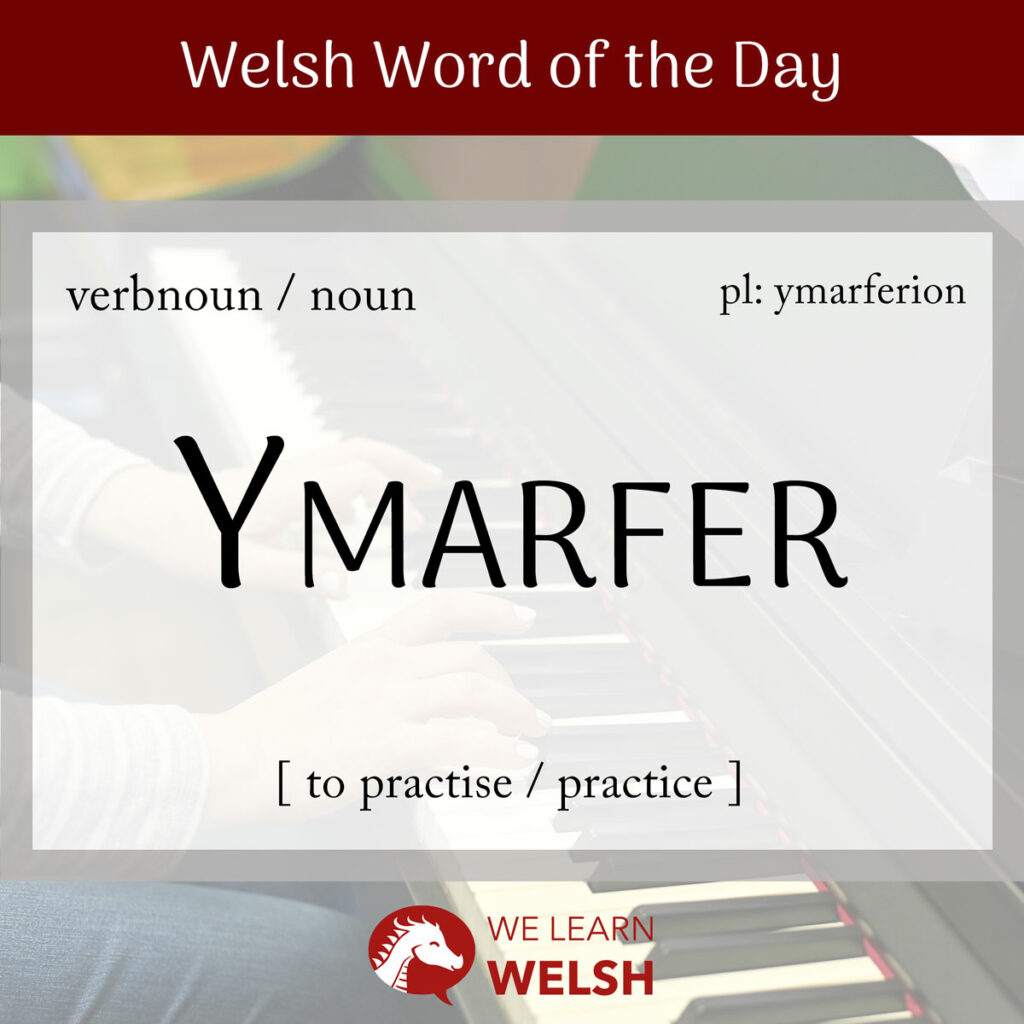
Ymarfer is both a verb, meaning to practise, and a noun, meaning practice. It’s very often heard in the phrase ymarfer corff (exercise, literally body practice). The noun is feminine and its plural is ymarferion (practices), but this is rarely necessary; arferion (habits, practices in the sense of habits) is more common.
ymarfer
practise / practice
Arfer is actually where ymarfer comes from. You can read more about arfer here, but it’s a noun meaning habit, practice, or custom, and also a verb meaning to be used to or to become used to.
To make ymarfer, we add the reflexive prefix ym– which indicates that something is being to oneself or to another person. So you could say ymarfer literally means to get oneself used to. We can also make ymarferol which means practical in some senses, or, the adverbial phrase yn ymarferon, in practice.
It makes sense, then, that ymarfer mainly means practise as in practise to try to improve at, like rehearse or train. You could ymarfer an offeryn (instrument), or chwaraeon (sports). Here, some people might also say practisio or practeisio. It is like mynd drosto (going over) something in order to dysgu (learn) or perffeithio (perfect) the sgìl (skill).
The slightly old-fashioned use of practise referring to practising a profession generally varies in Welsh depending on the specific gyrfa (career), but it is usually most natural to simply say bod (be) – bod yn feddyg (to be a doctor / to be practise medicine), for example.
Meistr pob gwaith yw ymarfer.
Practice makes perfect (literally the master of all work is practice).
What about practice as a noun? It depends what it means! Practice as in the direct noun equivalent of practise to get better at is ymarfer.
An interesting contrast, though, is that if you were saying you were in practice at a particular skill, you would probably say wedi ymarfer (this is basically having practised), whereas to say you are out of practice the most natural form is wedi colli’r arfer (having lost the habit). There is also digon ‘tebol versus dim digon ‘tebol (literally capable enough versus not capable enough) in the North.
Though allan o ymarfer is sometimes heard, this is considered an Anglicism.
The practice of a doctor is meddygaeth deuluol (general practice, literally family medicine). A practice as in a habit is just arfer, or arferiad, as in dyna’r arfer (that’s the usual practice).
Then to put something into practice is a different thing entirely – you would usually just say ar waith, which literally is more like at work, but ar arfer is also used.
There’s also the further form ymarferiad which also means practice. It tends to come up in more formal contexts, like ymarferiad a threfnadiaeth (practice and procedure).
Gad i ni ymarfer bach mwy cyn i ni adael.
Let’s practise a bit more before leaving.
Probably the most common form in which you’ll hear ymarfer is ymarfer corff (exercise). From addysg gorfforol (P.E., physical education) at ysgol (school) to trying to keep heini (fit) amidst the business of life, ymarfer corff can take many different forms:
- nofio = swimming
- rhedeg = running
- ioga = yoga
- dawnsio = dancing
- codi pwysau = lifting weights
- chwaraeon = sports
As a verb exercise can be ymarfer, too, but it depends on the context – anything physical is ymarfer, as in ymarfer eich cyhyrau (to exercise one’s muscles), but to exercise a right or to exercise control is arfer.
What’s your favourite way of ymarfer eich Cymraeg (practising your Welsh)?
By the way, if you live in the Tywyn (Gwynedd) area, we invite you to join We Learn Welsh for our monthly Ymarfer Club meet-ups where we chat in Cymraeg over tea and coffee from 10-11:30am!