
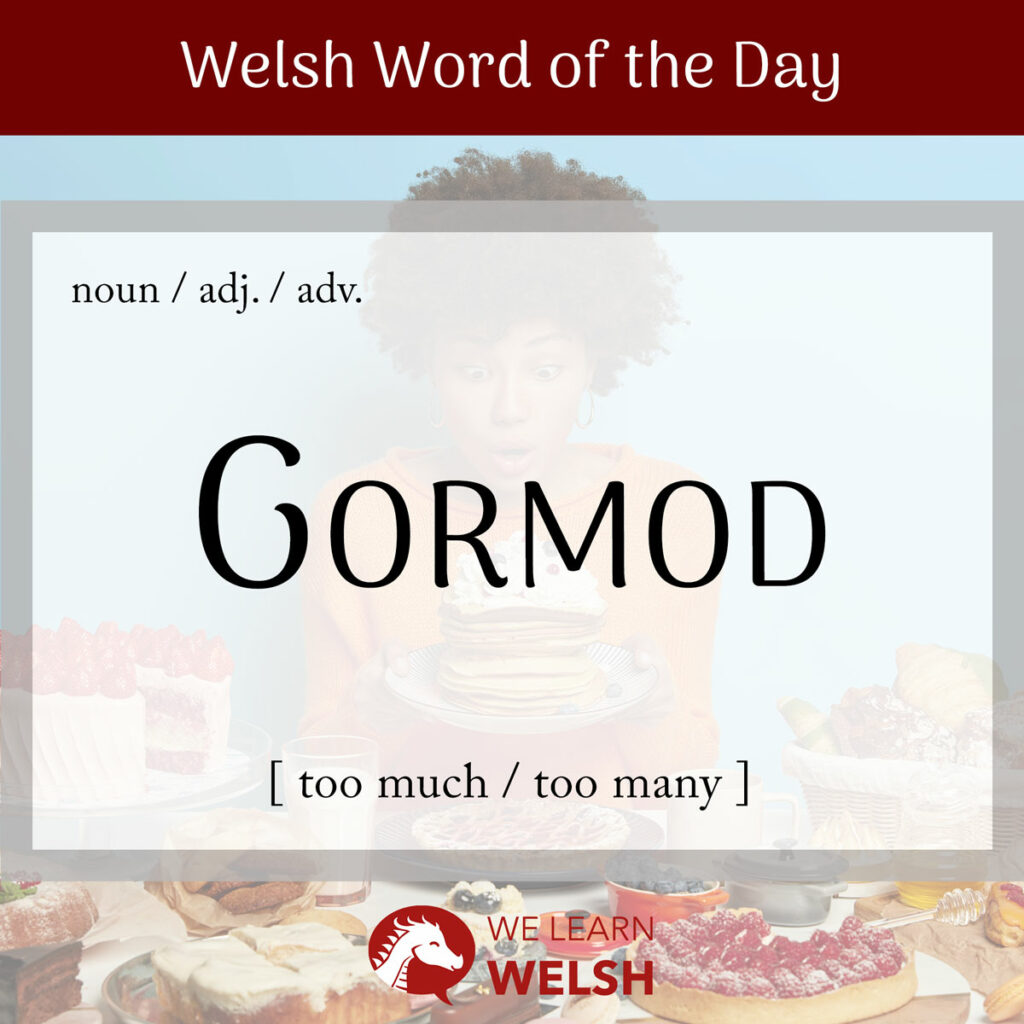
Do you ever feel you have gormod ar eich plât (too much on your plate), or even gormod o heyrn yn y tân (too many irons in the fire)? I think everyone does sometimes, no matter how much you enjoy and value the things and people that take up your amser (time).
Give this article about gormod a read and you’ll at least have done some Welsh practise for the day – that’s one thing off your plat!
gormod
too much / too many
You will most often hear this word in the phrase gormod o, which means too much, too much of, or too many. For example:
- Dyna ormod o bupur! = That’s too much pepper!
- Ti ‘di defnyddio gormod o’r pupur. = You’ve used too much of the pepper.
- Mae gen i ormod o felinau pupur. = I have too many pepper pots.
Okay, you may never need to say the last one, but do you see how the phrase works the same way with the different meanings?
To be fair, there are some differences in mutations between the sentences. That’s because anything that comes right after gormod o with nothing intervening will soft mutate, like pupur (pepper) becoming bupur in the first phrase and melinau (mills / pots) becoming felinau in the last. Gormod itself also soft mutates in the first and last example, becoming ormod.
Soft mutation
ormod
Nasal mutation
ngormod
Aspirate mutation
N/A
Gormod can also be used without reference to any particular thing of which there is too much. I’m sure we’ve all had times where we’ve been shopping and later reflected ‘nes i wario gormod (I spent too much), complained to a rheolwr (boss) that mae’r gwaith yn ormod (the work is too much), or perhaps even had to admit to llyncu gormod (getting too drunk, literally swallowing too much).
So now we know how to use gormod o, but what about gormod itself? What does this word actually mean?
Gormod is really a noun. I think it works quite well to see it as meaning an excess, and then when you add the preposition o afterwards, it’s as if you’re saying an excess of. You know, like in that common exclamation, “I have an excess of pepper pots!”.
But even though we wouldn’t literally say that in English, the meaning is the same and hopefully makes some sense.
Since gormod is a noun, it has a gender (masculine), and it can technically be pluralised, usually as gormodion. But it would be really unusual to see it in this form so I haven’t included it at the top of the article – please don’t worry about remembering it, there’s really no need!
We almost always see gormod in this idiomatic and very useful phrase, gormod o. The other common use is as an adverb, in which case it also means too much.
Mae hi’n astudio gormod, yn fy marn i.
She studies too much, in my opinion.
There is a second way to employ gormod as an adverb, which is in the phrase yn ormod / yn ormodol (excessively). You can also use gormodedd as another way of saying excessively – this is i ormodedd (literally to excess).
Excess is in fact something the Welsh language warns us against, pointing out that you absolutely can have too much of a good thing with the unfortunate proverb gormod o bwdin dagith gi (too much pudding chokes a dog).
Where does gormod come from? You may recognise the first part, gor-, since it appears as a prefix in a lot of Welsh words. Here are just a tiny selection:
- gorfywiog = hyperactive
- gorfeirniadol = hypercritical
- gormodiaith = hyperbole
- goranadlu = to hyperventilate
- gorlawn = overly full
- gorofalus = overly careful and anxious
- gorgyffwrdd = to overlap
- gorlifo = to overflow
As you can see, it is often similar to the English hyper– and over-, but can really be used in any situation that is to do with an excess of something. One example which isn’t equivalent to hyper– or over– is goryrru, literally overdrive, which means to speed in a car.
In the case of gormod, it has been added to the word modd, a flexible word that, in this case, means a measure or a degree of something.
So you can see how the two things come together – it is like gormod literally means too much of a measure of something.
Ro‘n nhw’n teimlo’n sâl iawn ar ôl iddyn nhw yfed gormod o win.
They felt very sick after drinking too much wine.
This isn’t the only way of expressing surfeit or excess in Welsh. There’s also rhy, an adverb broadly meaning too, or you can simply say mwy na digon (more than enough) or mwy nag sydd angen (more than is needed). I have come across the noun syrffed, a borrowing of the English surfeit, but it’s not that common.
On the other hand, if you have just enough of something, then that’s digon, which is used a lot as both a noun and as an adverb.
By now, I’m sure you’ve had hen ddigon (quite enough) – though hopefully not gormod! – of learning about gormod, so we’ll leave it there. 😉