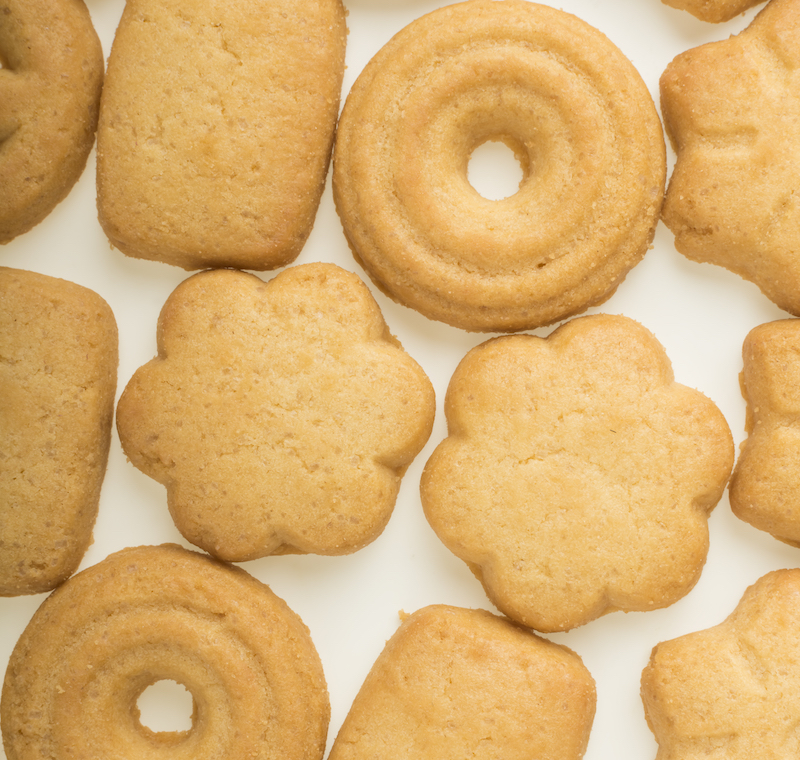
Did you know that around 84% of the British population drink at least one paned (cuppa, usually of tea) a day? All that te (tea) going down is often paired with a sweet treat – Brits eat by far more bisgedi (biscuits) than the population of any other country in the world.
Like a lot of food words in Welsh, the ‘default’ form of bisgedi is the plural. Words for the singular vary (but they are all feminine), with bisgeden preferred by more old-fashioned dictionaries, and the simple bisged possibly the most common colloquially.
bisgedi
biscuits
These are the most common options but it doesn’t stop there. Some people shorten bisgeden to sgeden or sgedan, and some people say simply bisgit, keeping the word more similar to the English that it is borrowed from. There is also bisgïen / bisgisen appearing in some Southern dialects, in which case the plural may be bisgis. Of all of these many options I always say bisged and so do most people I know. But you can say whatever you prefer!
So, these words are of course all borrowings from the English biscuit. Though it’s a French word originally, with the root being old French bescuit.
Soft mutation
fisgedi
Nasal mutation
misgedi
Aspirate mutation
N/A
The meaning of biscuits and thus bisgedi differs between countries and cultures. Bisgedi originated as bisgedi llongwyr (sailor’s biscuits), which were a solution for the need to take small, calorie-dense pieces of bwyd (food) on long journeys on llongau (ships). They were designed to aid treulio (in this case digestion, although also generally to spend) and to be caled (hard) so that they would last a long time.
Today in the United Kingdom they refer more generally to a variety of small, flat, firm baked goods. Geiriadur Prifysgol Cymru (the Welsh University Dictionary, for example) defines a bisged as a cacen fechan fflat heb lefain (a small flat unleavened cake) and Gweiadur, another great Welsh dictionary available online, describes math o deisen fach denau, galed (a kind of small, thin, hard cake).
Paid ag anghofio prynu bisgedi!
Don’t forget to buy biscuits!
But in North America, for example, these are often called cookies, alongside the larger and softer versions that we would agree are cwcis (cookies) in the UK. The word biscuits, on the other hand, refers to unsweet sgons (scones) or sometimes to the kind of savoury cracers (crackers) commonly eaten with caws (cheese). Most Welsh speakers live in the UK, so for the avoidance of doubt, I’m privileging the British classification system throughout this article.
Cacennau / teisenni (cakes) are of course another thing entirely, and beyond the scope of this article – as is the eternal debate on Jaffa Cakes! 😉
That being said, there’s another grey area when it comes to shortbread, which is a kind of sugary, crumbly bisged, which originated in yr Alban (Scotland) but is also considered traditional in Wales. In British English we treat shortbread and shortcake as synonymous, although they are different in American English.
Perhaps it’s simpler to simply go with the Welsh, who agree that shortbread is much like a cake, and call it teisen frau (literally weak cake but this is functionally an equivalent of shortcake).
There are also the regional alternatives teisen Berffro (Aberffraw cake) which is sometimes used in the North-West, and teisen crin (withered / dry cake) in Glamorganshire, although the latter has largely died out due to the decline of the Morgannwg dialect.
Of all Wales’ traditional pwdins (puddings / desserts) and baked goods, teisennau brau (shortbreads) are the most uncontroversially bisgedi. The well-loved bara brith (a kind of dark fruitcake, literally speckled bread) is more of a teisen (cake), and picau ar y maen / teisennau gradell (Welsh cakes, literally little cakes on the stone / griddle cakes) remind me of a cross between bisgedi and sgons.
Cefais sawl bisged a mwg mawr o siocled poeth.
I had several biscuits and a big mug of hot chocolate.
Moving beyond those specific to Welsh culture, other popular bisgedi include bisgedi sinsir (ginger biscuits), bisgedi gwenith (digestive biscuits, literally wheat biscuits), and bisgedi siocled (chocolate biscuits).
Really the possibilities are endless. All that bisgedi generally have in common is that they are made of blawd gwenith (wheat flour), olew llysiau (vegetable oil), some kind of cyflasyn (flavouring), and siwgr (sugar), although British bisgedi are less melys (sweet) than many teisenni and their cousins cwcis.
Bisgedi are often enjoyed as a small snac (snac), alongside cinio (lunch / dinner) as a kind of pwdin, or as part of te’r prynhawn (afternoon tea).
The proper British way to consume bisgedi is by dowcio (dunking) them into your te (tea) – although you do have to be careful not to drop them into the cwpan (cup).