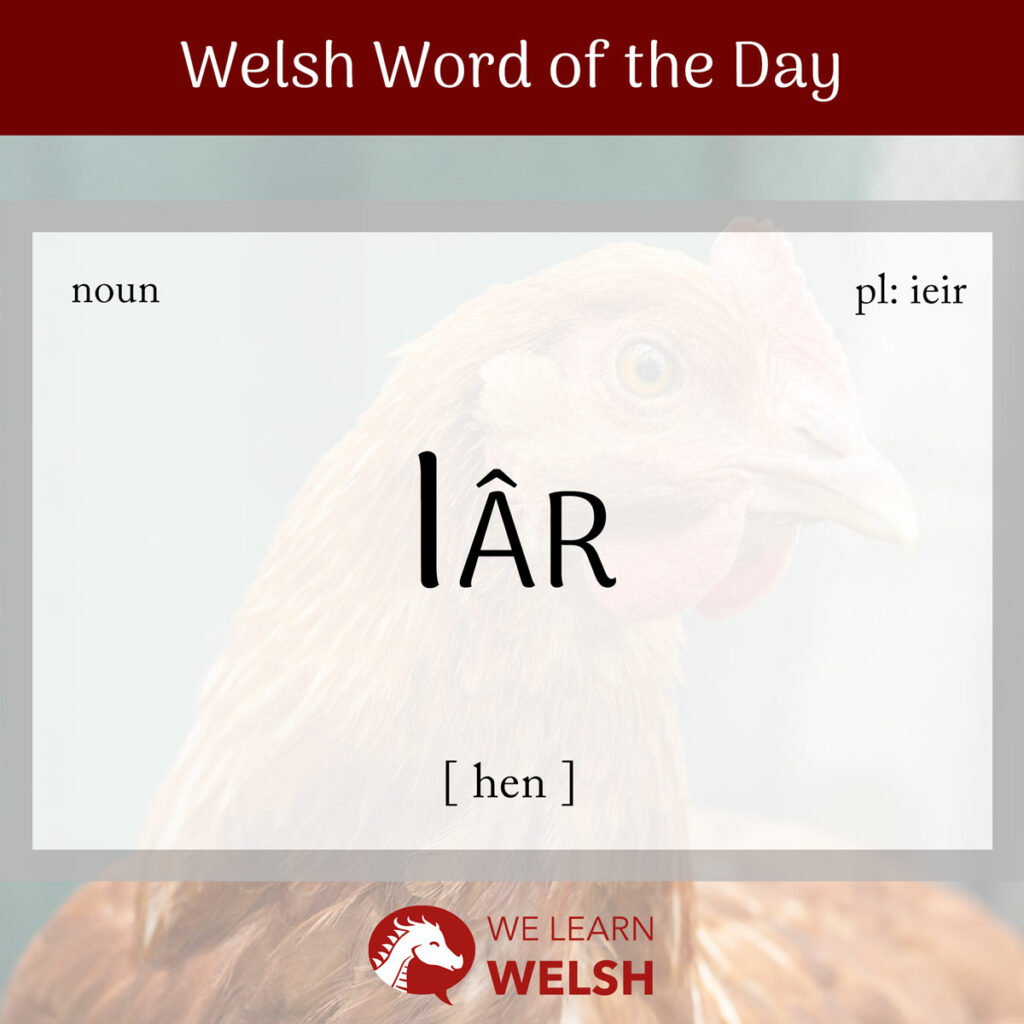
Today, we’re going to talk about the humble hen. The Welsh word for a hen, often used more broadly to refer to the whole species of chickens, is iâr. The plural form of iâr is ieir (hens / chickens).
iâr
a hen
ieir
hens / chickens
Iâr is a very old word in Welsh. We have records of its use in a recognisable form from the tenth century, and this is not much later than the date of writing of Carreg Cadfan (the Cadfan Stone) which bears the earliest known example of written Welsh.
It is a native word, a descendant of the proto-Celtic *yara. No surprise – ieir have lived on the British Isles since the Iron Age, and been a popular source of bwyd (food) since the Roman conquest of Britain. We’ve needed a word for ieir for longer than the Welsh language has existed!
The spelling is more modern than the word itself. Welsh orthography was only standardised very recently, as it was traditionally a spoken language. So older texts show a mixture of yar, iar, jâr, giâr and iâr. The variant giâr is still used by some older speakers in South Wales.
These days, the to bach (little roof) on the a is important because it shows that it’s a long vowel. So you need to pronounce the word so that it rhymes with the English car. That final r is also key because it differentiates iâr from the very similar iâ (ice).
(Ry)dyn ni’n cadw ieir yn yr ardd gefn.
We keep chickens in the backyard.
As I mentioned, iâr means hen but is also used to refer to this species of adar (birds) generally. It’s a feminine noun, while ceiliog, the word for rooster, is masculine. Because iâr is feminine, adjectives used to describe it should take a soft mutation, although they should not do this after the plural ieir. For example a broody hen is iâr glwc but broody hens are ieir clwc.
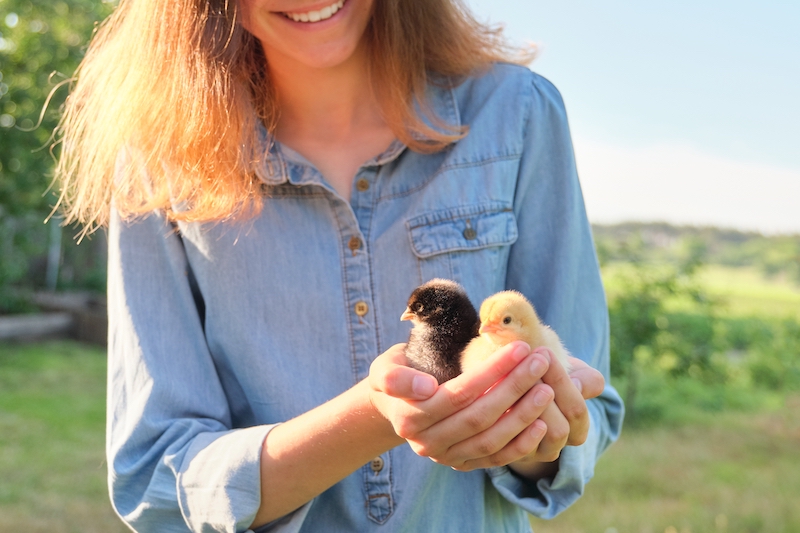
A chick is cyw, also masculine. Technically a female chick is cywen, but this word is not that common.
Like its English equivalent, cyw is used to refer to the young of any kind of aderyn (bird). You might think that for added specificity one might say cyw iâr. However, you should be careful with this one. This is the most common way to describe the cig (meat) of the anifail (animal), so that’s what most people’s minds would go to first when hearing it unless the context was very specific.
Dwi’m yn meddwl y byddai’n hoffi’r cyw iâr. Llysieuwr ‘dy o, yndo?
I don’t think he’d like the chicken. He’s a vegetarian, isn’t he?
Ieir were bred from ffowls (fowl) that lived in the jyngl (jungle) of South-East Asia. They are usually du (black), brown (brown), coch (red), gwyn (white), or llwyd (grey), and are known for their llygaid bychain (small / beady eyes) and flightless adenydd (wings). A iâr’s pig (beak) is also sharper than it looks!
Of course their features vary between species, too. My mum, who’s an avid iâr-keeper, particularly loves a iâr ddandi (bantam hen) because they’re so tiny and cute.
Aside from cig, the ffermio (farming) of ieir is done generally for the production of wyau (eggs). They also make good anifeiliaid anwes (pets) that you can keep in a cwt ieir (hencoop) in the backyard. They’re very social and affectionate and it’s nice knowing where your wyau come from!
When buying cyw iâr (chicken meat) or wyau (eggs), be sure to check that your bwyd is coming from ieir maes (free-range hens) rather than ieir caeth / ieir batri (battery hens).
Unfortunately, not all ffermiau (farms) treat their ieir maes as ethically as the name suggests, so the best option of all is to buy from small local ffermiau which you can trust. I always see bocsys wyau (egg boxes) outside people’s tai (houses) and tyddynau (homesteads / smallholdings) for people to pay for an honesty basis, which I think is a lovely way to get an wy (egg) for your cinio (lunch / dinner)!
Gwelon ni iâr fach ddu ar y fferm.
We saw a little black hen at the farm.
Ieir pop up in many old Welsh proverbs and idioms, proving again just how ubiquitous this farmyard fowl truly is.
- fel iâr ar farwor = like a hen on embers (English equivalent: like a cat on a hot tin roof)
- paid â bwyta’r wy cyn ei ddodwy = don’t eat the egg before it’s laid (English equivalent: don’t count your chickens before they’ve hatched)
- lle crafa’r iâr y piga’r cyw= where the hen scratches the chick will pick (English equivalent: the apple doesn’t fall far from the tree)
- porfa’r iâr = the hen’s lawn (English equivalent: someone’s own backyard)
- nid cyw ifanc yw hi = he’s not a young chick (English equivalent: he’s no spring chicken)
- gwell wy heddiw na iâr yfory = better a hen today than a chicken tomorrow (English equivalent: a bird in the hand is worth two in the bush)
I don’t think it’s used anymore, but one phrase I came across when using this article was the wonderful cyfraith yr iâr a’r mynawyd (law of the hen and the awl). This was apparently used in the 18th and the 19th centuries to make fun of particularly ridiculous lawsuits.
You won’t be surprised to hear that many other species of adar are named after our friend the iâr – cwtieir (coots), ieir mynydd / ieir rhos / grugieir (grouse), ieir coed / coedieir (pheasants), and ieir gini (guinea fowl) are all guilty of name theft. Plus, no matter the kind of aderyn, you can put iâr in front of the species name to show when you’re talking about a female.
You may be surprised to hear that the butterfly also borrows a name from ieir! Though pili-pala is the most commonly used word for these colourful pryfed (insects), the bizarre iâr fach yr haf (little summer chicken) takes second place. It’s quite cute, isn’t it?