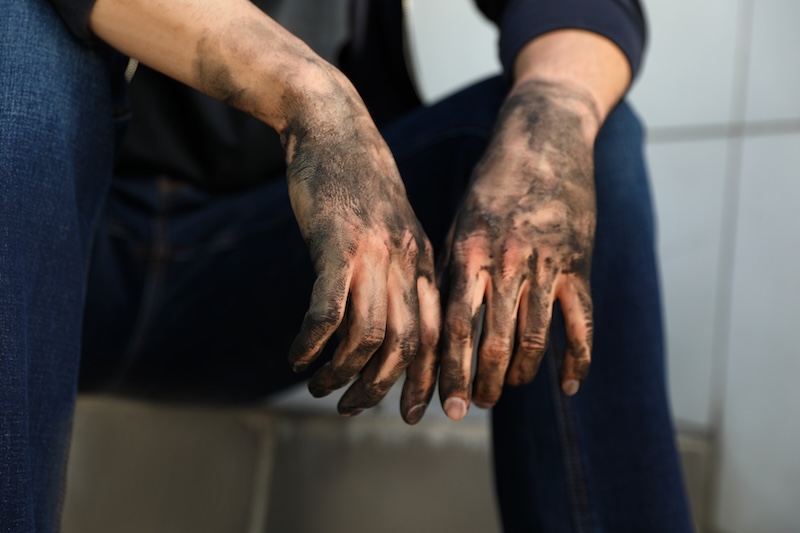
We’ve already learned about the Welsh word glân, which means clean. Today we’ll take a look at y gwrthwyneb (the opposite): brwnt.
brwnt
dirty (South Wales)
Brwnt is quite a Southern word, and it was the word for dirty I grew up using the most in Powys. If you live yng Ngogledd Cymru (in North Wales), you’re more likely to hear the more standard word budr. As a child, you might even have read the Tudur Budr (Dirty Tudor) books, which are kind of like a Welsh version of Horrid Henry! Luckily for all the Gogs (Northerners) reading, budr and brwnt both start with B, so all the same mutation rules apply.
budr
dirty (North Wales and standard Welsh)
Soft mutation
frwnt
Nasal mutation
mrwnt
Aspirate mutation
N/A
Soft mutation
fudr
Nasal mutation
mudr
Aspirate mutation
N/A
You’re unlikely to ever see the nasally mutated versions mrwnt and mudr; there are two main triggers for the nasal mutation (fy, meaning my, and yn when it means in), and adjectives don’t usually appear after them. This is because most Welsh adjectives come after the noun, so there will always be a sort of ‘buffer word’ in between brwnt/budr and the mutation-triggering word. Take a look at the following sentences:
Dyma fy nillad brwnt.
Here are my dirty clothes.
Glaniodd y bêl yn nŵr brwnt y llyn.
The ball landed in the dirty water of the lake.
In the first case, the nasal mutation lands on the word dillad (clothes), changing it to nillad. In the second case, it lands on dŵr, changing it to nŵr. In this way, brwnt is shielded from the nasal mutation.
The soft mutation, on the other hand, is very likely to be applied to brwnt. In fact, you might end up seeing frwnt more often than brwnt! This is because of a different use of yn to the one we saw above.
The Welsh present tense works differently from English; we use yn as a linking word to connect things to their actions and descriptions. If you’re describing something, yn causes a soft mutation. This sounds pretty confusing in the abstract, so let’s take a look at frwnt as an example:
Mae’r llestri yn frwnt.
The dishes are dirty.
We can break the English sentence up into three parts: the dishes (the thing being described), are (the verb to be) and dirty (an adjective). All of these show up in the Welsh sentence too, just in a slightly different order: the conjugation of to be, Mae, shows up before the thing being described. There is also one extra part: the linking word, yn.
| Thing being described | Conjugation of “to be” | Linking word | Adjective | |
| ENGLISH | The dishes | are | NOT NEEDED | dirty |
| CYMRAEG | ‘r llestri | Mae | yn | frwnt |
Remember, this mutation only applies to adjectives and nouns! Verbs don’t mutate after the linking yn.
If you want to get more penodol (specific), you could try one of these words instead of brwnt or budr:
- llychlyd = dusty
- drewllyd = smelly
- sticlyd, gludiog = sticky
- chwyslyd = sweaty
Most of Wales is covered by y cefn gwlad (the countryside) so the Welsh language also contains many words meaning muddy. The most common word is mwdlyd, but you might also come across the more formal lleidiog. Geiriadur yr Academi lists a whole host of slang terms meaning muddy used in South-West Wales, including: slacht, slabri, bwdelog, slacsog and slwt!
Another option is to describe something as yn [blank] i gyd (literally all [blank]) where the blank is filled in with whatever it is that is making something brwnt.
- yn fwd i gyd / yn llaid i gyd / yn llaca i gyd = all mud i.e. covered in mud
- yn chwys i gyd = covered in sweat
- yn llwch i gyd = covered in dust
Be careful using the word baw; the closest translation of this word is probably muck. It can be used to mean simply mud but it’s also used to mean dung or poo. So if you say that something is bawlyd or yn faw i gyd, you might be interpreted as talking about normal mud or you might get a stronger reaction than you expected! On the other hand, the set phrase mwd a baw (mud and muck) is simply used as a more expressive way to say mud.
Let’s end with a little hwiangerdd (nursery rhyme) that describes someone getting brwnt thanks to the Welsh weather:
Morus y Gwynt ac Ifan y Glaw
Daflodd fy nghap i ganol y baw.
Morris the Wind and Ifan the Rain
Threw my hat into the middle of the muck.