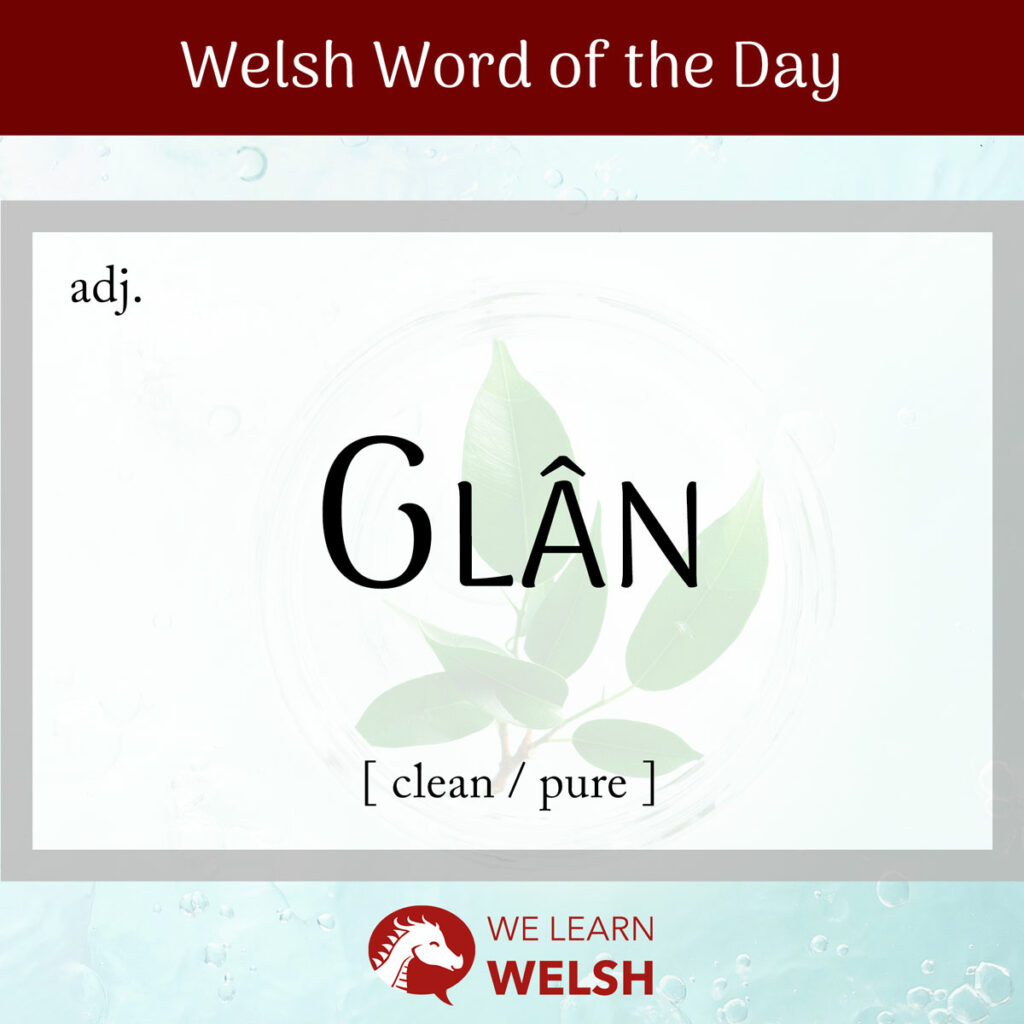
Today’s Welsh word of the day is glân, which means clean or, more rarely, pure.
glân
clean, pure
Glân starts with a g, so it’s susceptible to y treiglad meddal (the soft mutation) and y treiglad trwynol (the nasal mutation). In practice, though, you’re very unlikely to see an adjective undergo the nasal mutation, and this holds true for glân too.
Soft mutation
lân
Nasal mutation
nglân
Aspirate mutation
N/A
Ruling out the unlikely nasal mutation, how can you tell when to use glân and when to use lân? Let’s take a look at two examples in context.
Firstly, have a listen to Dafydd Iwan singing the children’s song Bachgen Glân Wyf I and read along with the first few lines below.
Bachgen glân wyf i
O Wlad yr Hud rwy’n dod
Mi ganaf gân
I am a pure lad
I come from Magic Land
I’ll sing a song / I sing a song
Here, glân is paired with the masculine word bachgen, meaning boy, so it’s left unmutated.
Now, let’s take a look at a more famous example: the chorus of Calon Lân.
Calon lân yn llawn daioni
Tecach yw na’r lili dlos
A pure heart full of goodness
It is more beautiful than the pretty lily
Calon (heart) is a feminine noun, so it causes glân to mutate to lân.
Mae angen clwt glân ar y babi.
The baby needs a clean nappy.
As you’ve probably noticed, glân doesn’t necessarily mean clean in the context of these songs; it’s used in a more figurative way to mean pure or holy. You’ll also see glân used this way in Christian terms such as yr Ysbryd Lân (the Holy Spirit) or yr Eglwys Lân Gatholig (The Holy Catholic Church). Going back in time a bit, an older form of glân even appears in the title of the first Welsh Bible: Y Beibl Cyssegr-lan, (The Holy Bible).
Glân can also take on a more abstract ystyr (meaning) when used as part of part of an adverb i.e. a verb used to describe an action. In English, we usually create adverbs by adding -ly to the end of an adjective (cold becomes coldly, slow becomes slowly etc). On the other hand, in Welsh, we add the word yn before the adjective, which in this case triggers the soft mutation.
| Adjective | Adverb | |
| English | clean | cleanly |
| Cymraeg | glân | yn lân |
Yn lân can of course be used in a straightforward, literal way such as in cadw’n lân (to keep clean), but you will also see it used in certain contexts to mean completely or very.
- wedi blino’n lân = completely tired out, exhausted
- wedi drysu’n lân = completely confused, very confused
- methu’n lân â = to completely fail to
Pay extra attention when using that last one; the preposition â causes y treiglad llaes (the aspirate mutation), which affects words starting with T, C and P.
Dwi’n methu’n lân â chysgu.
I’m completely failing to sleep.
You’ll have noticed by now that I’m adding a special symbol above the A in glân. This is called a hirnod (circumflex) or, more informally, a to bach (little roof)! This accent tells you to pronounce a word with the long version of the vowel. It can be tempting to leave out little details like this, but the to bach is very important and can sometimes completely change the meaning of the word! For example, without the to bach, it’s easy to confuse glân with glan, the word for bank or shore.
glan
bank, shore
There are actually quite a few word pairs in Welsh differentiated only by the to bach, and learning them can be a fun way to build your vocabulary and improve your pronunciation. I’ve made a table of some examples below.
| Gyda Tho Bach (with a circumflex) | Heb Do Bach (without a circumflex) |
| ffôn (m) (phone) | ffon (f) (staff, stick) |
| hŷn (older) | hyn (this) |
| tân (m) (fire) | tan (until) |
| môr (m) (sea) | mor (so) |
| tâl (m) (payment) | tal (tall) |
| llên (f) (literature) | llen (f) (curtain) |
| mân (fine, small) | man (m/f) (place) |
| gwên (f) (smile) | gwen (white) |
I hope you’ve learned something new today, but if you’re wedi drysu’n lân, please feel free to drop us an email! We’re happy to answer any questions you might have about the Welsh language.