Nyddu is our Welsh word of the day today. This verb means to spin, in the sense of making edafedd (thread, yarn). It can also be used to describe the actions of a corryn (spider), though gweu (to knit) is also common here, and non-literally to talk about composing barddoniaeth (poetry).
nyddu
to spin
The word comes to us, through Proto-Celtic *sniyeti and Proto-Brittonic *niddid, all the way from the proto-Indo-European *(s)neh (to twist or to spin). A modern cousin of nyddu is nedha (to twist) in Cornish.
Nyddu is the oldest form of the word in the Welsh language, but it has some descendants, like nyddwr, which means a spinner, and is also sometimes used for the bird a nightjar.
Another is nydd or nydd–dro, not too often used, but meaning a spin or a twist. Then there is nyddiad, which is a noun referring to the process of spinning, although nyddu as a verb-noun is also very much fine here.
The range of nyddu is pretty short as compared to the English spin. Archaically in Welsh, it was used in a broader sense than it is today, often similar to the word wring in English.
For example, one might nyddu’ch dwylo (wring one’s hands), an expression I quite like. A less pleasant example is nyddu gwddf rhywun (wring someone’s neck). But these expressions are only recorded in older texts and not heard in modern Welsh.
Nyddu also doesn’t refer to turning around, which is troi, or turning or spinning something else like a pêl (ball) or ffon (stick / cane), which is troi or troelli. The word chwyrlïo means spinning or whirling along. In general, troi, more often translated as to turn, is usually a good translation.
But nyddu is what you want when you’re talking about deunydd (material, fabric), and perhaps the specificity that Welsh offers here is a good thing.
I have to admit I don’t understand much about what the process of nyddu actually entails, but Geiriadur Prifysgol Cymru (the Welsh University Dictionary) defines it as troi ffibr yn un darn hir o edafedd (turning a fibre into one long piece of thread). Some possible ffibrau (fibres) with which this can be done include cotwm (cotton), gwlân (wool), and llin (flax).
Other prosesi (processes) that may take place in the production of deunydd include gweu (knitting), gwehyddu (weaving), cardio / cribo (carding), lliwio (dying), and gwnïo (sewing).
Yn stori Rumpelstiltskin, mae merch yn gorfod nyddu gwellt yn aur.
In the story of Rumpelstiltskin, a girl is made to spin straw into gold.
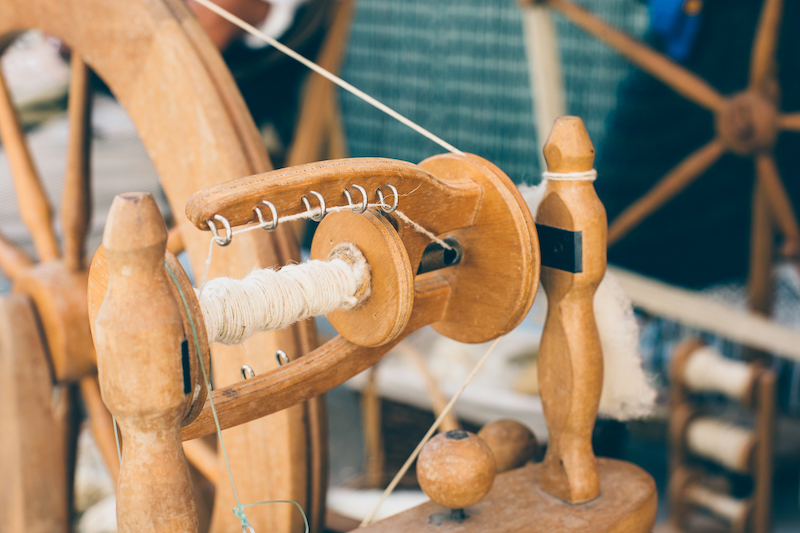
Originally nyddu was done by hand with a cogail (distaff) and gwerthyd (spindle) – the kind that Sleeping Beauty pricked her finger on! – but these were replaced in the with the invention of the troell (spinning wheel), which was spread from the Arab world to Ewrop (Europe) in the 13th century. The troell is often called more specifically a troell nyddu, or in South Wales a rhod nyddu.
Since y Chwyldro Diwydiannol (the Industrial Revolution), the process has become further mechanised. In Cymru (Wales), nyddu became one of the country’s most important diwydiannau (industries), despite the new technology taking longer to become fully adopted here than it did in Lloegr (England).
Melinau nyddu appeared dotted throughout Cymru and helped turn many of the country’s pentrefi (villages) and farming communities into larger industrial trefi (towns), as in the case of Y Drenewydd (Newtown) in Powys and Llambed (Lampeter) in Ceredigion.
Today there are only fifteen active melinau nyddu remaining in Cymru, and most of these are small family businesses focussing on creating traditional deunydd rather than catering to a mass market. Many of them are open to the public for tourism purposes as well as producing commercially
And for learning about nyddu and gwlân and their place in Cymru’s history, there of course is also Amgueddfa Wlân Cymru (the National Wool Museum) in Felindre – a pentref (village) once called ‘the Huddersfield of Wales’ due to its importance to the diwydiant gwlân (woollen industry).