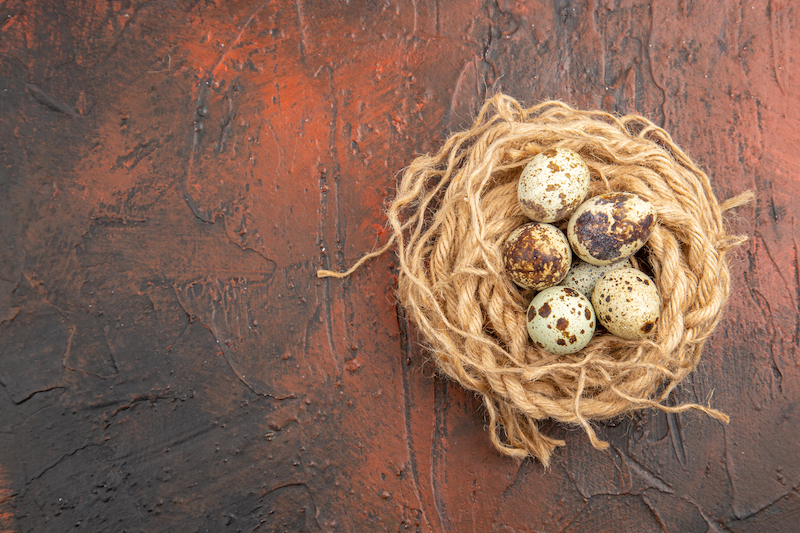
Did you know that adar (birds) aren’t the only kind of anifail (animal) that build nythod (nests)? Gwenyn / cacwn (wasps) also do the same, as do llygod (mice) and even, bizarrely, aligatorod (alligators).
But the nyth (nest) of an aderyn (bird) is distinctive and particularly complex. It can be constructed from a wide variety of materials, such as brigynnau (twigs), dail (leaves), rhisglau (pieces of bark), the aderyn’s own plu (feathers), and even scavenged man-made finds like defnydd (fabric) and llinyn (string).
nyth
nest
nythod
nests
Nyth comes from the proto-Indo-European root *nizdo-, the same as nest in English, nid in French and nido in Italian. Though it’s technically a feminine noun, this is one for which there’s a bit of variation and in some dialects you may hear it treated as masculine.
The nyth of an aderyn isn’t its cartref (home); it’s purpose-built for the dodwy (laying) and deor (incubation) of wyau (eggs) and the rearing of cywion (chicks).
They’re built wrth reddf (by instinct) – even adar raised in captivity away from their own rhieni (parents) know how to do it. It’s generally female adar that do most of the adeiladu (building) and addurno (decorating) but in some species the male builds the gwaelod (base) and the female the leinin (lining).
The greddf nythu (nesting instinct) is a term applied not just to adar, with cŵn (dogs), cnofilod (rodents), and other mamaliaid (mammals) displaying the urge to amass and collect soft materials when beichiog (pregnant), even if their species don’t typically build actual nythod. Supposedly humans have this instinct too!
Mae mulfrain yn gwneud eu nythod yng nghlogwyni’r ynys.
Cormorants make their nests in the island’s cliffs.
Different species of adar have different styles of nythod and build them in different places – in coed (trees), holes in creigiau (rocks), or ar y ddaear (on the ground). Some adar even have to do without, like albatrosod / gweision y weilgi (albatrosses).
Some adar, especially bigger ones, use the same nyth over multiple blynyddoedd (years). Others, such as robiniaid (robins), take on the process of nythu anew with every tymor nythu (nesting season). If you have a gardd (garden) and are fond of adar, you can help them out by providing a blwch nythu (nest-box).
The defnyddau (materials) used also differ by species: adar-y-si (hummingbirds) are so small that they make use of gweodd pryfed cop (spiderwebs) for theirs.
We don’t as often use nyth in a non-literal sense. But the words nythfa / nythle (nest-place) and nythaid (nestful) exist and can be handy. A good example is the common phrase a nest of robbers, for which many speakers would normally use nythaid instead of nyth, so, nythaid o ladron.
A nest of money, like a nest egg, is arian wrth gefn (arian to the back) or a celc, and a nest of objects is a cyfres (series) or simply a set (set).
Bydda’n ofalus! Wi’n credu taw nyth cacwn yw honna.
Be careful! I think that’s a wasps’ nest.
Before we finish, here are some interesting Welsh idioms about nythod:
- caru’r nyth ac nid yr aderyn = to go into a marriage for money and not for love (literally to love the nest and not the bird)
- cachu yn eich nyth eich hun = to do harm to one’s own interests trying to harm others, a bit like to cut off one’s nose to spite one’s face (literally to defecate in one’s own nest)
- nyth y cythraul = a very untidy place (literally the devil’s nest)
- chwilio am nyth cwhwrw = to go on a wild goose chase (literally to look for a mare’s nest)
- bach y nyth = a youngest child, particularly one who’s spoilt by their parents (literally the little of the nest)
And one that’s used in much the same way as it is in English is nyth cacwn (a wasp’s nest / a hornet’s nest) – i.e., peidiwch â chicio un (don’t kick one)!