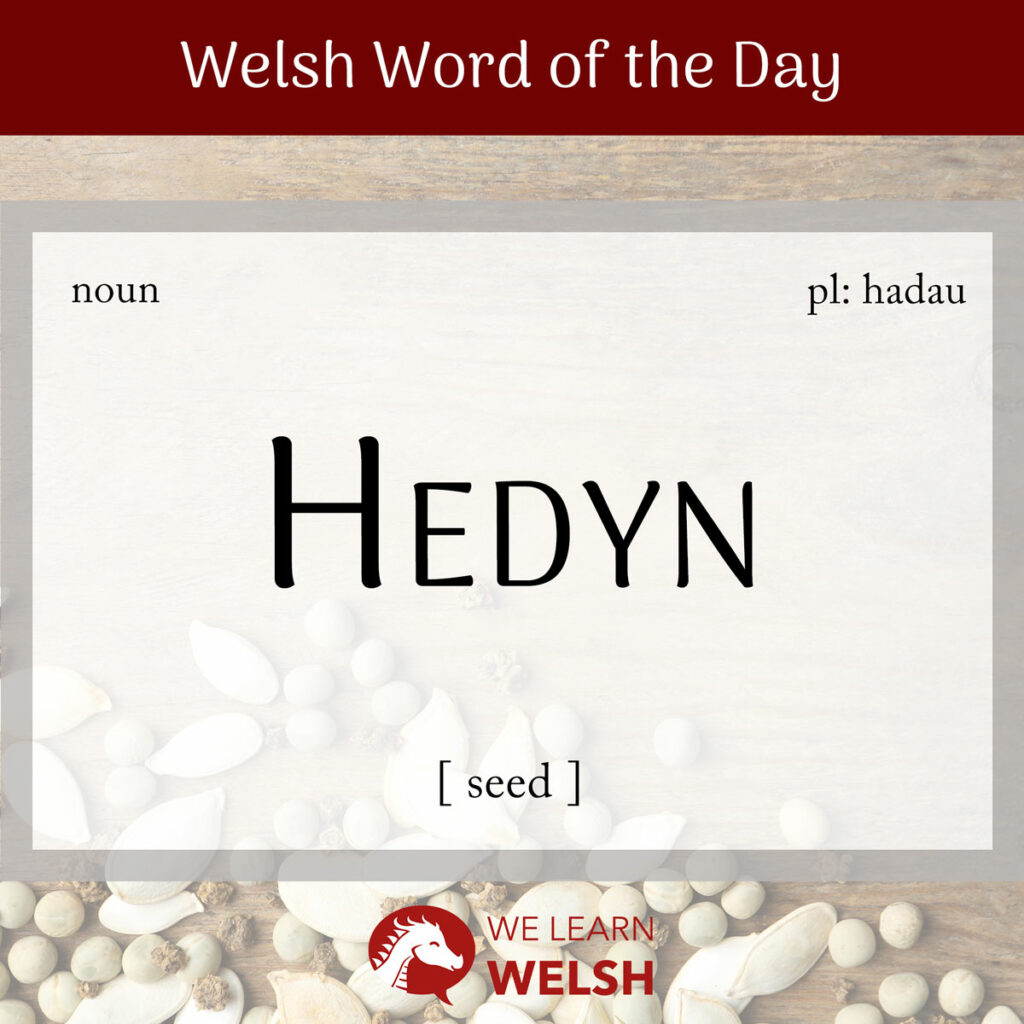
When I’m not working in front of the computer or working out at the leisure centre, I take great pleasure in tending to our local community allotment. Every year we plant different kinds of llysiau (vegetables) to share with our community fridge – though admittedly some years have been more successful than others! On occasion we use starter plants, but more often than not, we grow our vegetables from seed. The translation for seed in Welsh is hedyn, and it’s also our word of the day!
hedyn
seed
There are many possible singular forms for seed in Welsh – most commonly haden, hadan, hadyn and our choice, hedyn – and the one you’ll end up using depends on where you live in Wales.
The most widely used plural form is hadau, or the poetic-sounding had, and you may also hear hade, hadoedd and hadyd in some parts of Wales. Luckily for learners, it never needs to undergo any kind of mutation because it begins with h.
hadau
seeds
Hedyn is quite simply the combination of had + yn. In Welsh, adding -yn (for masculine nouns) or -en (for feminine nouns) to the end of a noun is a method of forming a singular noun from a collective plural.
It belongs to the Celtic word-family and is cognate with Cornish (has) and Modern Breton (had). According to the ever-reliable GPC, all of these words go back to Proto-Celtic *sato-, derived from the verbal root *sē(i)- / *sei- / *sī-, meaning “to throw, cast, or sow.”
Take care not to confuse it with adyn (ruffian or scoundrel) which, when subjected to h-prothesis, becomes hadyn as well!
Did you know that…?
In south-west Wales, haden and hadyn are used to refer to a funny girl or boy who likes to have a good time.
Mae hi’n dipyn o haden, ti’n gwybod. = She’s a real character, you know.
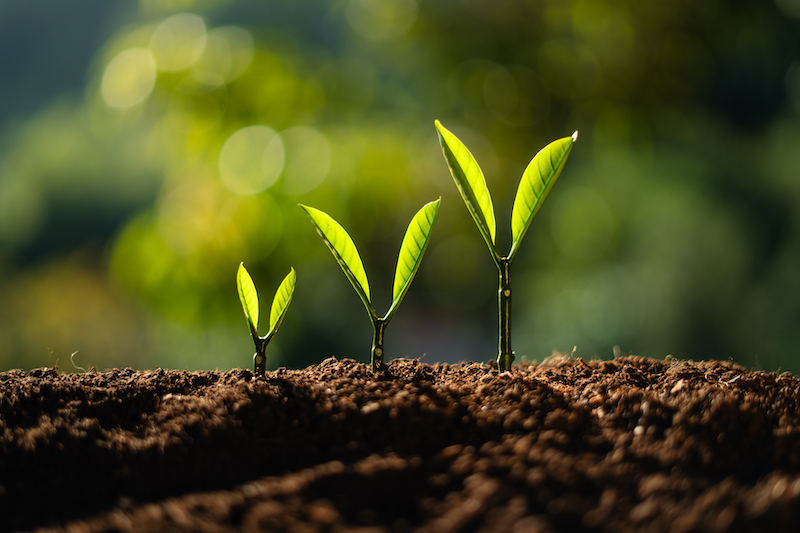
A plant’s life cycle begins with a hedyn. Inside the seed is a tiny plant embryo, along with stored food to help it start growing. When the seed gets the right conditions – usually dŵr (water), cynhesrwydd (warmth), and ocsigen (oxygen) – it begins eginiad (germination). The seed coat breaks open, a small gwraidd (root) grows downward into the soil to absorb water and nutrients, and a shoot grows upward toward the light.
As the blaguryn (shoot) reaches the surface, it develops leaves and begins ffotosynthesis (photosynthesis), using heulwen (sunlight) to make its own food. This stage is called a eginblanhigyn (seedling).
Over time, the plant grows taller and stronger, developing more dail (leaves), coesau (stems, in English literally legs), and gwreiddiau (roots). Eventually, it becomes an adult plant capable of producing blodau (flowers), ffrwythau (fruits), or conau (cones), which create new seeds and begin the cylchred oes (life cycle) all over again.
Dw i wedi plannu’r hedyn a nawr dw i’n aros iddo dyfu.
I’ve planted the seed and now I’m waiting for it to grow.
You probably already know that hadau are a very healthy addition to a balanced diet because they are packed with important maetholion (nutrients) in a small amount of food. Many hadau contain healthy brasterau, protein, ffibr, fitaminau a mwynau (fats, protein, fibre, vitamins, and minerals) that support overall health.
Because seeds are so nutrient-dense, even a small handful added to meals can boost the nutritional value of your diet, which is why I have them at brecwast (breakfast) every morning with my muesli! Here are some of the most nutritious:
- sunflower seeds = hadau blodyn yr haul
- pumpkin seeds = hadau pwmpen
- chia seeds = hadau chia
- flax seeds = hadau llin
Many people, especially during the winter months, enjoy putting out a porthwr adar (bird feeder) filled with seeds to help small birds survive the winter. However, there is growing evidence that feeding birds in the garden is linked to risks such as the spread of disease and parasites. If you do decide to use a porthwr adar, always make sure that it is extremely glân (clean) and free of lleithder (moisture).
Sperm in Welsh is usually referred to as sberm, but don’t be surprised if you also hear had. Still, you are far more likely to hear banc sberm than banc had when talking about a sperm bank, for example.