
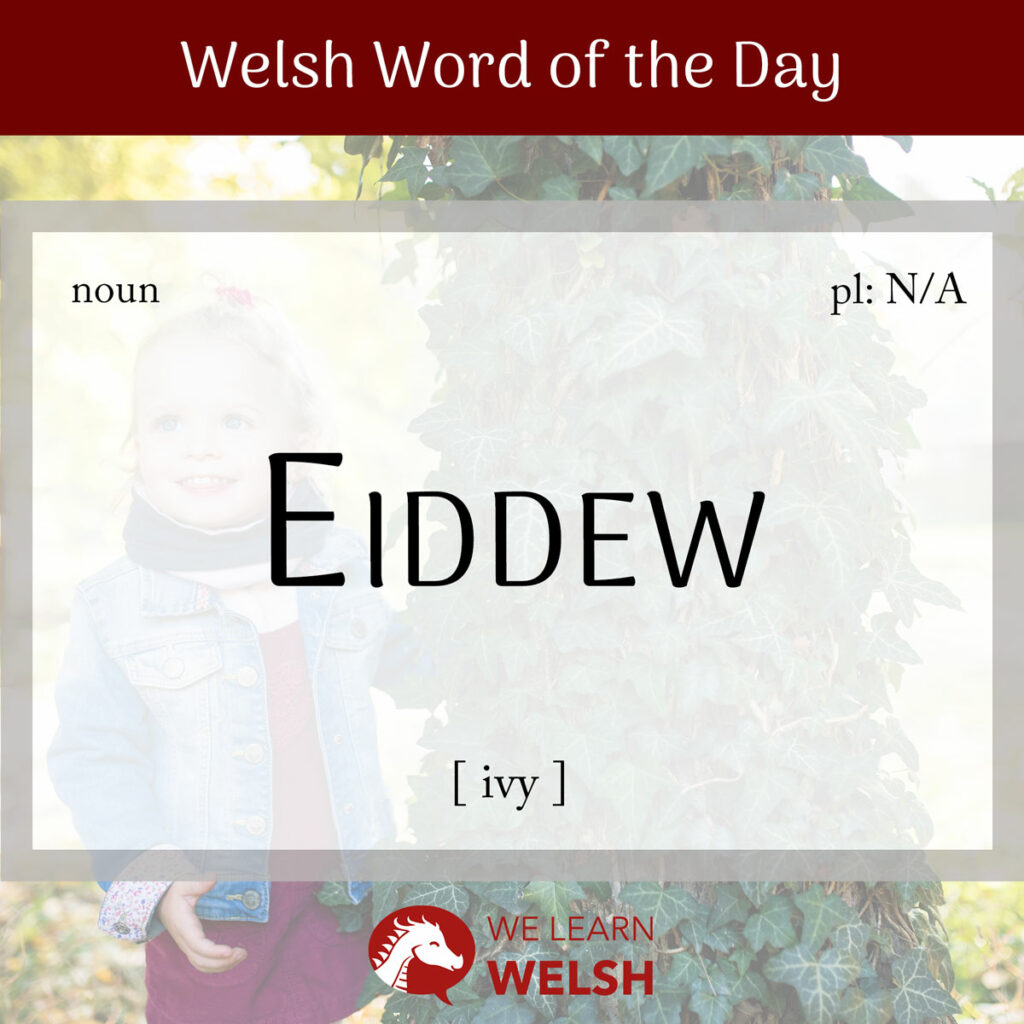
Eiddew (ivy) is a type of planhigyn prennaidd (woody plant) common across much of the world. It’s known for clinging close either to pridd (soil) or coed (trees).
In many European cultures, the fact that eiddew is bythwyrdd (evergreen) means that people associate it with resilience and other spiritual properties. That’s likely the reason behind why it’s traditionally used to addurno (decorate) homes through the gaeaf (winter), especially at Nadolig (Christmas).
Eiddew is an uncountable noun, which is much like the word ivy itself in English. It’s also masculine.
eiddew
ivy
The word is an indigenous Celtic formation, appearing as eido in Middle Welsh and as *edennos even further back in proto-Celtic. It is likely that the original proto-Indo-European root that gave rise to this word was *ped, a verbal root meaning to restrain or to bind, much in the same way that eiddew winds around the boncyffion (trunks) of coed.
A different version eiddiorwg also developed from the same root, which has given rise to the form iorwg / iwrwg, standard in much of South Wales.
Forms like irwgl and even mwrwgl are recorded in some texts but are not common now. Also uncommon are some shortenings of eiddew that were once used in the South-East, such as iddew, iddi or itie. Sadly, the indigenous Welsh dialect of the South-East is now pretty much obsolete, so you are very unlikely to come across these variants.
Mae’r geifr yn hoffi bwyta’r eiddew oddi ar y goeden.
The goats like eating the ivy off the tree.
Eiddew is a pretty striking looking plant, with its shiny dark green dail (leaves) and mwyar cochion (red berries). Because it is a planhigyn dringo (climbing plant) it often adorns coed and even adeiladau (buildings), especially older tai (houses) made of cerrig (stones). The effect of eiddew all over a building is aesthetically very romantic – it’s this after which the Ivy League prifysgolion (universities) in the USA are named – but I’m told it can also cause serious saernïol (structural / architectural) headaches!
Around y Nadolig (Christmas / Christmastime) in the UK, many people still decorate their homes with eiddew, often by including it in a torch (wreath), and it’s a common emblem for a cerdyn Nadolig (Christmas card) or papur lapio (wrapping paper).
The very festive planhigyn also features in the British folk carol (carol) “The Holly and the Ivy”, in which eiddew is used as a metaphor for y Forwyn Fair (the Virgin Mary) and celyn (holly) for Iesu Grist (Jesus Christ).
But its connotations are quite different in Gogledd America (North America) and Awstralasia (Australasia), where many rhywogaethau (species) of eiddew are highly ymledol (invasive).
The word eiddew is used quite generally to refer to a type of planhigion (plants) referred to by the Latin name Hedera, which actually includes a wide variety of rhywogaethau, including:
- eiddew pigfain = needlepoint ivy
- eiddew calon aur = Jubilee English ivy, literally golden heart ivy
- eiddew y Canarias = Canary Island ivy
- eiddew Gwyddelig = Atlantic ivy / Irish ivy
There are also many kinds of planhigion which are colloquially referred to as eiddew, but are technically distinct, such as the popular houseplant eiddew eurfrith (devil’s ivy).
You can also substitute iorwg in any of these phrases, and this is what will make most sense if you mostly speak a more Southern dialect of Welsh.
Dyn ni’n mynd i gyflogi garddwr i gadw’r eiddew dan reolaeth.
We’re going to hire a gardener to keep the ivy under control.
This Christmassy planhigyn is not the only one associated with Rhagfyr (December) and the gwyliau (holidays / festivities). I already mentioned celyn, but there’s also the iconic coeden Nadolig (Christmas tree) itself, which is usually a pinwydden (pine) or a pefrwydden / sbriwsen (spruce). In general, it’s coed bytholwyrdd (evergreen trees) and llwyni bytholwyrdd (evergreen bushes) that are popular this time of year, for obvious reasons.
Let’s finish off with an interesting – though slightly unpleasant – factoid. The bacterial haint croen (skin infection) sometimes known in English as St Anthony’s fire is often called tân iddew in Welsh. Here, iddew is a form of eiddew, so this literally means ivy fire.
It’s likely that this connotation has been adopted from the cosfa (itch) caused by eiddew gwenwynig (poison ivy). However, since eiddew gwenwynig is not actually a true eiddew, I have to say I think this name is a little unfair!