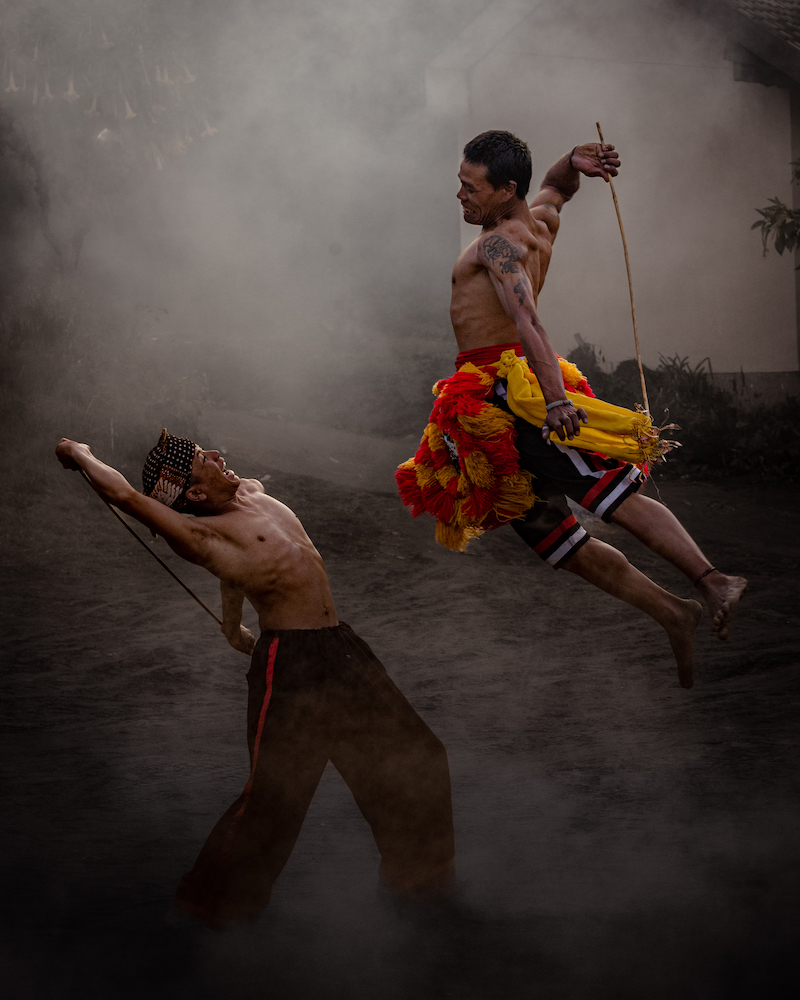
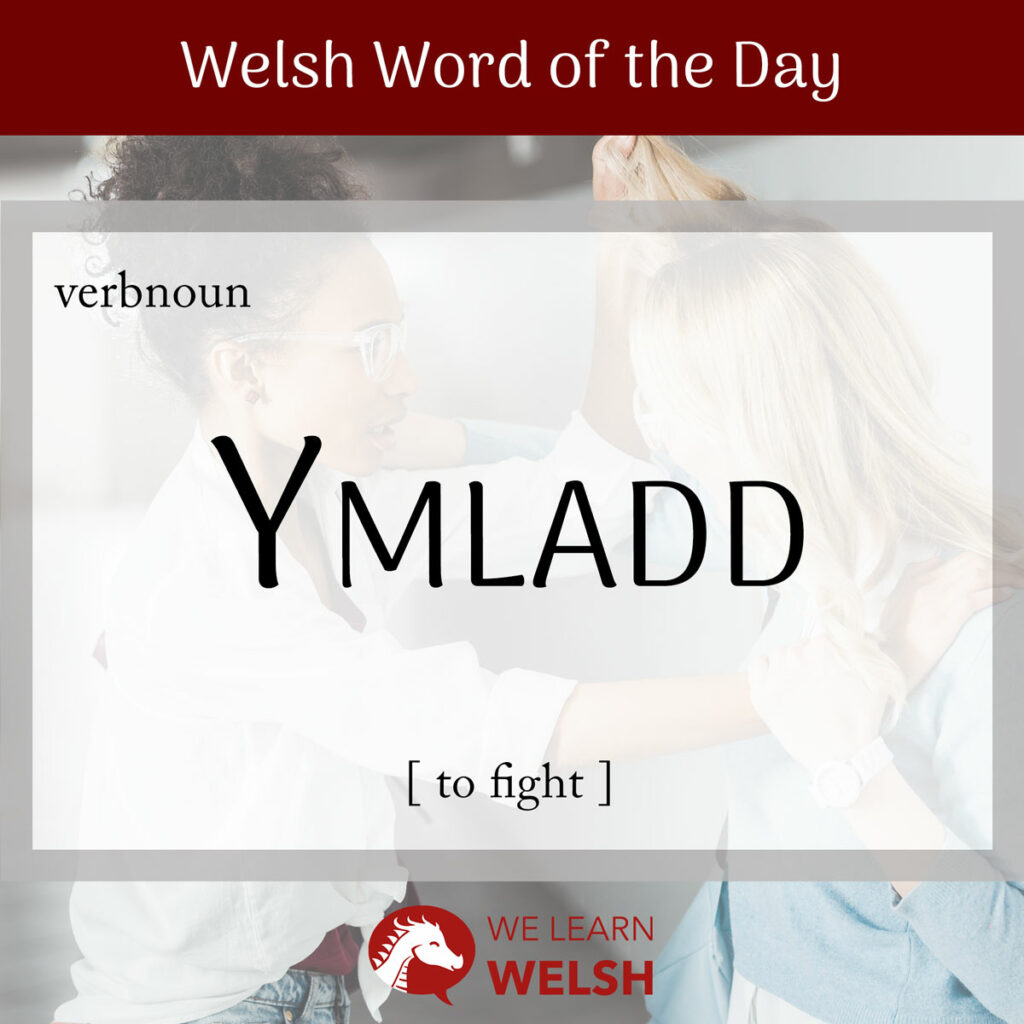
Today’s Welsh word of the day is not the world’s nicest, but unfortunately it’s an important one! I’m talking about ymladd, a verb-noun which means to fight.
ymladd
to fight
Ymladd has a bit more of a brutal sound than its English translation, which is really because of its etymology. It comes from combining the reflexive prefix ym with the soft mutated version of the word lladd (to kill) – so it literally means to kill each other. Of course it’s not exclusively used to refer to such horrible fighting, but this does mean that it’s not generally used to mean to argue in the way that to fight is casually in English.
That doesn’t mean you can’t use it non-literally at all though. You can definitely ymladd ag afiechyd (fight against disease), ymladd dros rywbeth (fight over something), or ymladd achos (fight a case). You just might want to avoid being misunderstood by talking about ymladd with, say, your brawd (brother) or chwaer (sister), unless that’s literally what you’re doing!
We don’t need to bother about learning any mutations of ymladd because it starts with a vowel. But remember that if you’re speaking formally or reading something literary, h-prosthesis will apply.
This only comes up in three phrases – ei hymladd (to fight her), eu hymladd (to fight them), and ein hymladd (to fight us). There are literally no other times that h-prosthesis will apply to this word, and even in these cases it will very often be dropped ar lafar (colloquially).
Roedd rhaid i mi ymladd fy ffordd allan.
I had to fight my way out.
Different synonyms of ymladd convey slightly different nuances of fighting. For example, brwydro is best translated as to battle, as it’s derived from brwydr (a battle). Similarly, rhyfela comes from rhyfel (war), and carries the same kind of weight. These are more serious, formal words — much like ymladd itself.
If you’re talking about something more like scrapping, you can use words like cwffio, paffio or padlo.
You could also be more descriptive about what the opponents are using to fight with – for example by specifying that they are ymgodymu / taflu codwm (wrestling), ymladd cleddyfau (sword-fighting), bocsio / paffio (boxing), or engaging in a brwydr saethu (shoot-out).
More arfau (weapons) that an ymladdwr (fighter) might use could include:
- cyllell = a knife
- bwa a saeth = a bow and arrow
- cerrig = stones
- ffyn = sticks
- pastwn / clwpa = a club
- bom = a bomb
- dryll = a gun
Remember that the false-friend gwn in Welsh normally means a big dryll, like a cannon.
Parhaodd yr ymladd am oriau.
The fighting went on for hours.
A fight as a noun really depends too on the kind that we’re talking about. There is a more general word, ymladdfa, but it’s very literary and most people don’t use it. Brwydr would definitely be used for a battle, but for an everyday skirmish the preferred word varies a lot.
I’ve heard a lot of people just say ffeit, borrowed from the English, but this isn’t universal. In the North, people sometimes say cwffas – this being related to the word cwffio that I mentioned earlier. It’s a bit of a silly word, sort of like fisticuffs in English. Sgarmes is a pretty direct translation of skirmish that could come in handy too. And it’s not impossible to use brwydr exaggeratedly for a playground scrawl of this kind.
Of course, as nasty as it can get, ymladd (fighting) is an ability and an instinct in humans and other anifeiliad (humans) for a reason. We need a sense of ymladd neu ffoi (fight or flight) to preserve us against perygl (danger).
You could certainly argue, though, that modern day humans have become far too ymladdgar (belligerent). The Welsh national anthem laments that dros ryddid gollasant eu gwaed (for freedom they lost their blood), referring to the many ymladdwyr (fighters) who died trying to preserve Welsh independence from England. Cymru is far from the only country to have lost so many in this way.