Plenty of sounds in Cymraeg (Welsh) can be hard to make if you didn’t grow up speaking the iaith (language). The dreaded ch and ll get a lot of attention, but actually some of the trickiest are sound combinations that we do have in English, but not at the start of the word.
One of these is tl, which appears at the beginning of the word tlawd (poor), as well as of tlws (pretty, a gem or pretty thing).
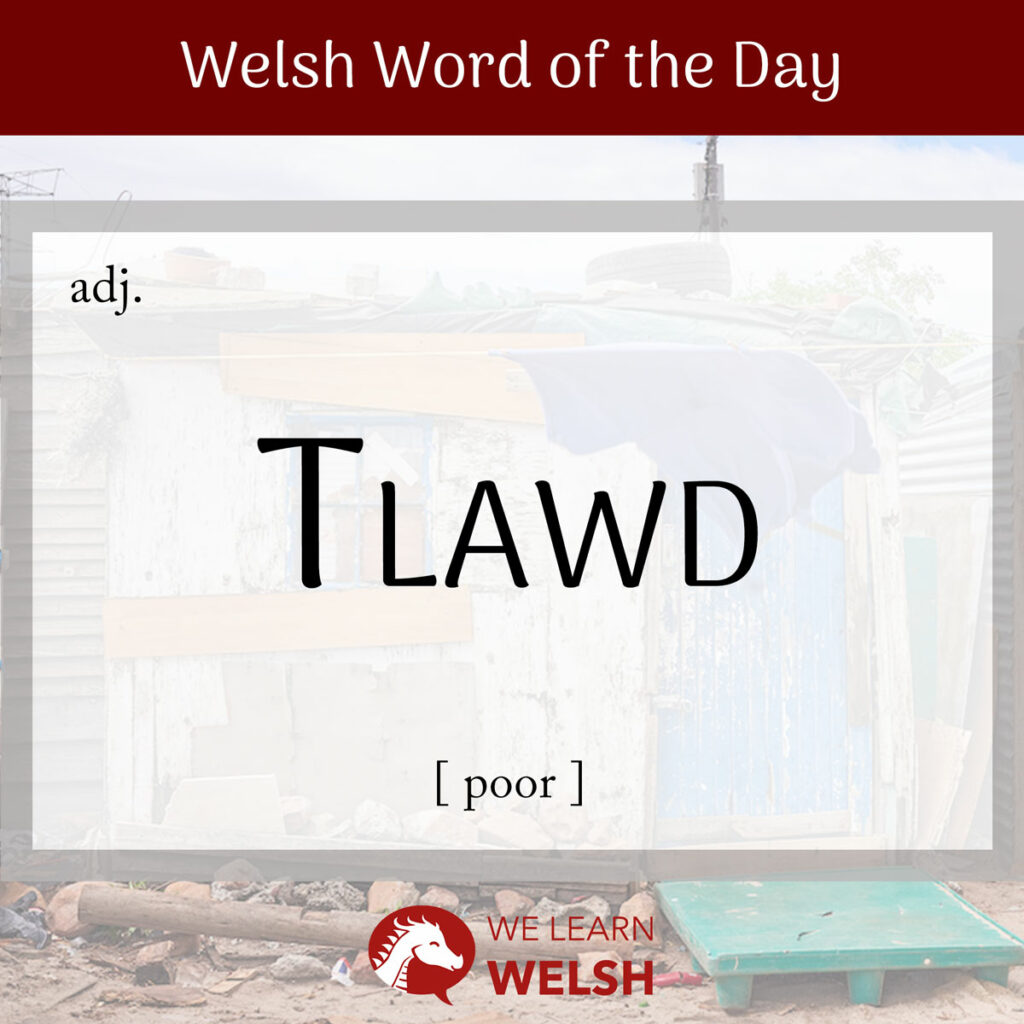
tlawd
poor
A good trick to make saying tl easier is to try to speak it very fluidly along with whatever word came before: attach the t (or d if the word has soft mutated, as it often will) at the beginning to the end of the previous word. Then practise speeding up until the two words flow into each other.
This strange tl sound seems to be the result of a vowel being contracted into nothingness over time, since the root of tlawd is the proto-Indo-European *telh (to support or to bear). This became the adjective *tlatis in proto-Celtic, meaning weak, possibly because of a connotation that having suffered a weight would cause the bearer to become weak.
*Tlatis has living descendants not just in Welsh but in multiple Celtic languages, all beginning with the same pair of letters.
Tlawd and tlws are not the only two Welsh words to begin with tl, but the others are all related to one of these two roots. For example, from tlawd, we have also tlodi (poverty), tlotyn (a pauper), and tloty (a workhouse).
Here is how tlawd mutates:
Soft mutation
dlawd
Nasal mutation
nhlawd
Aspirate mutation
thlawd
The main opposite of tlawd is cyfoethog, and you can read more about cyfoeth (wealth, riches) here. In some parts of the country cefnog is also used to mean that someone is well-off – it literally means back–ish!
When it comes to synonyms, tlawd is really the only commonly used word that perfectly conveys poor as in not having much money or resources. But similar words include truan, which means poor in the sense of someone that you have pity on, anghenus, which literally means needy, and diymgeledd, which means destitute.
You can use tlawd to describe the same kinds of nouns as you would with poor in English – an individual person, like a dyn (man) or dynes (woman) can be poor, but so can a collective group like a teulu (family), and you can even say that a dinas (city), ardal (region) or gwlad (country) is comparatively poor in cyfoeth and adnoddau (resources).
Nod y polisi yw helpu’r teuluoedd tlotaf.
The policy’s aim is to help the poorest families.
Cymraeg (Welsh) has some interesting idiomatic expressions to denote tlodi:
- cyn dloted â lleuen = as poor as a louse
- cyn dloted â llygoden eglwys = as poor as a church mouse
- heb yr un geiniog = without even one penny
- heb edau i ymgrogi = without thread to hang oneself with
- yn y llety llwm = in the humble guesthouse
The one I have heard most often is cyn dloted â lleuen. Notice here the word dloted – this is actually a form of tlawd itself, the equative form, tloted (equally poor), but soft-mutated to dloted because it comes after cyn.
Maen nhw’n eithaf tlawd. Does ganddyn nhw ddim llawer.
They’re quite poor. They don’t have much.
Tlodi is a problem throughout the world, including, certainly, yn y Deyrnas Unedig (in the United Kingdom) and Cymru (Wales). A recent inquiry into the circumstances of plant (children) growing up in Cymru found that a shocking 31% are living in tlodi cymharol (relative poverty) once housing costs are considered.
One of the most important things we can do to combat tlodi in our own cymunedau (communities) and elsewhere is to think carefully about the kinds of political parties we offer our cefnogaeth (support) to, be it through pleidleisio (voting) or more direct involvement.
Another path is giving to elusennau (charities). The Sefydliad Bevan (Bevan Foundation), named after founder of the GIG (NHS) Aneurin Bevan, works to combat tlodi in Cymru. You can donate to their efforts here.