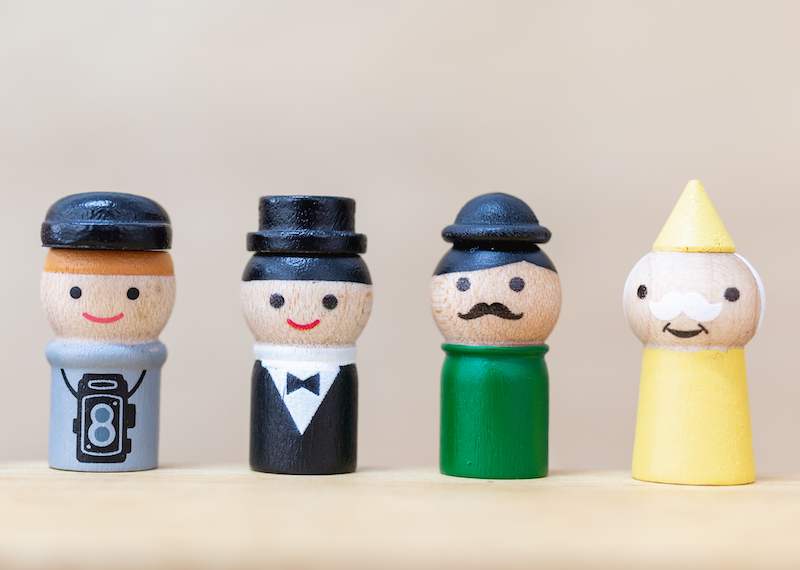
What was your favourite tegan (toy) to chwarae (play) with as a plentyn (child)? Try telling me in Welsh – and if that sounds like a step too far right now, don’t worry. Sit back and read on, and we’ll give it another go at the end of the article! 😉
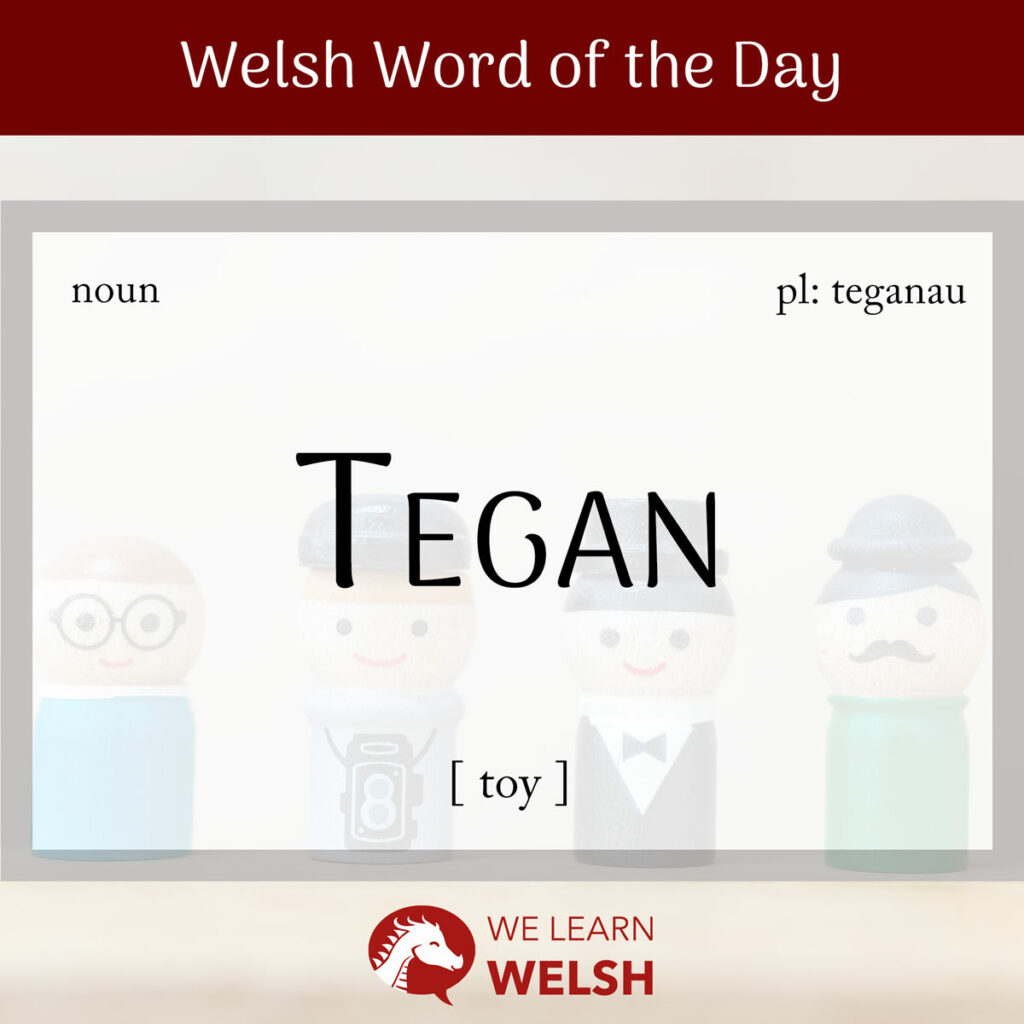
Tegan, of course, is our Welsh word of the day today. This simple masculine noun has the plural form teganau (toys).
tegan
toy
teganau
toys
You may have read our article a few months ago on the Welsh word teg (fair). This is such an important and evocative word, which really tells a story about Welsh culture and linguistics – so give the article a read if you haven’t already. And I’m not just saying that to self-advertise, since tegan wouldn’t exist without teg.
Teg can mean fair as in just or as in beautiful, and it can also sometimes refer to something just being very nice and pleasant. The suffix –an is an affectionate diminutive, so tegan could be literally translated as fair little thing.
Roedd y bachgen bach a’i chwaer fawr yn rhannu eu teganau.
The little boy and his big sister were sharing their toys.
It’s probably safe then to assume that the word originated as a pet name – it is still sometimes used as such, and also as a given name for girls. (This name sounds similar to, but is distinct from, the more common name Tegwen, also derived from teg.)
It’s likely from here that the word came to be used to mean toy. It’s easy to imagine a little bachgen (boy) or merch (girl) calling their favourite tedi (teddy) or doli (doll) by the fond pet name tegan, later causing the evolution of the word into a general term for toy.
If, in English, you called someone fy nhegan (my toy), it would sound a bit weird, almost as if you were being possessive or manipulative. But to do so in Welsh is normal and sweet – it’s like saying my dear one, my favourite, or my pet.
Fy nhegan is an example of tegan being affected by the treiglad trwynol (nasal mutation), one of the three mutations it can take:
Soft mutation
degan
Nasal mutation
nhegan
Aspirate mutation
thegan
The treiglad meddal (soft mutation) also shows up very regularly. It’s caused by the pronouns dy (your) and ei (his), and by the phrase mae gen i (I have), among other things.
The treiglad llaes (aspirate mutation) is the least common. Many Welsh speakers completely drop the aspirate mutation or replace it with a soft mutation even when it’s technically required. Interestingly, words beginning with t generally have their aspirate mutation omitted even more commonly than words beginning with c and p, the other letters that can aspirate mutate.
It is still worth knowing the contexts where tegan should take the aspirate mutation so you can recognise them in conversation. It happens when ei means her, so her toy is ei thegan despite his toy being ei degan, and it also happens after a (and), so for Nadolig (Christmas) a babi (baby) might get llyfr a thegan (a book and a toy).
One word causing aspirate mutation that’s particularly relevant to tegan is gyda (with). This means that playing with a toy is chwarae gyda thegan. The word efo, a synonym for gyda more common in North Wales, doesn’t cause any mutation. The last Welsh word for with is â and this causes an aspirate mutation too.
Dwedaist na fydden ni’n prynu rhagor o deganau iddyn nhw.
You said we wouldn’t buy them any more toys.
When plant (children) are very little, they often play with teganau like blociau (blocks), blancedi (blankets), and ratlau (rattles). They may also have a favourite tegan meddal / tegan anwes (soft cuddly toy, like a teddy or stuffed animal).
Ratlau are particularly interesting because the word used for them changes throughout the country.
Though ratlau or the alternative plural ratls is generally understood since it sounds like the English, rhuglen and rygar are used too. In North-West Wales some people say morthwyl sinc – a combination of the word for hammer with the onomatopoeic sinc, intended to represent a chinking sound.
And many Welsh speakers, especially in the South, use the word cleciwr to refer to any tegan for small children that makes a loud or a clicking noise, including a ratl but also other teganau synhwyraidd (sensory toys), like castanets or rain-makers. It’s a funny one because cleciwr is also used to mean a gossip!
Funny Welsh words referring to a range of teganau (toys) don’t stop there. Take chwyrligwgan, which can mean anything from a spinning top to a merry-go-round: the only requirement is that it spins!
One favourite that a lot of plant like is teganau that replicate adult experiences. My chwaer (sister) always loved to play with llestri tegan (toy tea sets) and fake bwyd (food) and equipment for coginio (cooking), as well as chattering on a toy ffôn (phone)!
My brother loved model ceir (cars) at one point, although his favourite was always anifeiliaid (animals). Trips to the siop deganau (toy shop) always resulted in big decisions when he was allowed to choose one model-anifail (model animal) and would spend long times deciding on his favourite to add to the bocs teganau (toybox).
This vocabulary brings up an interesting point – in English we often call something a toy version if it’s a small model or replica, like toy trains for model trênau (trains) that might in fact be enjoyed by adult rheilffordd (railway) enthusiasts. In my experience this is slightly less common in Welsh, and I personally would say model-drênau (model trains).
Mae’r ferch yn caru ei thegan meddal hi.
The girl loves her soft toy.
As for me, I liked forcing them both to chwarae ysgol (play school). I would make them pretend to be a tywysoges (princess) and tywysog (prince) and I’d be their athrawes (governess / teacher); I’m not sure why I never wanted to be the glamorous one myself!
At least we all agreed on all chwarae gwisgo (playing dress-up), especially to put on a drama (play) that our rhieni (parents) were forced to watch.
Older plant are more likely to play with a pêl (ball), dolis (dolls), and eventually more complicated gêmau (games) like gemau bwrdd (board games) and gemau cyfrifiadur (computer games).
Importantly, the verb for all of these activities is chwarae (to play). In Welsh, we don’t use tegan as a verb in the way that you can say to toy with something in English.
So, have you got your answer to the question yet? What was your favourite tegan (toy) to chwarae (play) with as a plentyn (child)? If I haven’t given the Welsh word for that particular tegan, let us know and we’ll get back to you!