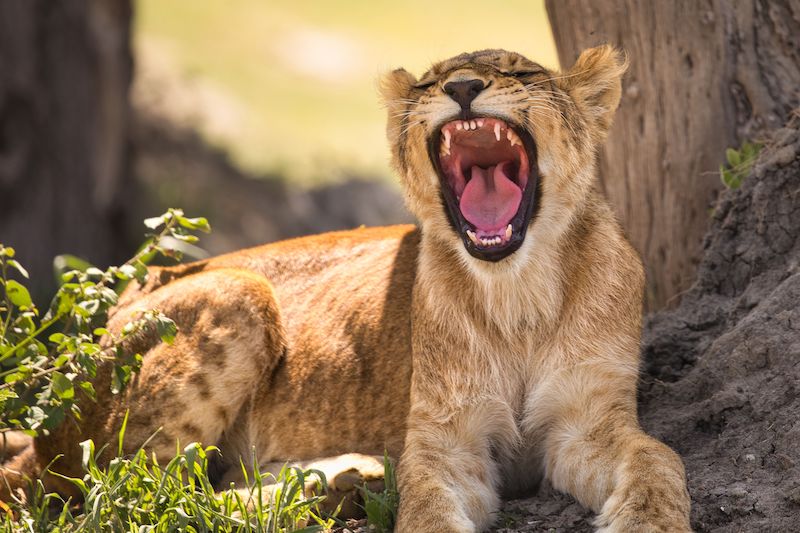
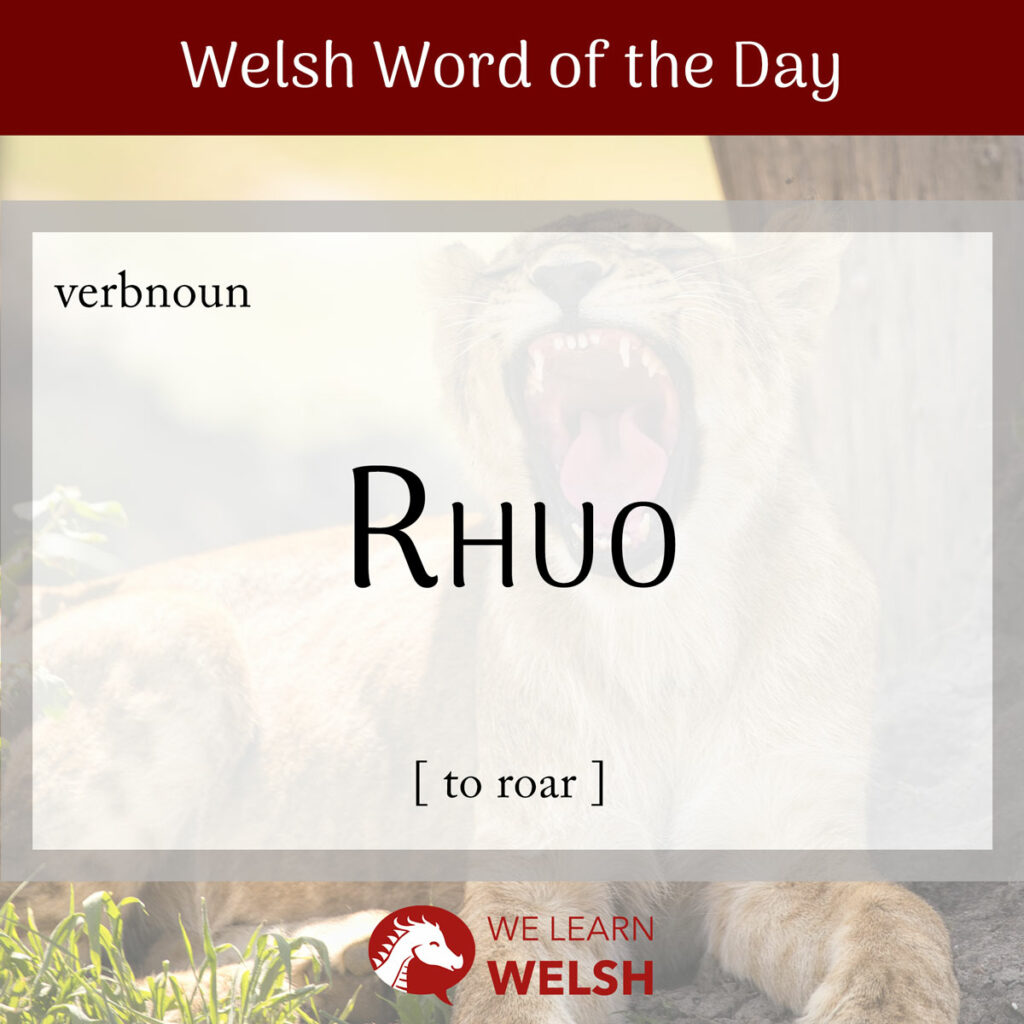
Today’s Welsh word is very much associated with llewod (lions), as well as other anifeiliaid (animals), but can also be used to emphasise the uchder (volume) or ffyrnigrwydd (ferocity) of a person’s llais (voice).
The verb in question is rhuo, meaning to roar or to bellow.
rhuo
to roar
Above is rhuo pronounced in an accent more typical to South Wales. In North Wales, the letter u has a specific sound not heard at all in English. This means that rhuo sounds like this:
Rhuo and its etymological predecessors may have been borrowed into the Celtic languages from the Latin rugio, meaning the same thing, or they may simply come from the same root in proto-Indo-European. It’s likely that this root was in the first place onomatopoeic, meant to mimic the sound of an anifail (animal) actually rhuo (roaring).
The word is subject to soft mutation:
Soft mutation
ruo
Nasal mutation
N/A
Aspirate mutation
N/A
Usefully, this word can be, and is naturally used in many of the same metaphorical senses that we use the English roar. For example, it can describe the sound of y môr (the sea), a person chwerthin (laughing), ceir (cars) on a highway, or, as is particularly common, tân (fire).
In byd yr anifeiliaid (the animal kingdom, literally world of the animals) it is definitely llewod that are most often associated with this impressive vocalisation. These cathod mawr / cathod mawrion (big cats) live in cnudoedd (packs, but in English, it’s prides), making them uncommonly cymdeithasol (social) compared to other species of cathod. Along with their rhuo, they are also known for having fabulous myngau (manes).
But it’s not all about llewod. Technically, the trumpeting of an eliffant (elephant) is a very similar vocalisation, and indeed is usually described in Welsh as rhuo, as is the bellowing of a tarw (bull). Other animals capable of rhuo include eirth (bears), morloi (seals), many kinds of epaod / abau (apes), and even ceirw (deer).
Amongst cathod (cats), there’s an anatomical distinction whereby some species rhuo, and others canu grwndi (purr, literally sing humming / sing purring). Those that rhuo are llewod, teigrod (tigers), jagwarod (jaguars), and llewpardiaid (leopards) – although llewpardiaid yr eira (snow leopards) are purrers, as are llewpardiaid hela (cheetahs, literally hunting leopards).
Roedd y gwynt yn rhuo tu allan.
The wind was roaring outside.
A roar, as in the noun, may be rendered either rhuad or simply rhu. Either way, it is a masculine noun, but the plural technically differs – more than one rhuad is rhuadau, but rhu becomes rhuon.
Often, the noun form is simply not used. For example, you could say rhuodd chwerthin (literally he roared laughing) for he gave a roar of laughter. Literally translating the latter is not incorrect, but for many native speakers it can sound more idiomatic to rearrange the sentence to feature the verb.
Alternatively, when talking about people, you can usually replace rhuad with bloedd (a shout).
The excellent online Welsh dictionary Gweiadur defines rhuo as “gwneud sŵn mawr, isel sy’n para’n hir” (making a loud, low noise that lasts a long time). When we detach the association with llewod, several other Welsh verbs fit this description, too – so while you’re getting your head around rhuo, you may also be interested in learning words like chwyrnu (to growl), bugunad / bwgwnad (to bellow), peuo (to bellow), gweiddi (to shout), and bloeddio (to shout).
My favourite use of the word is in the phrase rhefru a rhuo. This first word, rhefru, is a verb which is hard to directly translate. It is a bit like prattle – it means to talk on and on about something. Sometimes, it’s also used to mean to tell off. The full phrase is close to an equivalent of the English to rant and rave about something, but I think the imagery of the Welsh version is much more fun.