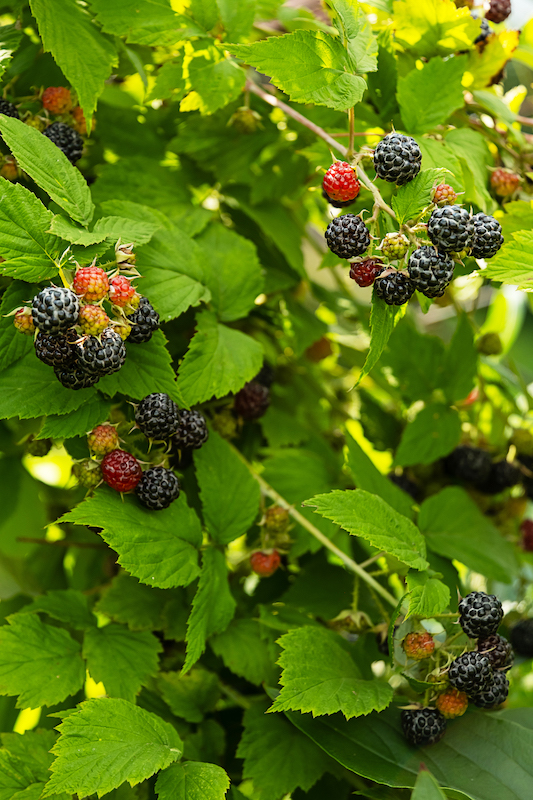
Our Welsh word of the day today is mieri, which means brambles or briars. It refers to the whole planhigyn (plant) rather than just to the mwyar (berries). Like in English, it is sometimes used in a general sense to refer to llwyni (bushes) with lots of drain (prickles or thorns).
Mieri is a collective term referring to brambles in the plural. It is the default form of the word, which is common for Welsh words about natur (nature). The singular form, a bramble, is miaren, or occasionally mieren, and it is feminine. Miaren is sometimes used as a girl’s name in Wales.
mieri
brambles
miaren
a bramble
Mieri comes from the hypothesised root *muɨar in proto-Brythonic, which interestingly also produced the word mwyar (berries).
Although they are sometimes called mwyar duon for greater specificity, mwyar also means berries and also in particular blackberries, meaning that mwyar grow on mieri. Plus, the word mwyar is sometimes used colloquially to refer to mieiri as a whole rather than just the berries, so these two words being an etymological doublet makes a lot of sense.
Only one mutation applies to mieri, the soft mutation:
Soft mutation
fieri
Nasal mutation
N/A
Aspirate mutation
N/A
The online Welsh dictionary Gweiadur explains a miaren as “llwyn pigog, gwyllt, yn enwedig un sy’n perthyn i deulu’r rhosyn gwyllt neu i’r llwyn y mae mwyar gwyllt yn tyfu arno”. This definition gives us a lot of useful vocabulary relevant to mieri and mwyar, so let’s break it down a little.
- llwyn = bush
- pigog = spiky
- gwyllt = wild
- yn enwedig = especially
- perthyn = to belong
- teulu = family, here mutated to deulu because of the preposition i (to)
- rhosyn = a rose
- tyfu = to grow
So overall it means “a spiky, wild bush, especially one which belongs to the wild rose family, or the bush on which wild berries grow.” As you might expect from the mention of rhosod (roses), mieri don’t just grow mwyar and drain but also blodau. The marchfiaren / rhosyn gwyllt (dog rose bramble / briar rose, in Welsh literally horse-bramble / wild rose), for example, is one well-known member of this teulu of planhigion (plants).
Though it’s not mentioned in that entry, it’s also worth you knowing the word drysi, which is a semi-synonym of mieri. It is more general and tends to refer to any kind of thorny or brambly planhigyn. Its singular is drysïen, which is also feminine. It comes from the word dyrys (rough, thorny, or tangled) – which is also the ancestor of drysu (to confuse)!
Sometimes people refer to a bramble as llwyn mieri or llwyn drysi, so literally a bramble bush.
Mae’r mieri mor bigog!
The brambles are so prickly!
If you mean specifically a blackberry bramble rather than any kind of thorny plant, you might say llwyn mwyar or llwyn mwyar duon. Another way to say blackberries in Welsh is mafon duon, which uses the word mafon that usually means raspberries or sometimes berries more generally – so a blackberry bramble could then also be llwyn mafon duon.
One last variation is that although the adjective du (black) should become duon when describing a plural noun, often in the colloquial language this rule is not observed and it remains du. So all in all there are quite a lot of ways to say bramble in Welsh!
In English, we sometimes use bramble to refer to the mwyaren (berry) itself, not just to the llwyn (bush). We don’t usually do this in Welsh but the variant forms meri duon and merin duon for blackberries are heard traditionally in North-West Wales, as versions of mieri.
All this brings us to the word llwyn itself, which is the most frequently used word for bush, but certainly not the only one. It’s a masculine noun – not super common for words to do with natur (nature) in Welsh – with the plural llwyni.
The word perth is sometimes used as an alternative in South Wales, and twyn and shetin both exist in mid-Wales, towards the West and the East of the country respectively. Also, the word coeden (tree) is sometimes used in contexts where we would say bush in English. For a whole hedge rather than just a bush, the go-to word is gwrych, but shetin and perth are both used for this as well as for hedge, and sometimes clawdd is heard in North Wales.
Eating wild mwyar and mafon from mieri is one of my favourite things to do in the summer in Wales. Occasionally you do scratch yourself on a drainen (thorn), but it’s worth it – they taste sweeter when you pick them yourself 😉