
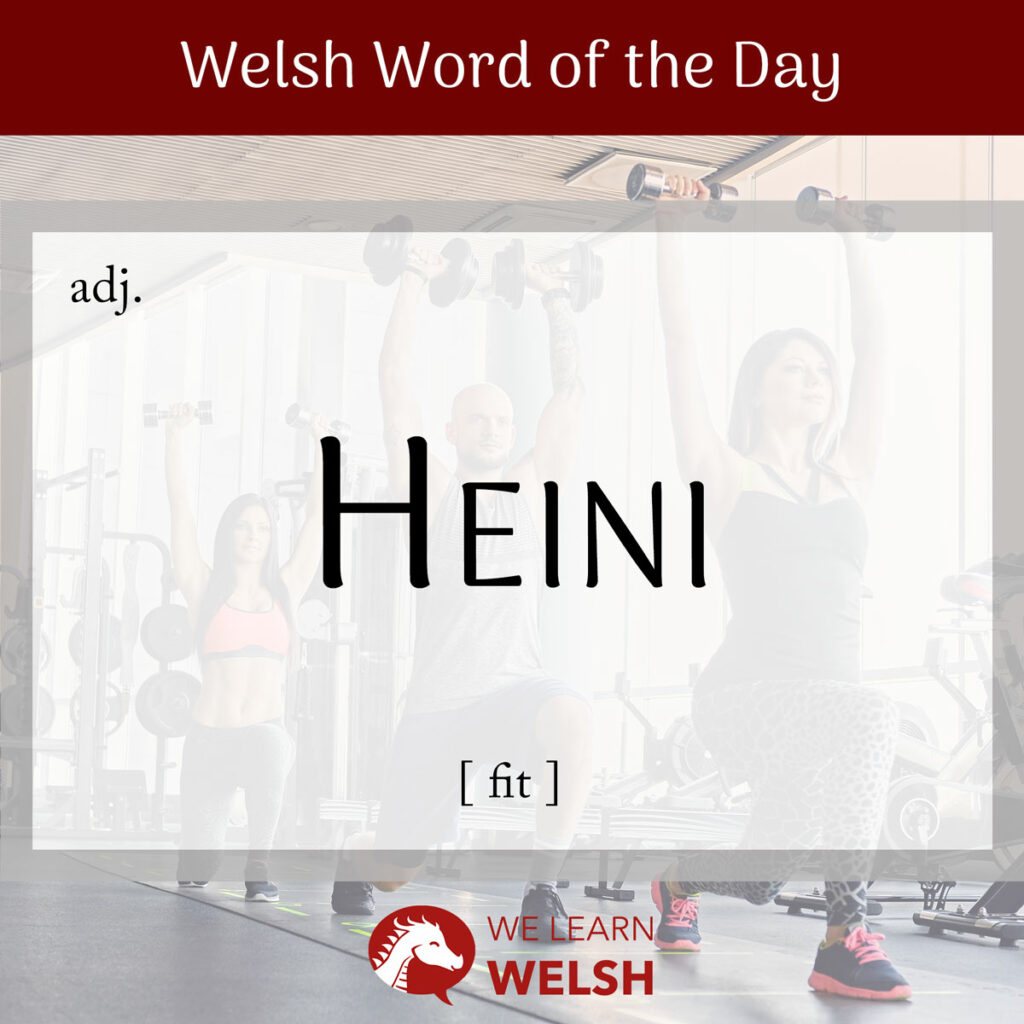
How do you like to cadw’n heini (keep fit / stay active)?
Heinifrwydd or, more commonly, ffitrwydd (physical fitness) is a complex subject since there are many factors – personal and societal – that influence someone’s level of iechyd (health) and abledd (ability). And the word heini is a complex word, too, since though it’s most often used to mean physically fit, it can also mean active or lively.
Since it starts with the non-mutable letter h, you don’t need to worry about any mutations for heini. It will always appear exactly as it is. This rule still applies when we start to think about comparative forms of the adjective – very simply, as fit is mor heini, more fit is mwy heini, and most fit is mwyaf heini – and there is also no separate gendered or plural form.
heini
fit
Heini ultimately comes from the very different looking proto-Celtic *sognim, a combination of root words meaning good and deed. This last part of the original word, *gnimus, also survives in the words gweinydd (waiter) and gweinyddes (waitress).
There are also surviving words from the same root in the other Celtic languages, like gníomhas(deed) in Irish and gníomh (task) in Scots Gaelic.
Being heini means different things to different people – some people value ffitrwydd to protect against salwch (disease), some people for their iechyd meddwl (mental health) and well-being, some people because they want their corff (body) to look a certain way, and some simply because they enjoy ymarfer corff (exercise) or chwaraeuon (sports).
Mae golwg heini arni ers iddi ddechrau gymnasteg.
She looks fit and well since she took up gymnastics.
In terms of the actual word itself, traditionally, it specifically refers to ffitrwydd that is corfforol (bodily / physical), but its association with the English word these days has led to some people extending it to talk about meddyliol (mental) kinds of ffitrwydd, as in with reference to iechyd meddwl.
But you still wouldn’t go for this word to talk about someone being fit to do something as in abl (able) or addas (suitable) for it. If you do want to use a word that straddles all of these potential meanings, you would just to have to go for ffit, a borrowing from the English which is used in multiple settings.
There is also atebol / ‘tebol, common in North Wales, which also covers both heini (physically fit) and abl (able), and then the very intuitive abl–iach (literally able–healthy), which is sadly becoming steadily less heard these days but which is similar in meaning to heini.
You can tell that heini is supposed to specifically refer to ffitrwydd corfforol because of the fact that it also means lively, active, sprightly, or agile. In this sense, it is similar to words like bywiog (lively), egnïol (energetic), hoenus (vivacious), and sionc (lively, well).
Because of this you can also convert it into an adverb and say yn heini (agilely, livelily) to describe the manner in which someone takes a physical gweithred (action).
This meaning is also probably the root of the word’s use as a man’s name in Welsh. A good example of a person called Heini is Heini Gruffydd, whose well-regarded textbooks certainly might be of interest to learners of the language.
Neidiodd y gath fach heini ar y soffa.
The lively, agile little cat jumped onto the sofa.
Let’s finish off by going through some useful vocabulary referring to common habits that many people use to cadw’n heini (keep fit).
- bwyta digon = eating enough
- bwyta ffrwythau a llysiau = eating fruit and vegetables
- yfed digon o ddŵr = drinking enough water
- peidio yfed diodydd meddwol / alcohol = not drinking alcohol
- cerdded bob dydd = walking every day
- ymestyn = stretching
- mynd i’r gampfa= going to the gym
- codi pwysau = lifting weights
- nofio = swimming
A good way to express your arferion (habits) is to use the word trwy. This is often translated to through, but for our purposes here it’s more like by.
For example, I might say dw i’n cadw’n heini trwy ddawnsio (I keep fit by dancing). As you can see, trwy has caused a soft mutation to dawnsio (to dance).
Can you use the structure above to express how you prefer to cadw’n heini? You can use one of the examples above!