Some words in Welsh have existed in the language since it developed from proto-Brittonic. Some are recognisable borrowings, recent or centuries-old, from English, Latin, or even further afield. But there’s one kind of Welsh word that feels like neither native or loan – words that were technically borrowed, but no longer exist in the original language.
Well, today’s word gwastraff (waste) is one of these. Let’s get into it!
gwastraff
waste
Now, gwastraff is probably in some way related to the English waste, but the second syllable doesn’t fit this pattern.
You could also be forgiven for thinking that gwastraff comes from the verb form, gwastraffu (to waste), but unfortunately it’s the other way around, so no clues there. Words like gwastraffus and gwastrafflyd (both wasteful) exist too, and again, they’re children rather than parents of gwastraff.
One clue is the existence of an old Scottish word, wasteriff. But this is really surprising, since it’s not Scottish Gaelic – another Celtic language – that we’re talking about here, but Scots, a Germanic language that evolved alongside English. The origin of both these words could be an archaic English word since lost to time, or it could be something else entirely.
Gwastraff is an uncountable masculine noun – that means it has no plural – which is subject to the soft mutation.
Soft mutation
wastraff
Nasal mutation
N/A
Aspirate mutation
N/A
Some people shorten it to gwast, or more commonly in my experience, wast. As with many Welsh words beginning with g, lots of speakers use the soft-mutated form even when this is grammatically incorrect. It almost becomes just another way of shortening the word – but I’m not giving you an excuse to get out of learning mutation rules! It’s still important to recognise them, and to stick to them in formal speech and language.
At the risk of over-simplifying, I’ll say that there are two main kinds of gwastraff. This is physical gwastraff, like sbwriel (rubbish), and metaphorical gwastraff, like when something is gwastraff amser (a waste of time). The latter essentially describes to a poor use of resources, which can be anything from amser and medrau (skills) to arian (money) and bwyd (food).
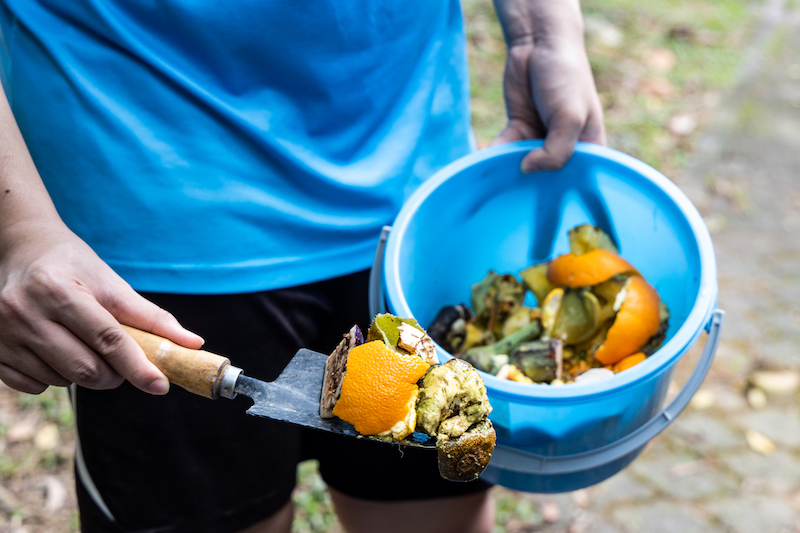
The physical kind of waste doesn’t just refer to things we put in our biniau sbwriel, like gweddillion (scraps), pacediadau (packaging), and things that are budr (dirty). There is physical gwastraff on a larger level too, like carthion (sewage) and, getting even more big picture, gwastraff niwclear (nuclear waste).
There’s also what’s often called wasteland in English. We don’t refer to this as gwastraff in Welsh. Instead we use the same words as for desert, though there are still a few options! Diffeithwch, diffeithle, and diffeithdir are all common. The word I would personally use for a desert specifically is anialwch, but as always, watch out for regional variation.
Mae gwastraff gardd yn cael ei gasglu bob pythefnos.
Garden waste is collected fortnightly.
On the other hand, we have the metaphorical kind of gwastraff. To say that something is a waste of something you have three options.
Firstly, you can literally translate the English word for word, producing gwastraff o rywbeth. Secondly, you can do the same but use ar (on) instead of o – so gwastraff ar rywbeth. This is more formal. Thirdly, and this is particularly common with more familiar set phrases, you can do what I’ve done in the phrase gwastraff amser above and use a genitive or “possessive” construction: gwastraff rhywbeth.
As you can see, in the first two methods the object of the phrase, the thing that is being wasted, takes a soft mutation. In the third example it doesn’t since gwastraff is a masculine noun.
Similarly, there are a couple of ways of saying something is going to waste. The most common is mynd yn wastraff. But if what you are talking about is a gardd (garden) or other tir (land) becoming overrun, you might say mynd yn ddiffaith – you can see the similarity between this and words like diffeithwch.
Peidiwch â gwneud hynny, mae’n wastraff papur.
Stop doing that, it’s a waste of paper.
When it comes to waste as a verb, there’s also some variety. You are usually safe to use gwastraffu (to waste), but there are other options too.
To start with, we don’t use gwastraffu when talking about someone wasting away. You could say nychu (to weaken) or gwywo (to wither).
Afradu is a fun dialectical alternative to gwastraffu – it’s a synonym that’s common in the South. Variations on this include bradu and bratu. Another option is difetha, which can mean to waste or in some contexts even to destroy.
There are also a few contexts where the most idiomatic word to use is colli (to lose / to miss). For example, to waste an opportunity is colli cyfle. You can also use this with amser (time); although gwastraffu is fine here too, for many native speakers it will feel more natural to say colli.
And I can’t omit the wonderful pencawna, common in the South-West and in Ceredigion, which means to waste one’s time all on its own. Literally, it means to pick the tops of stalks – and to be fair, that doesn’t necessarily sound like a great use of limited time.