
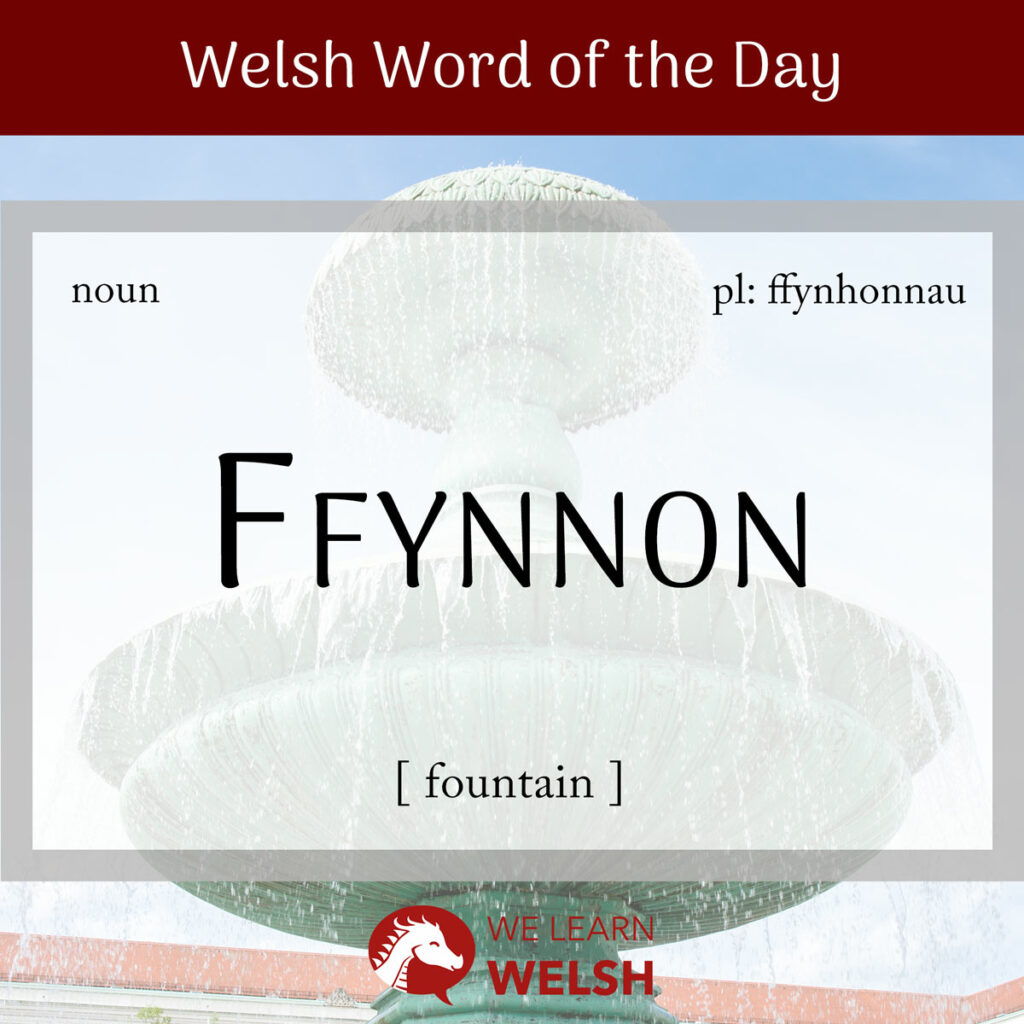
Do you often find yourself getting tripped up by false friends in Welsh? If so, one to get familiar with so you can make sure this doesn’t happen is ffynnon. At first glance, it doesn’t look like an English word, but when being said quickly in conversation it often sounds like funnel. But that’s not what it means – a funnel is a twmffat in the North and a twndish in the South.
Luckily, once you know what ffynnon means, its pronunciation makes a lot more sense too. A ffynnon is a fountain, well, or spring, and the plural form is ffynhonnau. There’s also another, almost synonymous word: ffynhonell, whose plural is ffynonellau. It’s amusing that in one version, the plural adds an h, while in the other, it takes it away!
ffynnon
fountain
ffynhonnau
fountains
Ffynnon comes from the proto-Brittonic *funton, which was a borrowing from Latin’s fontana, meaning the same thing. So, as well as sounding like fountain, it has the same root too. Though don’t let that lead you to think that they’re used in the exact same way: an ornamental water fountain would usually be called by the loanword ffownten in Welsh, as ffynnon refers to naturally occurring sources of water.
It’s not the only word that you could use: there is also tarddell, sometimes rendered tarddle. I find that this word tends to be more often used for natural sources of water like a spring, although the variation may be more dialectical than semantic.
Aeth hi i nôl dŵr o’r ffynnon.
She went to get water from the well.
Ffynnon, ffynhonell, tarddell, and tarddle are all feminine nouns.
They are used to talk about any kind of source of water. That means ffynnon sometimes occurs in the names of plants associated with bodies of dŵr (water), like berwr y ffynhonnau, which is another name for berwr y dŵr (watercress).
For this reason, in some parts of Wales, people use ffynnon to talk about a water tap, though just tap is more common. Some North Walians may go for feis ddŵr. That literally means water device, which I think is quite cute.
They’re also used more abstractly to talk about a source in general. Someone might refer to ffynhonnell / tarddle haint (the source of an infection) or use the idiom llygad y ffynon (the horse’s mouth / the source of the matter) which word-for-word translates to the eye of the spring. Both ffynnon and llygad (eye) are used metaphorically to refer to the source of something, so combining them we get the ultimate source!
Or, in computing, a source file is called a ffeil darddiad. The second word darddiad is a mutation of tarddiad, which is just another word in the tarddell / tarddle family, and in particular one that’s often used to talk about sources beyond just those of dŵr.
Mi greda i ddim y peth cyn ei glywed o lygad y ffynon.
I won’t believe it ’til I hear it from the horse’s mouth.
My favourite use of ffynnon is as a verb. Ffynhonni means to well up, and ffynnu means to prosper, to succeed, or to flourish. You know how in English we often associate thriving with a healthy planhigyn (plant) that’s tyfu (growing) big and strong? It’s a similar kind of image, as if llwyddiant (success) is represented by a gushing ffrwd (stream) of water.