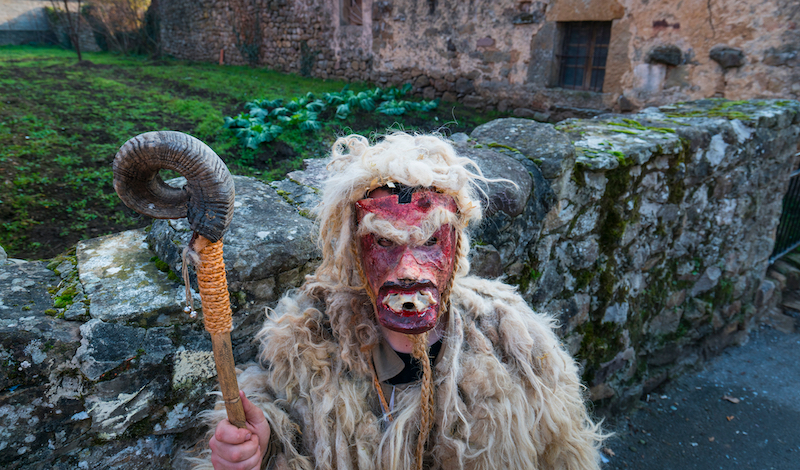
A few months ago, we published an article about the Welsh word hyll, meaning ugly or hideous. Now we’re going to kick it up a notch – this article’s about a word that’s even hyllach (uglier). It’s time to delve into the expansively awful adjective that is erchyll (hideous, ghastly, terrible, atrocious, dreadful… ).
erchyll
hideous / ghastly
It’s very likely that erchyll comes from hyll. In fact there is also an archaic word erch that means horrible, so combining the two of those certainly seems like a reasonable etymology for erchyll.
But we don’t know that that’s for sure the case, and it’s also important to remember that erchyll doesn’t just mean very ugly. It has additional negative connotations beyond that; it reminds you of something really awful, perhaps cruel, and even frightening. It’s quite often used to describe supernatural beings.
Now, Welsh doesn’t have any shortage of words to describe these kinds of qualities. There’s hagr (ugly), arswydus (horrible / horrifying), ofnadwy (terrible), hunllefol (nightmarish) and dychrynllyd (scary / frightening) just for starters.
Erchyll is one of my favourites though – it’s just so evocative! Plus, I love how it both rhymes and alliterates with ellyll, another favourite of mine. Ellyll is a noun referring to various kinds of coblynnod (goblins), diafoliaid (demons), and particularly evil or mischievous examples of the tylwyth teg (fairies).
Cododd y ddraig enfawr ei phen erchyll.
The huge dragon raised its hideous head.
So you could have an ellyll erchyll, which is a bit of a cwlwm tafod (tongue-twister). You could also have an anghenfil erchyll (hideous / ghastly monster), a gwrach erchyll (hideous / ghastly witch), or, stepping a little further from indigenous Welsh mythology, a fampir erchyll (hideous / ghastly vampire).
It’s even possible to have a plain old everyday situation that’s erchyll, like if you mix salt with sugar and cooked a cinio erchyll (atrocious dinner), or if you unfortunately realise that you’re wearing a gwisg erchyll (atrocious outfit). Don’t use it too often, though, or you’ll sound a bit hyperbolic!
Another thing I like about erchyll is that it’s a nice simple word. It doesn’t have any mutations and it doesn’t change for feminine nouns. For plural nouns, it may become erchyllion in formal speech, but this isn’t considered necessary when you’re chatting casually. Erchyllion is also sometimes used as a noun to mean horrible things / horrible creatures, a bit like the ellyllion (goblins etc)I was talking about!
It was once even used as a verb – erchyllu (to be hideous) – although sadly this has fallen out of use.
Stori hollol erchyll ydy o. Druan ohoni hi.
It’s a totally dreadful story. Poor her.
A more prosaic usage is as an adverb, as in yn erchyll (hideously or awfully). In this sense, it also functions as an intensifier.
Have you ever heard a Welsh person say something like mae hi’n ofnadwy o hael or mae hi’n hael ofnadwy (she’s terribly generous)? Here, ofnadwy is being tagged onto the end of a statement to strengthen its sentiment. This is a very common thing to do and a great way to add colour to your speech. To switch it up even further – especially when speaking descriptively or poetically – you can replace ofnadwy with erchyll.
As you might imagine, this is done especially, although not exclusively, when the statement you’re making is a negative one. For example, you could say mae’n drist erchyll (it’s hideously sad).
This isn’t too far-fetched; when you think about it, some (perhaps slightly posh) English speakers do say things like he was hideously attractive. For the record, that would be roedd o’n olygus erchyll. It’s a bit of a gwrtheiriad (oxymoron), but that’s language for you – it rarely makes sense!