Have you had anything cyffrous (exciting) to dathlu (celebrate) recently? Well, read on to learn how to talk about it in Welsh with today’s word of the day!
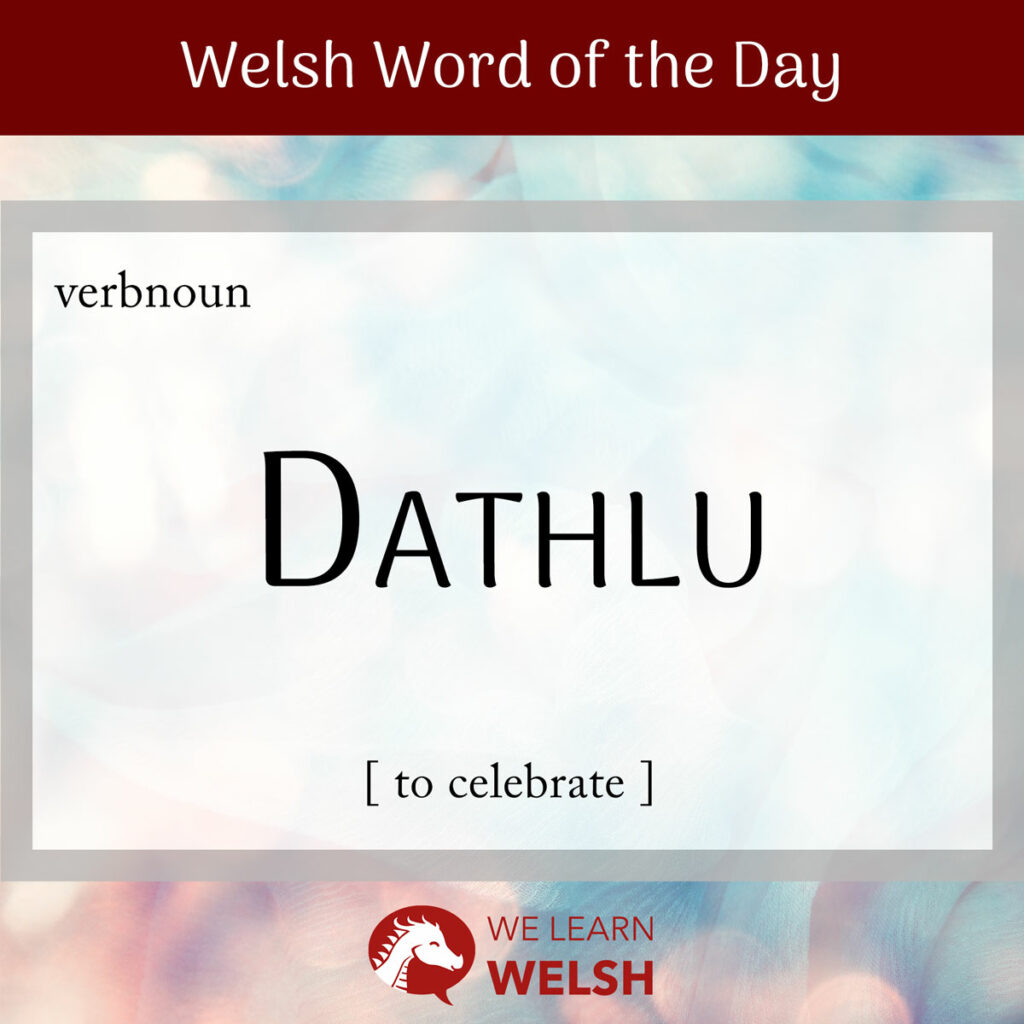
dathlu
to celebrate
Dathlu has one of the most curious etymologies of any word we’ve discussed on this blog so far. That’s because it was literally made up – and yet has still become a common, accepted, and correct word used in all registers and dialects of the Welsh language.
How on earth can that happen? The answer isn’t simple, but it is interesting. William Owen Pughe was a Welshman from Gwynedd who devoted to his life to studying and recording the iaith (language). Many of his contributions to Welsh studies were incredibly valuable. However, he was also guilty of being very imprecise in his approach. He published at times forged Welsh documents, as well as his own made-up words!
Most of the words Pughe invented are no longer used, but there are a few that are, especially those that were based on genuine roots that already existed in the language. One of these is dathlu. It’s based on the archaic adjective dathl, meaning famous or celebrated, and originally meant to celebrate as in to extol.
Today, it has evolved to refer mostly to the commemoration of actual dathliadau (celebrations), making it a very close equivalent of the English word to celebrate. And to extol in Welsh would be more likely to find itself translated as canmol (also to praise, to laud), though it is technically fine to use dathlu in this way too.
Dathlu can be affected by soft and by nasal mutation:
Soft mutation
ddathlu
Nasal mutation
nathlu
Aspirate mutation
N/A
Since it is a transitive verb, like its English translation, it is quite simple to use. You just insert the noun that you are celebrating right after dathlu. For example, dathlu penblwydd (to celebrate a birthday).
It’s worth remembering though that many nouns in Welsh take a definite article – that’s y / yr / ‘r (the) – in grammatical contexts where they wouldn’t necessarily do so in English. Nadolig (Christmas) is one of these, which means that celebrating Christmas should usually be written dathlu’r Nadolig.
You can also use dathlu without a noun, as in the following phrase:
Mi gawson ni newyddion da ddoe, felly dyn ni’n mynd i ddathlu heddiw.
We got some good news yesterday, so we’re going to celebrate today.
In this usage dathlu is working a bit like the word llawenhau (to rejoice), but the latter sounds a lot more flowery and formal, just like it would in English.
But there is one meaning of celebrate in English which shouldn’t be transposed into Welsh. This is the crefyddol (religious) usage, as in to celebrate Mass. In Welsh this is traditionally translated as gweinyddu’r Offeren.
How does dathlu conjugate? Use the table below to find the right form of the verb:
| Future | Conditional | Past | |
| First person singular | Dathla i I will celebrate | Dathlwn i I would celebrate | Dathlais i I celebrated |
| First person plural | Dathlwn ni We will celebrate | Dathlen ni We would celebrate | Dathlon ni We celebrated |
| Second person singular / informal | Dathli di You will celebrate | Dathlet ti You would celebrate | Dathlaist ti You celebrated |
| Second person plural / formal | Dathlwch chi You will celebrate | Dathlech chi You would celebrate | Dathloch chi You celebrated |
| Third person singular | Dathlith o /e / hi He/she will celebrate | Dathlai o / e / hi He/she would celebrate | Dathlodd o / e / hi He/she celebrated |
| Third person plural | Dathlan nhw They will celebrate | Dathlen nhw They would celebrate | Dathlon nhw They celebrated |
But remember, as always, that periphrastic conjugation is common in Welsh, and in fact in colloquial situations is often preferred. ‘Wna i ddathlu is just as good as dathla i for I will celebrate, as is ‘wnaeth hi ddathlu for she celebrated.
Ni fydd hi’n gallu gweithio’r diwrnod hwnnw, achos ei bod hi’n dathlu Eid.
She won’t be able to work that day, because she celebrates Eid.
From penblwyddi priodas (wedding anniversaries) to graddiadau (graduations), there are plenty of special occasions in life. Here are some things you might want to say to a friend or family member who is dathlu a personal milestone.
- Llongyfarchiadau! = Congratulations!
- Llongyfarchiadau mawr i ti / i chi. = Huge congratulations to you.
- Dw i’n falch ohonot ti / ohonoch chi. = I’m proud of you.
- Dw i’n falch drostot ti / drostoch chi. = I’m happy for you.
- Am newyddion gwych. = What great news.
- Mwynhewch! = Have fun!
Plus there are also plenty of cultural dathliadau (celebrations) to enjoy throughout the year. At the moment, of course, it’s nearly Nadolig, one of the most widely celebrated of these in the UK.
Nadolig Llawen i bawb sy’n ei ddathlu.
Merry Christmas to everyone who celebrates.
Do you dathlu’r Nadolig (celebrate Christmas), or any other seasonal gwyliau (holidays / festivities), like Gŵyl y Cysegriad (Hanukkah) or heuldro’r gaeaf (the winter solstice)? Let us know your plans – big or small – for mis Rhagfyr (December) in the comments below.