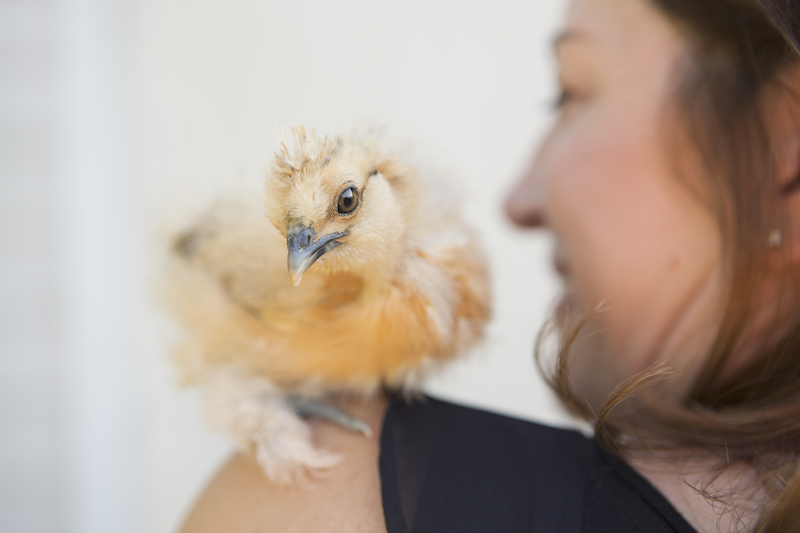
Today’s Welsh word of the day, cyw – a masculine noun with the plural cywion – is a multi-faceted one. Primarily, it means a chick from any species of aderyn (bird), but it’s also used in some dialects to refer specifically to ieir (chickens as a distinct species), plus it comes up in the term cyw iâr which is used for chicken as a cig (meat).
And it’s not only used to refer to adar (birds)! Back in the day the word was used to specify a baban (baby) of various kinds of species from ceffylau (horses) to cathod (cats), and though this isn’t the case today for most anifeiliaid (animals), you will still hear this word in reference to pobl (people).
It’s a common pet name, and is also used to refer to a person who is literally or metaphorically ifanc (young)– like the youngest plentyn (child) of a teulu (family), or someone who is early on in their addysg (education) or gyrfa (career). Cyw is a masculine noun with the standard plural cywion.
cyw
chick
cywion
chickens
I mentioned this word’s plural, which is cywion. Non-standard plurals have been recorded too, such as cywon, cywiaid, and cywain, but most people will use cywion. And technically there is also a feminine form, cywen, which has the plural cywennod, but this is rarely used.
This word comes from the proto-Celtic *kuwyos, which has a very long history. It likely originated in the proto-Indo-European root *kewh meaning to swell or to be strong. The great thing is that *kewh’s influence can be traced to ancient and modern languages all over West Asia and Europe, including Sanskrit.
Here is how cyw mutates:
Soft mutation
gyw
Nasal mutation
nghyw
Aspirate mutation
chyw
Now, in its modern Welsh form, cyw can be hard to pronounce at first, since the vowel sounds here don’t usually occur in this pattern in English. Try saying cih, like the first part of kick, and then oo, like the last part of kangaroo, and then gradually speeding up.
What it should not sound like is the English word queue. And just to make things more confusing, the Welsh word for queue is ciw, which is an exact homophone of cyw!
So the main usage of cyw is to refer to any kind of baby aderyn (bird), from those kept in people’s back gerddi (gardens) like ieir (hens), hwyaid (ducks), and gwyddau (geese), to those you might spot in your local coedwig (forest / wood) or coetrych (hedgerow) like adar y to (sparrows) and gwenoliaid (swallows / martins), to awe-inspiring adar rheibus (birds of prey) like eryrod (eagles), gweilch (hawks / ospreys), and barcutiaid (kites).
Because of this, if you’re talking about the cyw of a iâr specifically, you might feel the need to say cyw iâr to make it clear. However this is not the best course of action – most people will think you mean chicken meat when you say cyw iâr, unless context strongly suggests otherwise.
The word ffowlyn is also used to refer to a chicken for cooking. Broadly, it means a fowl or a bird.
Dwi’m yn meddwl y byddai’n hoffi’r cyw iâr. Llysieuwr ‘dy o, yndo?
I don’t think he’d like the chicken. He’s a vegetarian, isn’t he?
Whatever the species, most people associate cywion with fluffy yellow plu (feathers), gwanwyn (springtime), and y Pasg (Easter). You might hear one described as:
- cyw gwlanog / cyw blewog = a fluffy chick
- cyw melyn = a yellow chick
- cyw del / cyw pert = a pretty and cute chick
- cyw bach twt = a cute little chick
- cyw newydd = a newly hatched chick
- y cyw lleiaf = the smallest chick (of the litter)
- y cyw mwyaf = the biggest chick (of the litter)
Their adorable image is probably why a cyw was chosen as the mascot of Awr Fawr Cyw (Chick’s Big Hour), the name for children’s programming on the Welsh-language sianel deledu (television channel) S4C. Cyw has a gwefan (website) with gemau (games) and fideos (videos), which is a great resource if you have a child who speaks Welsh or is learning!
Their universally agreed upon anwyldeb (adorability) is probably also why cyw is used as a pet name, alongside other common Welsh terms of endearment like bach (little), del (pretty), pwt (tiny thing), and of course cariad (love).
However it’s not used to mean a young woman in the very general sense that it is in some dialects of English – though you could say that someone is nid cyw ifanc / nid cywen ifanc (not a young chick) in a similar way to no spring chicken in English.
Mae cywion y gwcw yn fawr ac yn gryf.
Cuckoo chicks are big and strong.
My mum is obsessed with ieir and hwyaid so we often had cywion running around our gardd (garden) when I was a little child. And whenever there weren’t chicks there would certainly be wyau (eggs) waiting to hatch in a dehorydd (incubator) or under the mother bird, so we were never too far away from another haid (flock).
To call out to a haid of cywion in Welsh, you can say tsic-tsic-tsic, much like the English chick-chick-chick, or simply cyw-cyw-cyw.
Let’s finish off with a few fun Welsh idioms. The phrase cyw melyn olaf means last yellow chick, and it is used to refer to a youngest plentyn. I’d also say it suggests a certain favouritism being displayed towards this plentyn, and may be used to tease the doting rhiant (parent) or the spoilt brawd (brother) or chwaer (sister).
Another that refers to family is lle crafa’r iâr y piga’r cyw (where the hen scratches the chick will pick). This is basically no different to the English proverb the apple doesn’t fall far from the tree. Similar but much more ominous is cyw a fegir yn uffern yn uffern y myn fod (a chick raised in hell will want to be in hell).
There’s also the interesting mendio fel cyw gŵydd (mending like a goose chick). This was apparently once used in North Wales to mean recovering quickly after being ill. I didn’t know cywion gŵydd (goose chicks) were so hardy!
Anyway, you should be careful using this, because these days cywion gŵydd is a fairly well-known term for catkins, which have nothing to do with getting better after a salwch (illness).
Mae pedwar cyw yn y nyth, ac un arall heb ei ddeor.
There are three chicks in the nest, and one more yet to hatch.
You may have already heard our final expression, which is the wise gwyn y gwêl y frân ei chyw (the crow sees her chick as white). Though this is generally recited and recorded in quite formal language, some of the vocabulary will still be recognisable, like gwyn (white), and brân (crow), which has soft mutated in this phrase.
The meaning of this is that a rhiant can’t see the faults of their own plentyn. Whether you think this is true or not probably depends on your relationship with your rhieni (parents)… and how much your own plant (children), if you have them, have annoyed you today!