
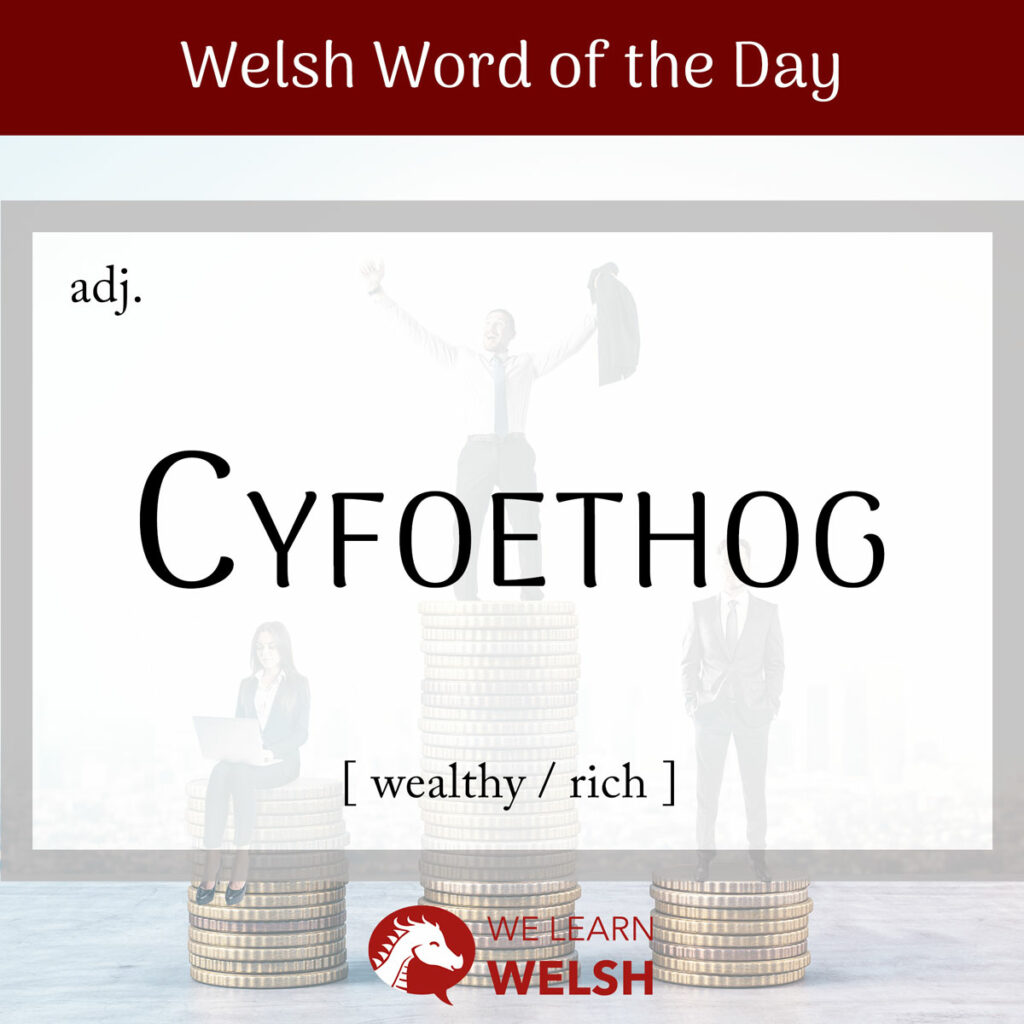
Arian (money) isn’t everything, but it certainly does make life a lot easier, so it’s no surprise that becoming cyfoethog is a primary goal for many people.
In English, there are two separate words for cyfoethog: wealthy and rich. Many people see the former as signifying a higher level of moeth (luxury / ease), eiddo (property), and braint (privilege) than the latter. Although there are words that are roughly synonymous to cyfoethog, and we’ll talk about those later, this binary distinction doesn’t exist in Welsh – making this word, perhaps, twice as useful!
Another difference from the English is that cyfoethog is not used to refer to rich bwydydd (foods), rich pridd (soil), or being rich in something. It is explicitly about someone having a lot of arian (money) and other gwerthfawr (valuable) things.
cyfoethog
wealthy / rich
Cyfoethog originally comes from a proto-Celtic word *komoktakos. This word could mean wealthy, but also influential and / or powerful, which is why cyfoethog is a cousin of words in the Gaelic Celtic languages, Irish Gaelic, Scots Gaelic, and Manx, that actually mean powerful rather than rich.
*Komoktakos was probably developed as an adjectival form of another root, this time a noun meaning power or wealth, which would have been the ancestor of the modern Welsh cyfoeth. This is a masculine noun, usually treated as uncountable, meaning wealth or affluence.
Cyfoethog can take all three of the soft, nasal, and aspirate mutations.
Soft mutation
gyfoethog
Nasal mutation
nghyfoethog
Aspirate mutation
chyfoethog
The nasal mutation wouldn’t often be needed, but it might be needed with the noun form, as in the phrase fy nghyfoeth (my wealth / my riches).
There is another noun version of cyfoethog, and talking about it reveals an interesting facet of Welsh grammar. I’m talking about cyfoethogion, which means rich people.
Literally, though, cyfoethogion is just the plural form of cyfoethog, i.e. the version of cyfoethog we would use when describing a plural noun. A rich man is dyn cyfoethog, but rich men is dynion cyfoethogion. (It’s fairly normally colloquially to skip this rule and just use the singular form of the adjective.)
It is quite common to do this in Welsh – to take the plural form of an adjective and treat it as if it were a noun itself. Within reason, you can do this to any adjective that has a plural form. You could turn tlws (pretty) into y tlysion (the pretty ones), coch (red) into y cochion (the red ones) and so on. Cyfoethogion is just a particularly useful example because we often want to talk about rich people!
It is also perfectly fine to simply translate rich people as pobl gyfoethog. Notice here that I’m actually not using the plural form of cyfoethog. This is because pobl (people) in Welsh operates as a singular, feminine noun – feminine is important because that’s what causes cyfoethog to mutate to gyfoethog. It’s not automatically plural just because it’s referring to multiple people.
Another word I think is interesting that comes from cyfoethog is cyfoethogi. This has a variety of meanings – originally it meant to bestow riches on someone else, as in mae hi’n cyfoethogi nhw (she is bestowing riches on them). It can also refer, in a more abstract sense, to the process of enriching one’s bywyd (life).
The word later developed such that it could also be used to talk about the person themselves. In this sense, mae hi’n cyfoethogi would mean she is getting richer. In more formal language, though, you’d translate that as mae hi’n ymgyfoethogi, using the reflexive prefix ym– to show that the verb is applying back to the same person enacting it.
Roedd ei rieni’n hael iawn ato fo, er nad oedden nhw’n gyfoethog.
His parents were very generous towards him, despite not being wealthy.
So what about those synonyms I was talking about? Well, to start with, there’s ariannog, which comes, you guessed it, from arian.
Another is cefnog, which comes from the word cefn (back) – this word is often used in Welsh to connote nerth (strength / power) or cyfoeth. Indeed, in some parts of the country cefnog is used to mean that someone is dewr (brave) and cryf (strong), but overall the more standard meaning is wealthy.
Abl means able. It’s quite an eclectic word, because it can mean literally able as in able-bodied, it can mean talented and skilful, and also historically it could mean wealthy, hence its inclusion here. This usage is becoming much less common today.
If you look wealthy up in an English-to-Welsh dictionary, there’s a good chance that you’ll see the option goludog. This is pretty much exactly synonymous to cyfoethog but is very literary.
If you want to be particularly expressive, there are some fun options for that. Someone who is incredibly rich is said to be yn graig o arian (literally a rock of money), or if you’re really not fond at all of the person you’re talking about, you could say that they drewi o arian (smell of money).
Lastly, there is a phrasal form, where you basically say that someone’s world is good. The phrase incorporates a pronoun, so it changes depending on who you’re talking about – if you’re describing yourself as wealthy, you would say da fy myd (good my world), if you were describing a woman, you would say da ei byd (good her world), and so on.
Cyfoethog iawn ydy Mari a’i gŵr. Mae ganddi hi swydd ardderchog.
Mari and her husband are very rich. She has an excellent job.
It’s disingenuous to pretend that whether one is cyfoethog (rich) or tlawd (poor) doesn’t have a huge impact on your life, and it doesn’t necessarily make someone trachwantus (greedy) to hope for the creature comforts in life.
That being said, the message of the iconic Welsh hymn Calon Lân always serves as a good reminder of the things that matter much, much more than cyfoeth.