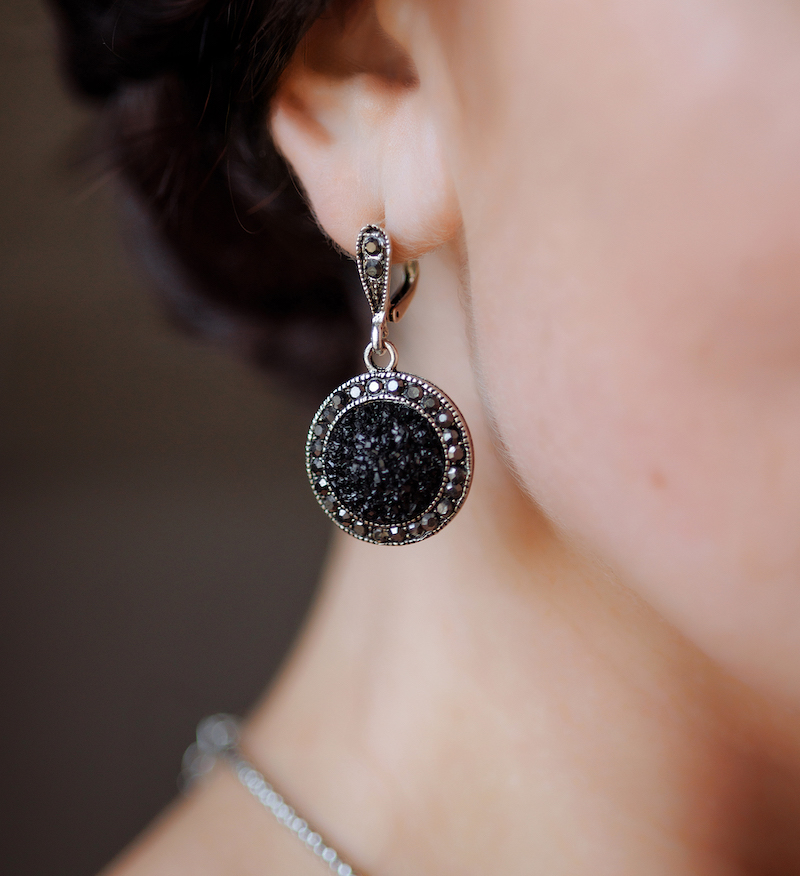
Do you have your clustiau wedi’u tyllu (ears pierced)?
I had mine done ages ago when I was thirteen, but since then they’ve closed up several times when I’ve forgotten to wear clustlysau (earrings). I’ve always managed to force back a twll (hole) in the clusten (lower earlobe) with a clustlws (earring) though… not one of my best habits, I must admit.
clustlws
earring
clustlysau
earrings
Clustlws comes from the simple combination of the words clust (ear) and tlws (trinket, but can also function as an adjective meaning pretty). So it just means ear-trinket!
This etymology is why you’ll also see the spelling clustdlws, retaining but soft-mutating the first letter of tlws. You can use which ever spelling you prefer; it is pronounced the same regardless.
Another very similar word is clustlys, which refers to a type of plant called earwort in English. The two words are easy to get confused because the plural of clustlws looks so similar, but luckily most people don’t need to talk about earwort that often so you can usually assume it’s an earring instead. 😉
Here is how clustlws mutates:
Soft mutation
glustlws
Nasal mutation
nghlustlws
Aspirate mutation
chlustlws
Simple, right? But whether it mutates after y (the) is a bit more of a tricksy question, as some people treat this noun as feminine while others treat it as masculine. This also, of course, affects whether adjectives that are used to describe it mutate. So some people say y glustlws borffor (the purple earring) whereas others go for y clustlws porffor to mean the same thing.
Overall, this confusion benefits learners, as no matter what you say, there’s at least one native Welsh speaker who’s in agreement with you!
Gwisgo clustlysau (wearing earrings) as an addurn (decoration / accessory) is common in many cultures the world over, be they stydiau / styds (studs) or cylchynau (hoops), made of metal (metal), gwydr (glass), or plastig (plastic), worn in the llabed clust (earlobe) or the cogwrn (helix).
Dw i eisiau tyllu fy nghlustiau er mwyn cael gwisgo clustlysau.
I want to pierce my ears so I can wear earrings.
Tyllu is done with a nodwydd (needle), usually by a reputable siop dyllu (piercing shop) – and any ail-dyllu (re-piercing) should be done this way too if you’re more sensible than me. And you’ll be given strict instructions after tyllu to wear only clustlysau arian (silver earrings) for the first few misoedd (months), as well as to golchi (clean / wash) the twll newydd (new piercing) regularly.
Many people also tyllu (pierce) their trwyn (nose), gwefusau (lips), bogail / botwm bol (navel / belly-button), or elsewhere.
Then of course there are other kinds of gemwaith (jewellery), like a mwclis (necklace), a broetsh / tlws (brooch), a breichled (bracelet),a fferled (anklet),or a modrwy (ring).
The last is an interesting one to talk about, because of course in English, one says ear-ring, not ear-trinket. Why don’t the Welsh do the same? In fact, both clustfodrwy and the shortened clustrwy were acceptable translations at one point for earring, but they’ve become so much less common than clustlws over time that they now feel somewhat archaic.
I have to say I think it makes more sense to call it a clustlws rather than a clustfodrwy anyway, since not all clustlysau are shaped like a modrwy. Far from it – I’ve mentioned the styden (stud) variety, but there’s also clustlysau dropyn (drop earrings) and clustlysau hongian (dangle earrings / dangly earrings) to name just a couple. I particularly love the look of jhumki, which are earrings from de Asia (south Asia) shaped like a cloch (bell).
Allwch chi helpu Sioned i chwilio am ei chlustlws?
Can you help Sioned look for her earring?
You can even get clustlysau which don’t require tyllu, using all kinds of ingenious methods. I remember before I was allowed to get mine done wearing clustlysau clipio (clip-on earrings) and clustlysau magnetig (magnetic earrings). Perhaps I’d never have been allowed to get them done at all if my parents had known then how often I’d end up going for DIY ail-dyllu!