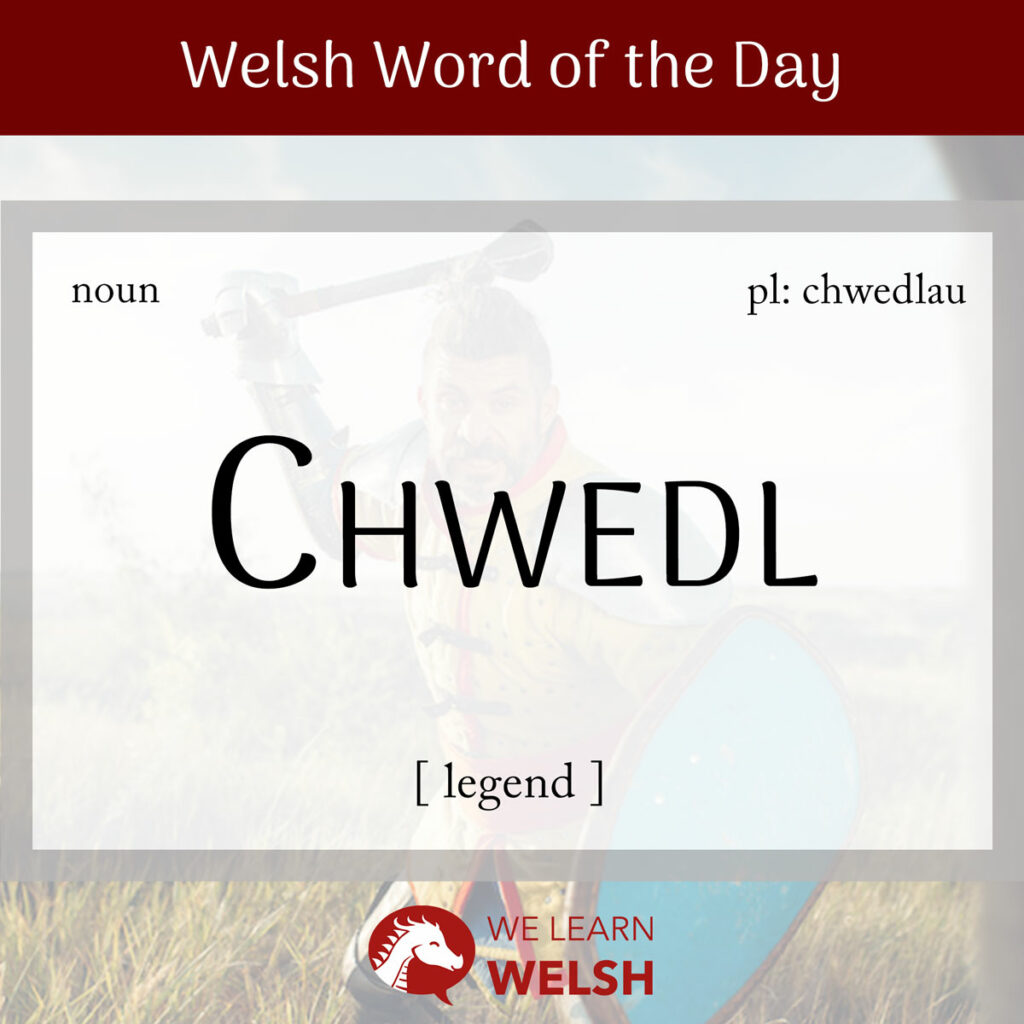
Chwedl is a great Welsh word meaning a legend or a fable. Since Welsh folklore is so rich in amazing chwedlau (legends, fables), I thought it would make a great word of the day for us today.
Chwedl is a feminine noun, and it is pronounced like this:
chwedl
a legend
But there are some variations; for example it is sometimes pronounced with a second syllable, inserting a vowel between the d and the l. Also, in South Wales in particular, you may hear the initial ch being skipped, producing ‘wedl.
This isn’t a mutation – chwedl doesn’t mutate at all – it’s just a peculiarity of South Walian Cymraeg (Welsh) that the ch is often dropped in words beginning chw-. The same happens with chwarae in the common expression ‘ware teg (fair play), or with chwerthin becoming ‘werthin.
The ultimate root of chwedl is a proto-Celtic word that would have been along the lines of *skwetlom and that meant a story. Itself, *skwetlom came from the proto-Indo-European root *sekw– (to say).
Chwedl is not only a noun, but can also work as a kind of preposition, synonymous to yn ôl (according to or so says).
It’s like you’re saying that what you’ve heard is the story of whoever it is that you heard it from. This is particularly common in North Wales, and it tends to be pronounced more like chwadal when used this way. You can also say:
Mi fydd rhaid i ni ganslo’r parti, chwadal Tom.
We’re going to have to cancel the party, according to Tom.
Similarly, there is a verbal form of the word, chwedleua, which means to gossip. You can also use chwedl in a casual way simply to mean a story that is not true – it doesn’t have to be an epic tale.
Chwedl certainly isn’t the only word for a kind of story in Cymraeg. There’s stori itself, obviously borrowed from the English, hanes which means history and is often used in the sense of a specific narrative tale, and even ffabl. The term cyfarwyddyd means a traditional story, especially one that has some kind of moral message.
But chwedl is a great word for talking about llên gwerin (folklore) and mytholeg (mythology). The online dictionary Gweiadur defines it as stori draddodiadol nad ystyrir ei bod yn wir (a traditional story which is not considered to be true). So that covers chwedlau tylwyth teg (fairytales), chwedlau hen wrachod (old wives’ tales), and of course straeon bwganod / straeon ysbrydion (ghost stories).
There is also a generic form of chwedl, which is chwedloniaeth, also roughly translatable as mythology, or perhaps a collective body of legend.
The word has a particular nationalistic feeling to it, hence Gweiadur describing this one as corff o chwedlau a mythau sy’n perthyn i lenyddiaeth a thraddodiadau cenedl (a body of legends and myths that belong to the literature and tradition of a nation).
Both definitions include interesting and relevant vocabulary, some of which you might not have encountered before:
- traddodiadol = traditional
- gwir = true
- corff = a body, literal and metaphorical, as here
- perthyn = to belong
- llenyddiaeth = literature
- cenedl = a nation
Some of them exist in the full sentences in a mutated form because of the grammatical context.
Beth ydy dy hoff chwedl o Gymru?
What is your favourite Welsh legend?
So, what is the corff o chwedlau a mythau sy’n perthyn i lenyddiaeth a thraddodiadau Cymru? In fact, the general body of Welsh mytholeg is often simply called Y Chwedlau (The Legends).
Because Celtic society was predominantly llafar (oral), much of what we know about the mytholeg and crefydd of Celtic Britain and Wales specifically has likely been distorted over time. But there are medieval llawysgrifau (manuscripts) collecting prose texts and barddoniaeth (poetry) written in Middle Welsh, as well as later collections in Latin and in English by outsiders.
Most famous of these are the Mabinogi, also known as Pedair Cainc y Mabinogi (the Four Branches of the Mabinogi), which were compiled out of traddodiad llafar (oral tradition) around the 11th century and survived through llawysgrifau kept in private homes and collections.
They contain tales of heroic journeys through Annwn (the Otherworld), tragic rhyfel (war) between Prydain (Britain) and Iwerddon (Ireland) and reconstruction afterward, dewiniaid (sorcerers) and dewinesau (sorceresses), complex struggles of gwleidyddiaeth (politics) and grym (power), and of course, of cariad (love) and teulu (family).
You can read a literal translation of the Mabinogi into English online here, and see the original Middle Welsh here. There are also copies of editions held in llyfrgelloedd (libraries) throughout Prydain, including several, of course, in Llyfrgell Genedlaethol Cymru (the National Library of Wales) in Aberystwyth.
Y Chwedlau have also had a huge cultural impact beyond Cymru itself. For example, the chwedl of Brenin Arthur (King Arthur), a folk hero central to the medieval British literary tradition, originates in Welsh chwedlau and barddoniaeth.
Though Brenin Arthur was probably not a real historical figure, the stories of him and his court shaped llenyddiaeth (literature) in the Western world permanently: it’s him we have to thank for the iconic, persistent tropes of serch cwrtais (courtly love) and the hero’s ymchwil (quest)… not to mention for Monty Python and the Holy Grail!