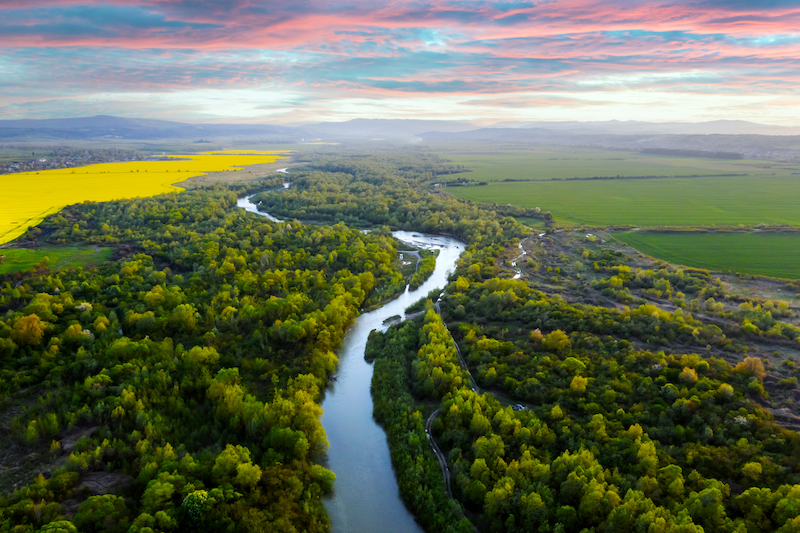
If you’ve been learning Welsh for a while, you may have already encountered our word of the day today, which is afon (river). The plural is afonydd (rivers).
This –ydd is a fairly common plural ending in Welsh; for example, it’s used in chwiorydd (sisters). Many, but not all, nouns that are pluralised with –ydd are feminine. Cyfarfod (a meeting) is an important exception as it becomes cyfarfodydd, but afon follows the pattern and is a feminine noun.
afon
river
afonydd
rivers
Afon becomes hafon after the words eu (their), ein (our), and ei (her), but not after ei (his). This is called h-prosthesis; it’s a bit like a rare kind of mutation. Some people only use h-prosthesis when writing or speaking formally.
If you are in South Wales, you will sometimes hear it pronounced like this:
Afon is an indigenous Celtic word, from the proto-Celtic *abu (river). All the surviving Celtic languages have a word for river related to it – abhainn in Irish and Scots Gaelic, awin in Manx, and avon in Cornish. In modern Breton stêr is much more common but avon and aven do exist, although these are considered archaic.
The word has been adopted outside of the Celtic languages. English and Scots – this is a different language to Scots Gaelic, closely related to English – both borrowed from proto-Brittonic to name their own afonydd, and for this reason Avon is the name of many afonydd in England, Scotland, Canada, and even Australia. There’s even an Ave River in Portugal! Avon also appears in town names including Stratford-upon-Avon, Shakespeare’s birthplace.
You might expect that it has named plenty of afonydd in Wales, too. Traditionally this was actually not the case. For example, the River Severn is simply yr Hafren in Welsh, not yr Afon Hafren.
Over time it has become more common for the word afon itself to be used and there are plenty of afonydd throughout the country with the word in their title, such as Afon Gwy (the Wye River) that traces the border with Lloegr (England), or Afon Wysg (the Usk River), the longest river that is entirely within Cymru (Wales). There’s also Afon Afan (the River Avan) which is notable because its name literally means River River!
Did you notice in the names of Afon Gwy, Afon Afan and Afon Wysg another quirk in the naming conventions of afonydd in Cymru? They don’t include the definite noun y / yr (the), even though their English equivalents do. But there are, as always, exceptions. Afon Menai (the Menai Strait) is sometimes called y Fenai, famous rivers abroad often receive the same treatment, and colloquially the rule may be ignored altogether.
The names of afonydd appear in the place names of trefi (towns) throughout Cymru. Famously, Cymru is filled with trefi called ‘Aber’ – this is always short for a longer name constructed of aber (an estuary) with the name of the particular afon that meets the môr (sea) at that place. For example, Swansea is Abertawe in Welsh, after Afon Tawe (the River Tawe).
Sometimes the tref simply takes the name of the afon without changing it, as in the case of Conwy (Conwy), or is named after some other nearby feature, such as Llangefni (Llangefni, literally church on the river Cefni).
Dim ond ffŵl sy’n defnyddio’i ddwy droed i brofi dyfnder afon.
Only a fool uses both feet to test the river’s depth.
Although afon is best translated as river, it is often used where stream would be used in English. There is also a specific word just for stream, which is nant; very small nentydd (streams) might be called cornant or ceunant but these words are becoming less common.
Nant is still going strong though, and can often be seen in place names. A town near where I grew up is called Nantmel. It would be nice to think that it comes from mel (honey) but it’s actually not related to mel at all, nor to nant as we know it. The first part comes from an older, now less common use of nant meaning valley, and the latter is probably derived from the male name Mael.
Other words for afonydd and nentydd include ffrwd (any flow of water, particularly when fast and strong), and llif (flow or flood). We would also use llif or occasionally ffrwd in most non-literal senses of river, such as llif o waed (a river of blood).
A spring is ffynnon or in South-West Wales traditionally gofer. Lastly, the word afonig is not common anymore, but it literally means small river. The suffix –ig is a diminutive and we also see it in the word tafodig (uvula), built on tafod (tongue).
More afon-related vocabulary includes glan afon / torlan (riverbank), gwely afon (riverbed, a direct calque from English), ystum afon (a bend in the river), basn afon (river basin), and the delightful llamau afon (stepping stones to get across a river or stream, literally river leaps).
Oes well gen ti nofio mewn afon neu lyn?
Do you prefer swimming in a river or a lake?
Afonydd, nentydd and of course the môr all define Cymru – not just physically but also culturally. Take the second verse of our national anthem Hen Wlad Fy Nhadau (Old Land of My Fathers), which praises Cymru’s beauty, saying mor swynol yw si / ei nentydd, afonydd, i fi (so charming is the murmur / of her streams and rivers to me).
They appear constantly in the country’s mytholeg (mythology) too – sometimes as the homes of anghenfilod (monsters). You should steer well clear of a ceffyl (horse) that approaches you when you are tired and hiking at night and offers you a ride, because it is probably the ceffyl dŵr (water horse), a demonic creature similar to the Scottish kelpie, which will drag you to a watery marwolaeth (death) in an afon or rhaeadr (waterfall).
Another anghenfil yr afon (river monster) is rumoured to live in a bottomless trobwll in the Afon Taf (the River Taff). Should you fall into the afon in the wrong place, you’ll be dragged into the trobwll and killed by the sarff. However, you’ll only be eaten if you’re a bad person. The sarff doesn’t like the taste of good people’s flesh so it spits them out.
One must also cross an afon to get from the realm of the living to that of the dead, called Annwfn, sometimes portrayed as a paradwys (paradise) and sometimes as more like uffern (hell). This mirrors similar stories in Greek mytholeg and is also reflected in the idiom croesi’r afon (dying).
Another idiom discusses croesi’r afon in a practical rather than an existential way. Cyrchu dŵr dros afon / cario dŵr dros afon (carrying water over a river) means doing something pointless or unnecessary. It is equivalent to carrying coals to Newcastle in English.
Finally, afonydd are absolutely crucial to the country’s natur (nature)and ecoleg (ecology), often described as the rhedwelïau (arteries) of the land.
Difwyniad (pollution) and excessive artificial management of the afonydd puts them under threat but luckily Cymru is full of people who care deeply about the tir (land) and want to support and restore it through using traditional methods of ffermio (farming), planting coed (trees), and removing invasive species. A lot of this good work is done by and with Cyfoeth Naturiol Cymru (Natural Resources Wales).
Afonydd not only supply dŵr (water) to pobl (people), anifeiliad (animals), planhigion (plants) and the tir. They also consist of important cynefinoedd (habitats) in and of themselves, for creatures from the flashy glas y dorlan (kingfisher, literally blue of the riverbank), to the humble brithyll (trout). Fun fact – in Arfon, brithyllod (trout, plural) are sometimes called literally just pysgon afon (river fish).
My favourite afon-based name for an anifail, though, is march afon / afonfarch (hippopotamus, literally water horse)… sadly you can’t find these in the beautiful afonydd of Cymru.