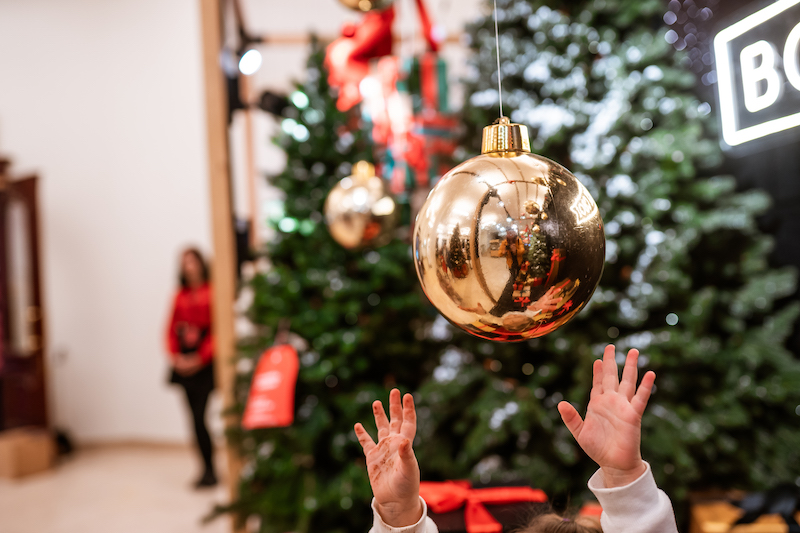
At Nadolig (Christmas) and Pasg (Easter), many people take the time to meticulously addurno (decorate) their cartrefi (homes), gerddi (gardens), and even places of gwaith (work) in accordance with the tymor (season).
addurno
to decorate
You may notice that addurno looks and sounds a little bit like the English word adorn. They are indeed cognates – both Vulgar Latin borrowings that originally stem from the Latin adorno, meaning either to furnish or to decorate.
Addurno is most commonly translated as to decorate, but it can mean, in various contexts, to embellish, to adorn, to decorate, to beautify, and historically even to tidy. Its The words harddu and prydferthu – both of which literally mean to beautify as they come from the adjectives hardd and prydferth meaning beautiful – are the closest thing we have in Welsh to an exact synonym of it.
Ddylen ni addurno’r goeden Nadolig yfory?
Shall we decorate the Christmas tree tomorrow?
But addurno does have plenty of cousins with the Welsh language; of these the most useful are addurniadau (decorations) and addurnol (decorative, ornamental).
A singular decoration is usually called an addurniad, though you may also come across the older form addurn. Both addurniad and addurn are masculine nouns. They are also the most straightforward way to translate ornament, making them even more relevant terms for Nadolig.
Another option for ornament is tlws, a word that’s hard to translate directly into English. As an adjective, it means pretty. As a noun, it can mean anything from jewel, to trinket, to trophy. It’s easiest to understand if you interpret it as referring to basically any pretty thing / precious thing.
One word in this family that isn’t as useful as it seems is addurnwr (one who decorates). This is not the same thing as a professional decorator, as in of tai. This kind of decorating in Welsh is called peintio a phapuro (painting and papering), so someone who does this as their job is a peintiwr a phapurwr (painter and paperer).
Another exception to be aware of is the concept of being decorated with a medal / bathodyn (medal), for example in recognition of gwasanaeth milwrol (military service). In this context, decorate translates to arwisgo.
Dw i am addurno stafell y babi.
I want to decorate the baby’s room.
So how do we use this verb in a sentence? Luckily, it’s quite simple. Like its English equivalent, it is a transitive verb; this means you can follow it up directly with an object, with no need of anything in-between. So addurno crys-T (to decorate a T-shirt) or addurno’r neuadd (decorating the hall).
The only slight complication is that addurno can be h-prosthesised – after ein (our), eu (their), and ei (her). It doesn’t h-prosthesise after ei (his). But this means that if you are talking about addurno something that in Welsh is a feminine noun, depending on the structure of the sentence, you may need to use the form haddurno. For example:
Roedd y dref i gyd wedi’i haddurno gyda goleuadau lliwgar.
The whole town had been decorated with colourful lights.
H-prosthesis is sometimes omitted colloquially.
Addurno something usually means adding lliw (colour), patrymau (patterns), and perhaps some disgleirdeb (brightness, shine, sparkle).
At Nadolig, here are some of the most common addurniadau used to do just that:
- coeden Nadolig = Christmas tree
- celyn = holly
- eiddew / iorwg = ivy
- uchelwydd = mistletoe
- torch Nadolig = Christmas wreath
- goleuadau = lights
- cannwyllau = candles
- clychau = bells
- tinsel = tinsel
- plu eira papur = paper snowflakes
I haven’t included a translation for bauble above because it’s a not such a straight-forward one. The word bauble in English originally meant something worthless – for which there are plenty of translations in Welsh! But none of them are really appropriate to the modern day meaning of a pelen liwgar (colourful ball / sphere) hung on y goeden Nadolig (the Christmas tree).
Personally, I always called them tlysau growing up. Similarly, many people will simply refer to as them addurniadau (decorations), with no further specificity. However, it is also common to just borrow the word bauble from English, perhaps Welsh-ifying it slightly to bawbl. Take your pick of the options!
My family’s coeden Nadolig at home was always very busy-looking and not particularly aesthetically pleasing – covered in old plastic tlysau that were falling apart, and messy addurniadau papur (paper decorations) that my brawd (brother), chwaer (sister) and I had made yn yr ysgol (at school). The mess is what makes it special, though, right? 😊