
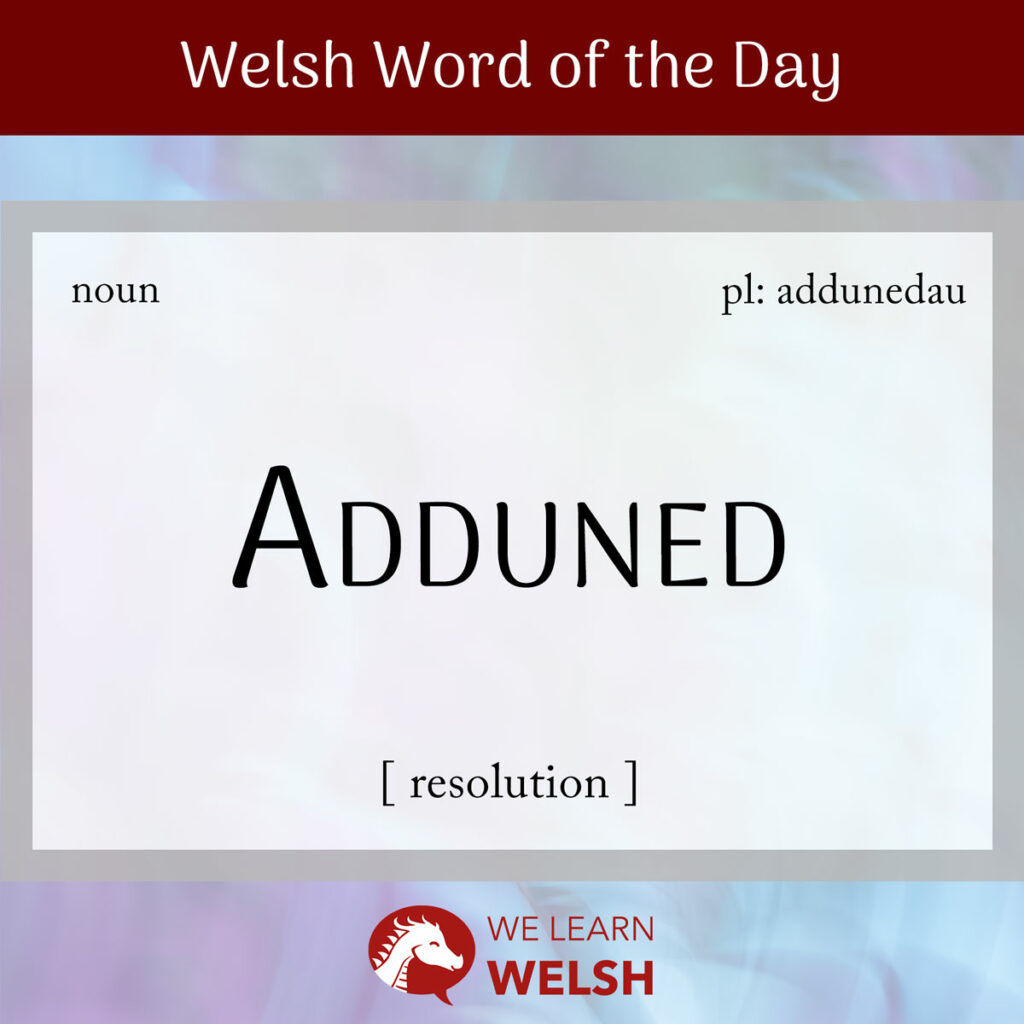
Today’s Welsh word of the day is adduned (plural: addunedau), a feminine noun which means resolution. This word is most commonly used in the phrase adduned Blwyddyn Newydd (New Year’s resolution), but adduned can also mean vow, as in addunedau bedydd (baptismal vows) or addunedau priodas (wedding vows).
adduned
resolution
addunedau
resolutions
The word adduned comes from the verb adduno, which can mean a range of things include to vow, to desire and to implore. This is a rather unusual word to hear, though. People are much more likely to use the word addo (to promise) in the context of addunedau. If you want to talk about a promise as a noun, you should use the word addewid, which generally suggests a less serious commitment than adduned.
Gwnes i adduned i loncian unwaith yr wythnos.
I made a resolution to jog once a week.
Interestingly, some people add a G to the start of addo to form the alternative (and arguable less correct) form gaddo. Can you think of why that might be? I’ll give you a clue: to work this out, you’ll need to understand y treiglad meddal (the soft mutation)!
So what is it? As many of you will already know, the first letter of many Welsh words changes, or mutates, in certain grammatical contexts. The most common type of change is called y treiglad meddal (the soft mutation). Let’s take a look at it in a handy table!
| Original Letter | New Letter |
| p | b |
| t | d |
| c | g |
| b or m | f |
| d | dd |
| g | nothing! |
| ll | l |
| rh | r |
The odd one out in this table is G, which is removed from the start of words without being replaced with another letter. For example, the word golau (light) mutates to olau. Native speakers of Welsh will instinctively recognise which words have had a G dropped from the start. For example, they will see olau, wael, and lân and think of their unmutated forms: golau, gwael and glân.
However, this instinct isn’t infallible – sometimes people will try to un-mutate words that weren’t mutated in the first place! This is what happens with the word addo; some native speakers interpret it as a word with a dropped G, and so they add that G ‘back in’ and say gaddo. The same thing happened to the Welsh word for face, which was originally wyneb but now also has the alternative form gwyneb.
This isn’t the only example of these sort of “phantom mutations”. Something I really love about the Welsh language is that some older loan words from English have been fully integrated into the language through being mistakenly (or creatively!) un-mutated in the same way as addo. Two of my favourite examples of this reinterpretation include potel (bottle) and crand (grand). What happened here was that Welsh speakers assumed bottle was a mutated form of “pottle”, and that grand was a mutated form of “crand”. Check it for yourself! If you go back to the table above, you’ll see that P mutates to B and C mutates to G.
This might all seem a bit abstract, but dwi’n addo (I promise) this is actually a concept that’s very relevant to you as a Welsh learner! Because the first letter of so many Welsh words is variable, you’ll often find yourself wondering whether a word is mutated and, if so, what the original form was. For example, let’s take the Welsh word law. What does law mean in the two sentences below?
Dwi ddim yn hoffi tywydd Cymreig achos mae ‘na ormod o law.
I don’t like Welsh weather because there’s too much …
Roedd hi’n rholio’r bêl o law i law.
She was rolling the ball from … to …
In the first sentence, law is a soft mutation of glaw, meaning rain. In the second sentence, law is a soft mutation of llaw, meaning hand! Words starting with L are the most amwys (ambiguous) in Welsh, because they might just be a word that starts with L originally, but they could also be soft mutated forms of words starting with G or Ll.
Bearing all this in mind, maybe a good adduned Blwyddyn Newydd would be to learn or revise some important mutation rules in Welsh! Personally, I find that if I set a target that is too ambitious, I end up doing nothing at all because it feels too intimidating to start. I do much better when I set a low target that I’m sure I can reach, because then I feel confident enough to make it a habit. In my opinion, cysondeb (consistency) is more important in learning than doing lots of work in individual practice sessions.
Pob lwc (good luck) and Blwyddyn Newydd Dda i chi gyd! (Happy New Year to you all!)