Most people will associate the Welsh word aber primarily with place names. And you’d be quite right to do so – Aberystwyth, Aberdyfi, Abergavenny, they’re all over the place!
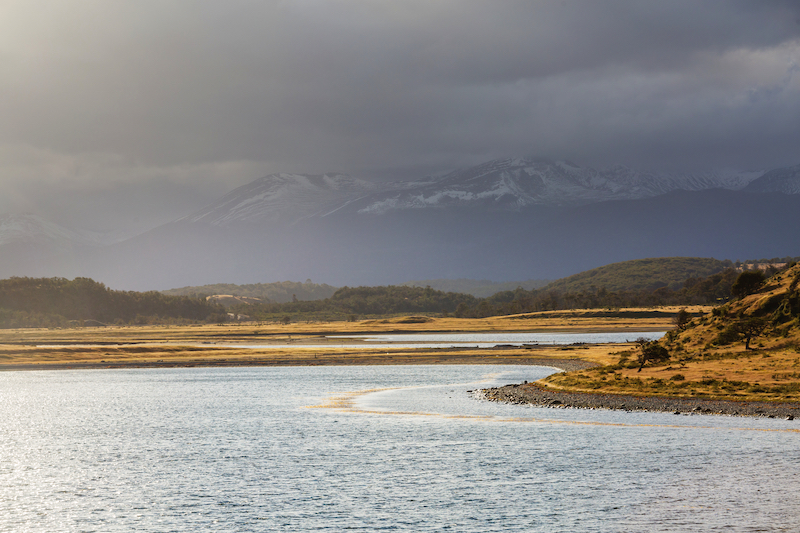
But as with many Welsh place names, these Aber- towns and villages are based on a real word that is still used in everyday conversation. Aber means estuary, a place where an afon (river) meets y môr (the sea) or another corff dŵr mwy (larger body of water).
It is generally treated as a masculine noun with the plural form aberoedd. You could come across the alternative plural form ebyr in an older text.
aber
estuary
aberoedd
estuaries
Plus, you can turn aber into a verb, aberu. This means to flow or to cause to flow. It is almost exclusively used in poetry. Similarly, the noun form may well be used in metaphorical senses in literature, referring to a flow or a stream of something other than dŵr (water).
There are synonyms for aber, though they’re less common. Moryd is one, and, differently to aber, it’s a feminine noun. You can also just say ceg afon or genau afon (river’s mouth). The words cymer and cydlifiad are now the go-tos for the joining of two afonydd (rivers) when they’re not running into the môr.
A delta in geography may be called an aberdir or sometimes an aber trionglog, though just borrowing the English word is common, too.
Mae hi’n ymchwilio i fioamrywiaeth aberoedd ar gyfer ei thraethawd.
She’s researching biodiversity in estuaries for her essay.
Though unless you’re a daearyddwr (geographer), you probably won’t have to use the word estuarial very often. Its Welsh translation is aberol, made by combining aber with the suffix –ol (which is used very often to create adjectives from nouns).
The word aber exists in all the Brittonic languages – Welsh, Cornish, and Breton. From Breton, it was even borrowed into French! It was a common element in a lot of Brittonic words referring to any confluence of waters.
Originally, it evolved from the proto-Celtic *adberos, which means there are similar words in Irish (abar, meaning a patch of boggy ground) and Scottish Gaelic (Obar and Aber, functioning in place names in the same way as Aber in Welsh). You may be thinking of Aberdeen, which is probably the most famous place bearing this prefix in the UK, and it’s not even in Wales!
But of course, even back within Cymru (Wales), there are no shortage of aberoedd that have given their name to the trefoedd (towns) founded on them.
Generally, the prefix Aber– is combined with the name of the afon in question. For example, Aberaeron is named after the small river Aeron which flows into Cardigan Bay.
But this isn’t always the case. There are a few small villages in Cymru called Abernant, which is based not on the name of a specific afon but on the word nant (stream). Another word for stream in Welsh is ffrwd and sure enough, there are a couple of places called Aberffrwd, too.
There are even more Aber- examples when you consider those that are usually known by their English names – consider Abertawe (Swansea), Aberdaugleddau (Milford Haven), Aberteifi (Cardigan), Aberhonddu (Brecon) and Abergwaun (Fishguard).
Many people just say Aber in order to refer to their local example. As you might imagine, this can quickly get confusing!
Dw i’n dod o bentre ger Aberteifi.
I come from a village near Cardigan.
Not all of these actually sit ar lan y môr (on the coast / on the seaside), because of the historic use of aber to also mean any meeting of two afonydd (rivers). Aberdare and Aberhonddu, for example, are both inland.
Outside of yr Alban (Scotland) and Cymru, there are also places with the prefix Aber in Brittany, Cornwall, and even other parts of England’s West coast. Inver, which has the same meaning coming from Gaelic rather than Brittonic, appears in even more place names, across Scotland, Ireland and the Isle of Man.
Though Inver- and Aber- are unlikely to be cognates, they share a meaning and a function, and between them, they cover a lot of Prydain (Britain) and the surrounding ynysoedd (islands). I take it as a welcome reminder of the lasting Celtic heritage of yr Ynysoedd Prydeinig (the British Isles) as a whole, no matter how dominant Saesneg (English) has become.