
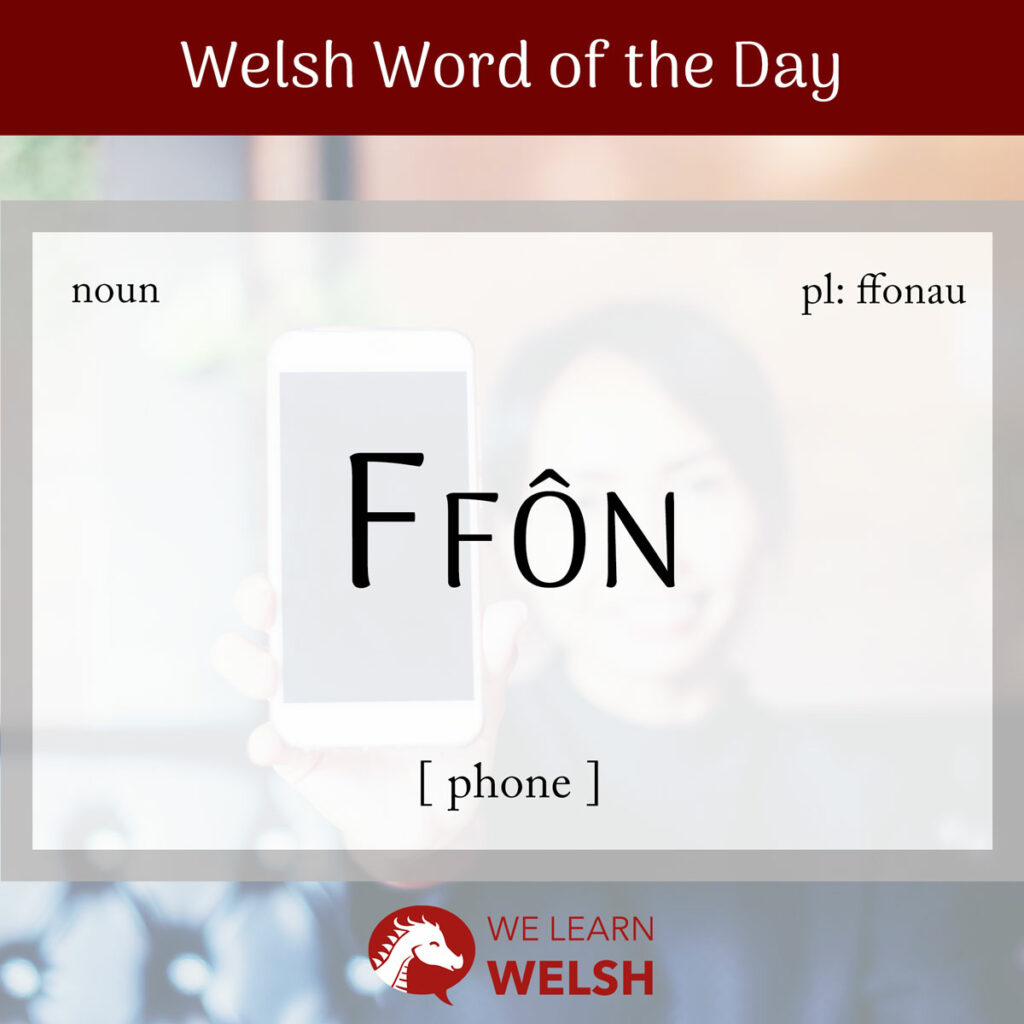
Our word of the day today is the masculine noun ffôn, the most common word you’ll hear in Welsh for a phone or telephone. The plural version is ffonau (phones).
The word can also apply to a phone in linguistics, as in a sain (sound). However, in this article, we’ll be focussing on the physical object used for cyfathrebu (communicating).
ffôn
a phone
ffonau
phones
As you can hear in the first of the two clips above, ffôn is pronounced with a long vowel sound. It’s different to the sound of the vowel in the English phone, from which this word was borrowed in the twentieth century, but it’s also different from the vowel in ffon (a stick).
However, in the plural ffonau, we do actually have a short vowel like in ffon. Luckily we can still tell it apart from ffon because the plural of that is usually ffyn (sticks).
The bottom line is, they’re easy to confuse. When writing this word, remember to include the to bach (little roof) circumflex accent because this is what allows us to differentiate ffôn and ffon.
One thing that’s quite ironic, though, is that with the ubiquity of ffonau symudol (mobile phones) these days, the word ffôn itself is more and more likely to be misspelt as ffon in texts and social media posts, since it’s quicker not to go to the effort of inserting the accent. Luckily, context will usually provide a clue as to whether someone is talking about a phone or a stick!
Sgwrsiais â mam ar y ffôn yn gynharach.
I chatted to mum on the phone earlier.
In English, phone referring to the dyfais (device) we use to keep in cysylltiad (contact) with people comes from the longer word telephone. There is a Welsh borrowing of that, too, which is spelt teliffon or teleffon, but it’s not used very often.
You can use this word just as you would its English equivalent. Useful phrases include:
- mae gen i ffôn symudol = I have a mobile phone
- does gen i ddim ffôn symudol = I don’t have a mobile phone
- mae angen ffôn newydd arna i / dw i angen ffôn newydd = I need a new phone
- mae fy ffôn wedi marw = my phone is dead (out of charge)
- mae camera fy ffôn yn wael = my phone camera is really bad
- dw i wedi colli fy ffôn = I have lost my phone
- ble mae fy ffôn? = where’s my phone?
That last one’s particularly handy if you’re forgetful like my sister – her boyfriend has learnt the phrase ble mae (where is) purely from how often she loses ei ffôn hi (her phone)! But if I’m being completely honest, she would actually say ble mae ffôn fi instead of ble mae fy ffôn. This construction, using ffôn fi instead of fy ffôn for my phone, is very common, especially colloquially and amongst younger speakers.
Cafodd e ffôn newydd fel anrheg Nadolig.
He got a new phone for Christmas.
It’s also important to be able to talk to about charging your phone. There is a native Welsh word for charger, which is gwefrwr, and to charge a phone is gwefru ffôn. However, it’s not as commonly used as you might expect. Instead, many – perhaps most – Welsh speakers will simply ‘borrow’ the English word in this context.
Another English word that’s often used in Welsh to discuss ffonau is landline. The literal translation of this, ffôn llinell dir, is considered acceptable and is used in formal contexts. However, simply saying landlein as a Welsh-ification of landline is normal day-to-day, like in the phrase galwad ar y landlein (a call on the landline). Lein on its own is often used too, despite the fact that we technically do have a Welsh translation, llinell (line).
So we’ve come to the word galwad (call). This gives us yet more relevant terms, like galw (to call) and galwad ffôn (a phone call).
An alternative is caniad, which literally means a singing; you could say for example Mi roddais ganiad i ti (I gave you a ring / I gave you a call). It makes sense because when the phone rings in Welsh we say it is canu (singing).
Then there is the very simple ffonio (to phone), as in ffonia fi heno (phone me tonight / call me tonight) or mae hi isio ffonio fo (she wants to phone him). Personally, I would rarely use phone as a verb in English, favouring call instead, but in Welsh I find ffonio to feel more natural than galw most of the time. Others’ mileage may vary!
What about texting, then? The Welsh word for a text is testun, and technically this is allowed to apply to a neges testun (text message) that you send on your ffôn symudol. However, again, this is a situation where a lot of Welsh speakers prefer to borrow the English word, text, and render it as tecst. This makes sense especially since tecstio is the generally accepted verb for to text. As you can see, the letters cs are being used to represent the English sound x which doesn’t exist as an independent letter in Welsh.
Other things many people do with their ffonau symudol include tynnu lluniau (taking pictures), sending e-bostiadau (emails, often colloquially shortened to e-bosts or e-bostiau), and browsing cyfryngau cymdeithasol (social media). I know I for one spend way more time than I’d like staring at my sgrîn ffôn (phone screen)…
But it’s not all bad. On cyfryngau cymdeithasol in particular, more and more people today are sharing their experiences of learning and / or speaking y Gymraeg (Welsh), so if you’re someone who enjoys scrolling Facebook or Instagram, put that time on your ffôn to good use and follow some pages for dysgwyr (learners) – including ours!
Paid â defnyddio dy ffôn tra dyn ni’n bwyta cinio, os gweli di’n dda.
Don’t go on your phone while we’re having dinner, please.
Before we end, let’s rattle through a few more key terms:
- ffôn clyfar = smartphone
- clustffonau = headphones
- rhif ffôn = phone number
- sgwrs ffôn = phone conversation
- llyfr ffôn = telephone directory / phonebook
- bocs ffôn / ciosg ffôn = phone box
The latter two certainly aren’t something we see much of these days, which is the subject of one lovely, albeit mournful, Welsh-language poem, by the wonderful Iwan Llwyd Williams. You can read and listen to it here.