One of the best things about being bilingual is being able to slip between ieithoedd (languages) to best convey whatever you’re feeling or saying in the moment. There are some words and phrases I pretty much always say in English, no matter who I’m talking to, and some that I always say in Welsh.
A simple expression that all of my English-speaking friends now recognise is dim ots – or sometimes sdim ots, a colloquial shortening of does dim ots. This captures the spirit of sayings like never mind, no worries, no problem, or it doesn’t matter.
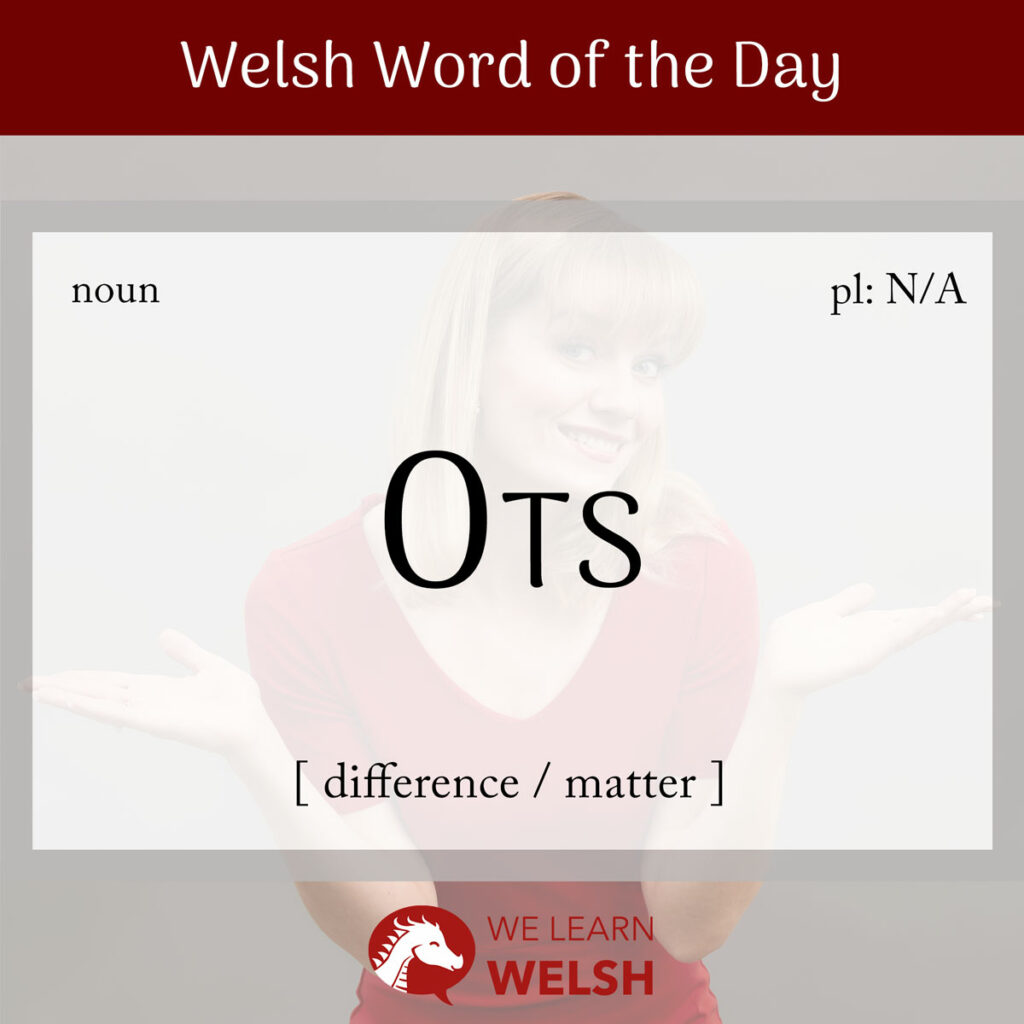
ots
difference / matter
You may notice a difference between the usage of ots throughout Wales. For example, North Walians generally pronounce it more like this:
ots
It’s also common in North Wales to completely omit the dim, and instead add a m to the starts of ots, creating a word that might be spelt motsh and can be used as a shorthand for don’t worry or it doesn’t matter all on its own.
Now, ots has an etymology you might not expect – it was borrowed from the English word odds, as in gambling odds. It was first used in this context in the 1500s, although its most common usage, as described above, is a more recent development. Most people would say ods instead of ots if they were actually talking about literal gambling odds today.
Today it more or less functions as a casual, idiomatic synonym of gwahaniaeth (difference); when you’re saying dim ots you’re saying there is no difference. Isn’t it funny that it’s an English word at its roots but the way it’s used in Welsh is completely original?
There are so many situations where you can say dim ots. I use it most often to express that I don’t mind what decision we make – like if we’re talking about which bwyty (restaurant) to go to – or to reassure someone that a camgymeriad (mistake) they’ve made doesn’t matter.
Sdim ots ‘da fi ble dyn ni’n mynd ar ein gwyliau ond bod hi’n heulog.
I don’t care where we go on holiday so long as it’s sunny.
Another one is if you’ve received news that’s siomedig (disappointing) or unexpected, and you’re consoling yourself; you might say something like a wel, sdim ots rili (oh well, doesn’t matter really).
Now, ots may be very common (and a particular favourite of mine!) but that doesn’t mean it’s the only way to express these sentiments in Welsh.
- nid yw o wahaniaeth = it doesn’t matter (formal)
- beth yw’r ots? / pa ots? = what’s the odds?
- ni waeth gen i ddim = it makes no difference to me
- man a man i fi = it’s all the same to me
- paid â phoeni / paid poeni / paid becso = don’t worry
- tae waeth = no matter
- (ni) waeth befo / hidio befo = it doesn’t matter / never mind
- dim taten o ots / hidio dim taten = it doesn’t matter at all
There is one last use of ots you might encounter, which is the phrase yn ots. This means differently, particularly if something is remarkably different or out of the ordinary. So you could say that someone is yn ots o denau (remarkably thin) or yn ots o glyfar (remarkably clever).
Dw i’n poeni’n fawr. Roedd y babi ‘na’n ots o welw.
I’m really worried. That baby was very pale-looking.
The best thing about learning a new language is discovering all the fun and idiomatic turns of phrase you can incorporate into your conversations that really make you feel like a native speaker! Dim ots is definitely one of these, and I hope you’ll enjoy making use of it.