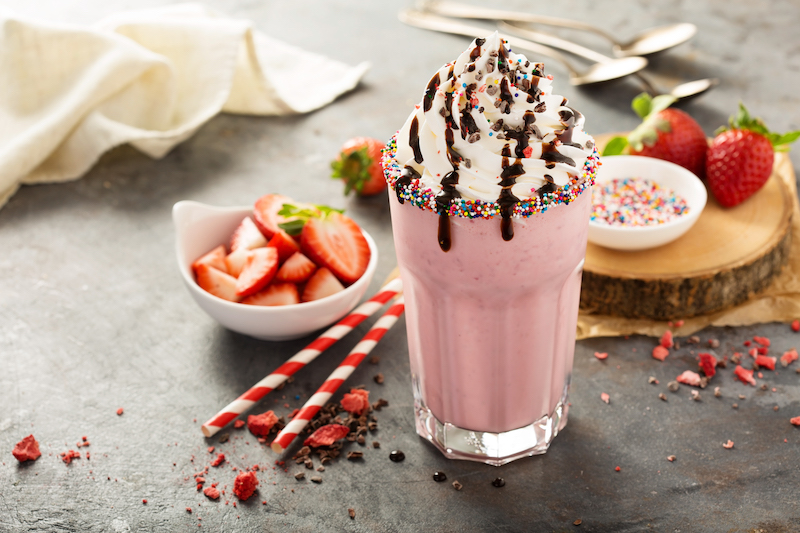
What’s your favourite diod (drink) to order at a caffi (café) or bwyty (restaurant)? There’s not many as danteithiol (delicious / indulgent) as an ysgytlaeth (milkshake).
Multiple milkshakes are ysgytlaethau, though remember that we don’t use the plural when counting nouns in Welsh. So to order two milkshakes for yourself and your date, you’d simply ask Ga i ddau ysgytlaeth, os gwelwch yn dda?
ysgytlaeth
milkshake
ysgytlaethau
milkshakes
Ysgytlaeth, a masculine noun, is a great example of a calque in Welsh.
A calque is the linguistic phenomenon of translating a word from one language into another by literally translating the different parts that make up the word. Like in English, the word rainforest is a copy of the German word Regenwald, literally meaning the same thing. Then Welsh joined in too with the term fforest law.
Similarly, ysgytlaeth is made up of the word ysgytio, a form of ysgwyd (to shake), and llaeth (milk). It’s very often shortened to ‘sgytlaeth, which is a really common pattern with Welsh words beginning with y, especially ys.
In some dictionaries, you may find the term llaeth wedi’i guro as a translation for milkshake. This means milk that’s been beaten. I would personally advise against using this one when making an order with a gweinydd (waiter) – it sounds a bit confusing and long-winded and most people are much more likely to use and recognise (y)sgytlaeth.
Ga i ‘sgytlaeth fanila, os gwelwch yn dda? Cewch, wrth gwrs.
Can I have a vanilla milkshake, please? Yes, you can, of course.
Ysgytlaethau are usually made of a mix of llaeth, hufen iâ (ice cream – another calque!), and some kind of specially flavoured surop (syrup). Popular choices for cyflas (flavour) include mefus (strawberry), siocled (chocolate), banana (banana – watch out for the alternative ffrwchnedd, which is not actually correct), menyn cnai mwnci (peanut butter) or menyn caramel (butterscotch). Then they’re sometimes decorated with ffrwythau (fruit), bisgedi (biscuits), sweet sawsiau (sauces), or extra hufen iâ on the top.
They were originally invented in yr Unol Daleithiau (the USA) and are associated with plentyndod (childhood) and diniweidrwydd (innocence). I always associate them with the image of those stereotypical American tai bwyta (diners), the kind of place where you could also get sglodion tenau (French fries) or a slice of tarten ffrwythau (fruit pie).
Despite the name, it’s possible to make ysgytlaethau with a plant-based llaeth. My sister is a fegan (vegan), and I’ve never seen her happier than at a caffi where they serve ysgytlaethau soia (soya milkshakes)!
I love ysgytlaethau too. I feel like they blend the refreshing taste of a smŵddi (smoothie) with the comfort of siocled poeth (hot chocolate) and the sweetness of hufen iâ.
Siocled poeth is another good example of a calque. Smŵddi isn’t – it’s just a direct borrowing from the English – but there is another word for smoothie sometimes used in Welsh which is smwythyn. It doesn’t look like a calque because it’s just one word, but it comes from combining the word esmwyth (smooth) with the diminutive –yn, which functions similarly to –ie. Clever, right?
Dw i’n bwriadu dysgu ‘neud ysgytlaethau gartref.
I mean to learn to make milkshakes at home.
Smŵddis / smwythynnau are probably the most similar drink to an ysgytlaeth. They are both trwchus (thick), oer (cold), cymysg (blended), and often include cynhwysion (ingredients) like ffrwythau and iâ (ice).
The main difference is that ysgytlaethau are more reliant on cynnyrch llaeth (dairy), although some people do put iogwrt (yoghurt) in smŵddis. Many people drink smŵddis because they’re seen as iach (healthy), whereas an ysgytlaeth is perceived as more of a treat or pwdin (pudding / dessert).
This BBC Bitesize video aimed at high school students learning second-language Welsh is set at a stondin smŵddi (smoothie stand), and incorporates some good vocabulary as customers order a variety of smŵddis with ingredients like mefus, bananas, mafon (raspberries), afalau (apples), and llysiau (vegetables).
Do you prefer ysgytlaethau or smŵddis? Let us know and see if you can answer in a full sentence! You can use phrases like hoff ddiod (favourite drink), dwlu ar (to dote on / to love), and mae’n well gen i (I prefer).