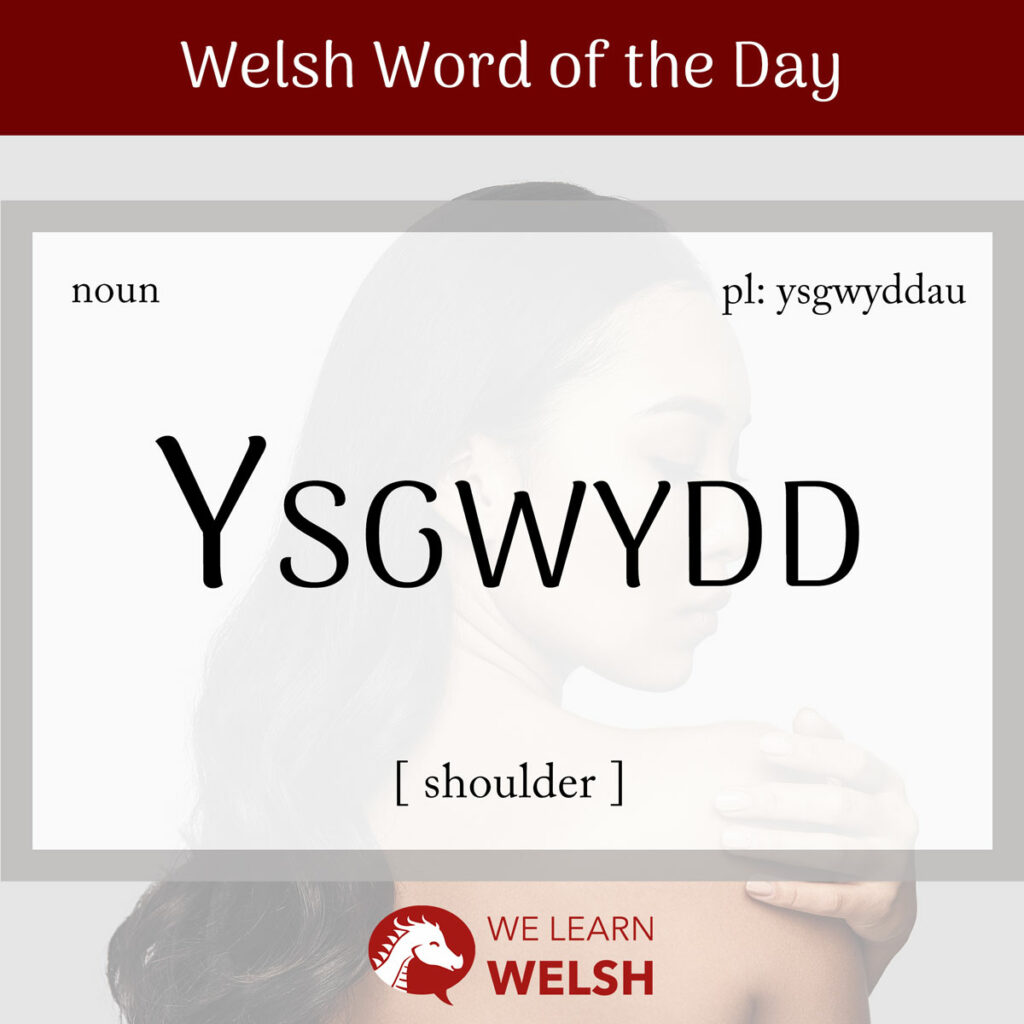
Struggling to memorise the parts of the corff (body) in Welsh? Never fear – today’s Welsh word of the day is ysgwydd, which means shoulder. The word for shoulders is ysgwyddau.
ysgwydd
shoulder
ysgwyddau
shoulders
Ysgwydd comes from the proto-Celtic *skeida, which also means shoulder. It’s been a very influential root in both the Brittonic and Goidelic branches of the Celtic language family tree. Shoulder is skoaz in Breton and skoodh in Cornish. And it’s also survived in the words for wing used in Scottish Gaelic, Irish Gaelic, and Manx, which are sgiath, sciathán, and skian respectively.
Now, the pronunciation I’ve given above is, overall, the most common. However, a decent proportion of speakers from South Wales actually say it like this:
So if you hear that and do a double take, remember it’s not a mispronunciation, just an accent!
Ysgwydd is a feminine noun, so remember that adjectives that follow it have to soft mutate. However, this doesn’t apply in the plural, like if we’re talking about someone’s shoulders. If someone has a broad shoulder, we say ysgwydd lydan with a mutation, but if they have broad shoulders, that’s plain old ysgwyddau llydan. The adjective broad-shouldered also works as a compound word – ysgwyddlydan.
Another relevant factor here is h-prosthesis. That’s when you add the letter h before a word that starts with a vowel. It happens after ei (his / her) when used to mean her, eu (their), and ein (our). This means that her shoulders are in formal language ei hysgwyddau, though in colloquial Welsh h-prosthesis is generally treated as if optional.
Cododd ei hysgwyddau ac ochneidiodd.
She shrugged her shoulders and sighed.
The ysgwyddau are part of an intricate system of cyhyrau (muscles) and esgyrn (bones), so let’s go over some useful words relating to this area of the corff:
- uwchelin / hwmerws = upper arm-bone
- pont yr ysgwydd / claficl = collarbone
- palfais / padell yr ysgwydd = shoulder-blade
- braich = arm
- aelod uchaf = upper limb
- gwddf = neck / throat
- cefn = back
- bachell ysgwydd = upper back, between the palfeisiau (shoulder-blades)
- gwar = another word for shoulders / upper back
The back and the shoulders are often used in Welsh to denote nerth (physical strength / power). Someone cefnog is brave and strong. Someone ysgwyddog is broad-shouldered, but with particular connotations of strength. And doing something with nerth eich braich a’ch ysgwydd (the strength of your arm and shoulder) means you really put your all into it.
That seems fair enough when you consider all the different things we can do with our ysgwyddau.
We can codi (lift) things, dawnsio (dance) and ymestyn (stretch) our breichiau (arms). We use them to express that we don’t gwybod (know) something by codi ysgwyddau (shrugging, literally lifting shoulders). We can also use them to ysgwyddo (shoulder) a weight, be it physical or emotional.
In fact, the ysgwyddau are some of the most symudol (mobile) of all the cymalau (joints) in the corff (body). However, this also unfortunately means they are also very prone to dislocating, which is called tynnu ysgwydd o’i le (pulling a shoulder from its place). Each of the ysgwydd’s three esgyrn can also experience toriad (fracture), or a tendon / gewyn (tendon) called the llawes troëdydd (rotator cuff) can tear, causing significant poen (pain). Niweidiau ysgwydd (shoulder injuries) are very common!
Rhaid i chi ymestyn eich breichiau a’ch ysgwyddau cyn codi pwysau.
You need to stretch your arms and shoulders before doing weight-lifting.
If you are talking about a shoulder of cig (meat), you may describe it a little differently. It’s not that ysgwydd isn’t used to talk about cig – it is – but just that there are more options too. Ysbawd was historically preferred but is becoming less common.
In the South, many people say palfais in this context. Another option is pen ysgwydd (top shoulder) – and actually we use this too to talk about our own ysgwyddau, as in the saying codi pen dy ysgwyddau (lift the top of your shoulders), which is a bit like chin up and encourages someone to show bravery, confidence, or pride.
People eat ysgwyddau of various cigoedd (meats) including cig oen (lamb), cig dafad / cig mollt (mutton), and cig eidion (beef). In order to talk about a shoulder of one of these cigoedd, just replace cig with ysgwydd, ysbawd, or palfais.
In driving, a hard shoulder is an ysgwydd galed or a llain galed. A soft shoulder is likewise an ysgwydd feddal or a llain feddal.
Caeth y fargen ei chytuno dan ysgwydd.
The deal was agreed upon in an underhand (lit: under shoulder) way.
There are a couple of interesting Welsh idioms regarding ysgwyddau. One I am fond of is cynnig dros ysgwydd (to offer over the shoulder), which means someone is offering something, but in a half-hearted or insincere way. Similarly, a gair dros ysgwydd (word over the shoulder) is one that shouldn’t be trusted.
Another with a similar structure but that is more literal is someone having llygaid dros ysgwydd (an eye over the shoulder), meaning they are watching out for something.
But many English idioms about ysgwyddau unfortunately don’t work in Welsh. Take having a good head on one’s shoulders; in Welsh we just say something is galluog / clyfar (clever) or, if we’re feeling fancy, hirben (long-headed). We don’t talk about people rubbing shoulders with the wealthy or famous but just say they’re cymysgu (mixing) – another good one especially if someone is being a bit of a suck up is hobnobio!
And nobody gives anyone the cold shoulder, they just anwybyddu (ignore) them.
Still, the English langauge’s influence is persistent, and some English sayings have been adopted into Welsh more recently. An example would be having a chip on one’s shoulder, which has now become cael tsip ar eich ysgwydd, or standing shoulder to shoulder, which has been borrowed into ysgwydd wrth ysgwydd, replacing the older form ochr yn ochr (side in side).
If you’ve got childhood nostalgia about the nursery song Head, Shoulders, Knees and Toes, I’ll finish off with a piece of good news for you – we sing that in Welsh too, and to the exact same tune!
If you have young kids to entertain, or they’re learning Welsh alongside you, here’s a fun animation of Pen Ysgwyddau Coesau Traed. Enjoy! 😉