Now, I’ll be the first to argue that the joke that ‘Welsh has no vowels’ isn’t really true, but occasionally a word comes up where even I have to admit that an extra vowel or too wouldn’t go amiss.
Abl (able or able-bodied) is one such word, which is probably why many speakers, especially in the South, write and pronounce it abal instead.
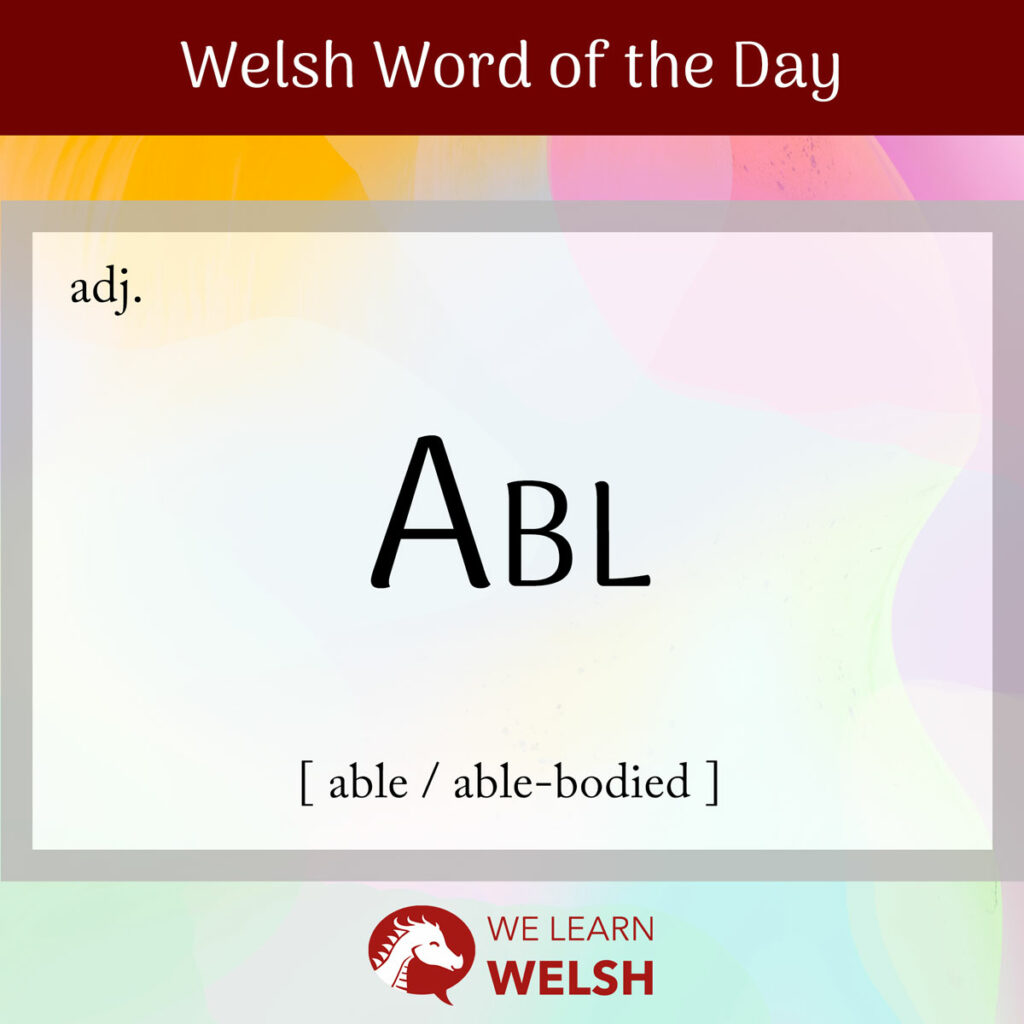
abl
able / able-bodied
It’s unclear whether abl was borrowed from Middle English or from Old French. Either way, its parent was the word habile, meaning, yes, able, which in turn evolved from the Latin habilis (able, especially being able to possess something).
You’d be wrong to use abl identically to the English able. For one thing, we wouldn’t ask wyt ti’n abl… as in are you able… when seeing if someone is able to do something. Apart from that, though, the usage is actually more expansive than the English. It can mean simply able as in capable – someone is an able, skilled, and / or clever person – it can mean able-bodied, it can mean physically strong, and sometimes it can even mean rich!
Historically, it was also sometimes utilised to mean suitable, but this is now archaic.
I’ll give the perpetual disclaimer here that all of this is dialectical. For example, North Walians are more likely than their counterparts in South, West and mid-Wales to use abl to refer to physical strength. But don’t worry too much about this, as you will usually be able to tell what someone means by abl from context, and so will they you.
Abl does not need to be altered for the gender or for the number of the noun it describes. As able is abled, abler is ablach, and ablest is ablaf.
Normally in Welsh, the full phrase as … as would be expressed as cyn …(ed) â or mor … â. However, there’s a little bit of variance with abl. In some parts of mid-Wales it is normal to say mor abled â, merging the two default phrases.
Another variant on this word is abledd (ability). Abledd is generally eschewed in favour of medru or gallu (verbs that mean to be able to) when you’re just talking about someone’s ability or power to do a specific thing.
But it’s still an important term, because it’s the basis for, and antonym to, anabledd (disability). And the word for disabled as an adjective is just anabl.
Teulu abl ydyn nhw; twrnai yw’r fam a meddyg yw’r tad.
They’re a well-off family; the mother is an attorney and the father is a doctor.
Though none of these words mutate since they start with a vowel, they are technically subject to h-prosthesis. This is when a h is added to the start of a Welsh word, and it happens after ein (our), eu (their), and ei (her). Ei also means his, but it doesn’t cause h-prosthesis in this context.
H-prosthesis isn’t the first thing on most learner’s radar, because it’s treated as optional in the colloquial language. I mention it for abledd and anabledd specifically because they are words that often come up in formal language, like government reports and news stories. So it’s useful to know that the phrases ei hanabledd (her disability) or eu hanableddau (their disabilities) will be rendered a little differently to the base form of the word.
Here are some more useful words and phrases related to anabledd:
- anableddau dysgu = learning difficulties
- anableddau corfforol / anfanteision corfforol = physical disabilities
- clefydau cronig = chronic illnesses
- pobl anabl = disabled people
- hygyrch = accessible
- addasiadau rhesymol = reasonable adjustments
- technoleg gynorthwyol = assistive technology
- gofal iechyd = healthcare
- anallu = disability in a more general / abstract sense
Did you know that there are more pobl anabl in Cymru (Wales) as a proportion of the population than in England, Scotland or Northern Ireland? In general, in the UK there is a lot more we can and should do to facilitate hygyrchedd (accessibility) and access to gofal iechyd with anableddau (disabilities) in mind.
As I mentioned, though, abl isn’t just used as an antonym to anabl. It’s a bit broader than that, because of the ways it’s used dialectically to refer to different kinds of gallu / abledd (ability).
Mae hi’n gallu gwneud y gwaith ei hunain. Mae hi’n ddigon abl.
She can do the work herself. She’s plenty capable.
That doesn’t mean abl is the only or even the best option in those various scenarios though. If you’re talking about someone’s general ability, particularly in the case of cleverness, you could also describe them as galluog, deheuig or medrus (competent, skilful).
If you’re referring to their physical cryfder – and remember this usage is most common in North Wales – alternatives are cryf (strong) itself and nerthol (strong, powerful).
If you’re describing someone as able-bodied, as in not anabl, I’d say abl is probably your best bet.
Cyfoeth (wealth) is one usage that is sadly beginning to fall out of fashion. I’m definitely behind reviving it, but most people will go for the simple word cyfoethog (rich) instead. Ariannog, which literally means money–ish, is another option. Even stranger is cefnog, literally meaning back-ish!
I hope I’ve managed to convey the fact that abl is actually a much more complex word in Welsh than it is in English. Remember that it’s used much more as an adjective than able is in English. You can read our article on the word gallu to learn more about translating the phrase to be able to.