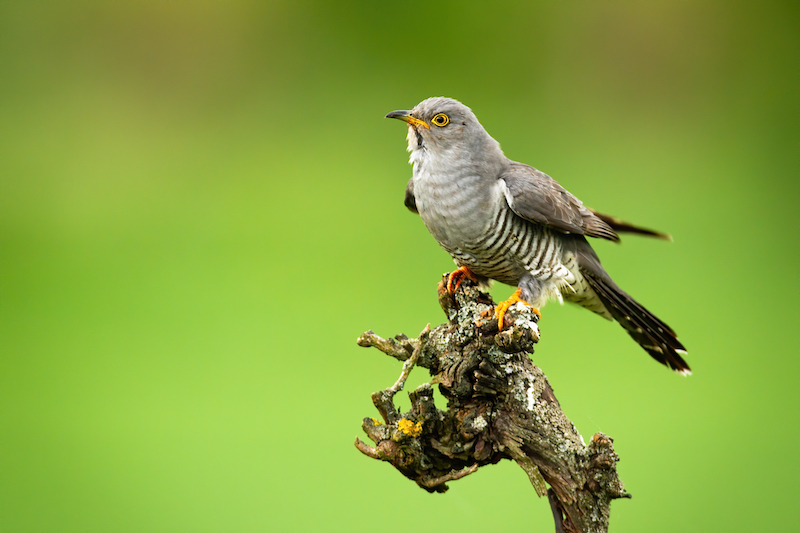
There are several Welsh words for the famous cuckoo; today we’ll talk about what is probably the most standard, as well as certainly the most recognisable to English speakers. That’s cwcw, plural cwcŵod (cuckoos).
cwcw
cuckoo
cwcŵod
cuckoos
Cwcw does come directly from cuckoo, which is itself a loan word from French. Further back it’s unsure whether or not it’s based on the Latin *cuculus – but either way, similar words have arisen for this aderyn (bird) in many languages, and it’s quite likely that this is onomatopëig (onomatopoeic), mimicking the call of the aderyn itself.
Most of the synonyms for cwcw in Welsh are very similar to the word itself, like cog, cwcan, cwgan, and cegid fechan. So it seems likely they’re all from the same root.
Things get even more confusing because cwcw is a feminine noun. This means it mutates after the definite article, becoming y gwcw (the cuckoo).
Soft mutation
gwcw
Nasal mutation
nghwcw
Aspirate mutation
chwcw
And for one reason or another cwcŵod are almost always given the honour, in Welsh, of being called y gwcw (the cuckoo) rather than just cwcw (a cuckoo). So a phrase in English using the words a cuckoo would by many native Welsh speakers be transformed in Welsh to actually use y gwcw (the cuckoo) instead.
This is the case to the extent that the mutated version of all these words – gwcw, gog, gwgan etc – have become broadly interchangeable with the basic forms and are almost treated as synonyms in their own right.
And on top of all that there are words for the various different kinds of adar in the greater cwcw family around the world:
- cwcw cyffredin / cog cyffredin = common cuckoo
- cöel = Asian koel
- coa glas = blue Madagascar coucal
- rhedwr = road-runner
- ani llyfnbig = smooth-billed ani
- malkoha = malkoha
Today, cwcw / gwcw and cog / gog are the most commonly found terms for the cwcw cyffredin as found in the UK. Cwgan / gwgan mainly turns up in place names.
Y gwcw is standard and more common in the South. Y gog is generally encountered Northward, which is funny since Gog is also a playful word for a North Walian.
In the North-West of Wales – Anglesey and the Llŷn Peninsula – it was historically specified in the name that y gwcw is llwydlas (grey / grey-blue). This lovely folk song, recovered and performed here by Gwynedd-born harpist Gwenan Gibbard, is an example of that.
Though it’s actually not from North Wales… it was found all the way over in Patagonia!
Another song about cwcŵod that I remember singing in primary school is simply called Y Gwcw. Its chorus is made up of nonsense words that play on the onomatopoeic sound of the word cwcw.
It’s a very nostalgic one for me; I can still remember the clapping game we used to play along to it.
Clywais y gwcw‘n canu yn yr ardd.
I heard a cuckoo singing in the garden.
There is one synonym that is slightly different to the others and has a different etymology. This is cethlydd, sometimes rendered cethlyd. Unlike the others it is not necessarily feminine, and is treated as both masculine and feminine across various writings that it’s been found in.
It means singer and chirper and is also used for some other kinds of adar (birds). I think it’s a sweet word – I’d love to hear if anyone’s using it in their part of Wales today.
Remaining on the subject of cân (song), the verb to cuckoo is canu cwcŵ (literally, to sing cuckoo).
But it’s not all positive associations with cwcŵod in Welsh. Though the Welsh language eschews the use of cuckoo as an adjective to mean crazy or stupid, we do have the idiom canu cywydd y gwcw (to sing the cuckoo’s song), which means to go on and on incessantly about the same subject. It uses the perhaps unfamiliar word cywydd, referring to a specific kind of traditional Welsh poetic verse.
Plus, the fact that some breeds of cwcŵod lay their wyau (eggs) in the nyth (nest) of another aderyn hasn’t gone unnoticed.
Mae cywion y gwcw yn fawr ac yn gryf.
Cuckoo chicks are big and strong.
The word cuckold in English means a gŵr (husband or man) whose gwraig (wife or woman) is anffyddlon (unfaithful), and especially who raises a plentyn (child) born out of that anffyddlondeb (infidelity). Sometimes it gets shortened to cuck, and in that sense, used as an insult, it’s had a bit of a renaissance of usage in the last ten years or so.
Though it’s old-fashioned, most people are aware of its meaning, if only from older books and plays. If you’re into your etymology you might have even known that it comes from the word cuckoo, and is based on the adar (birds) who unknowingly raise cyw cog yn y nyth (a cuckoo chick in the nest).
But did you know that the word works in the exact same way in Welsh, too? Cuckold is cwcwallt, derived directly from cwcw, and to cuckold is cwcwalltio.
It’s not exactly a word that most people need to use on a daily basis, but it’s quite a fun one to be aware of!