Coginio (cooking) is supposed to be about getting everything just right – not too much or too little of anything, be it halen (salt), pupur (pepper) or tsili (chilli).
When it comes to garlleg (garlic), though, I just can’t bring myself to take that advice. Any pryd o fwyd (meal), in my opinion, is improved by the addition of as much garlleg as humanly possible! You do have to be careful, though, to check after eating too much of it that you haven’t developed gwynt drwg ar eich anadl (bad breath, literally a bad wind on your breath).
garlleg
garlic
Garlleg is a collective noun, meaning that it’s technically a plural even though it’s the default form of the word. A singular bulb of garlic is a garllegen / garllegyn, but you will also hear people just use garlleg for the singular too, or spell out the whole thing: bwlb o garlleg (a bulb of garlic).
Wait a second – why didn’t garlleg mutate to arlleg in that last sentence? Normally, prepositions like o (of) cause a soft mutation.
Well, it would have been fine to use a mutation here and say bỳlb o arlleg, but it’s also fine not to. Garlleg is a loan word, borrowed from the Middle English garlec. It’s quite common for native Welsh speakers to skip mutations for loan words, but usually only very recent ones. However, with older loan words, interestingly, the soft mutation is more likely to be skipped when the word begins with g. So you might hear some speakers omit it here.
Here’s the word’s full mutation pattern for reference regardless:
Soft mutation
arlleg
Nasal mutation
ngarlleg
Aspirate mutation
N/A
So garlleg comes from Middle English, first recorded in written Welsh in the 14th century. The planhigyn (plant) itself has been growing in the UK for a lot longer than that, so what did Welsh people call it beforehand?
As is common with names for planhigion (plants) in mostly oral languages, there were multiple terms, with usage varying throughout the country. Some of them may still be used in dialect today, especially in small communities and by older people. Many have been lost to time, but we do know of craf / craf y gerddi (garden garlic), which is still quite common, craf y geifr (goat’s garlic), and winwns gwyllt (wild onions), among others.
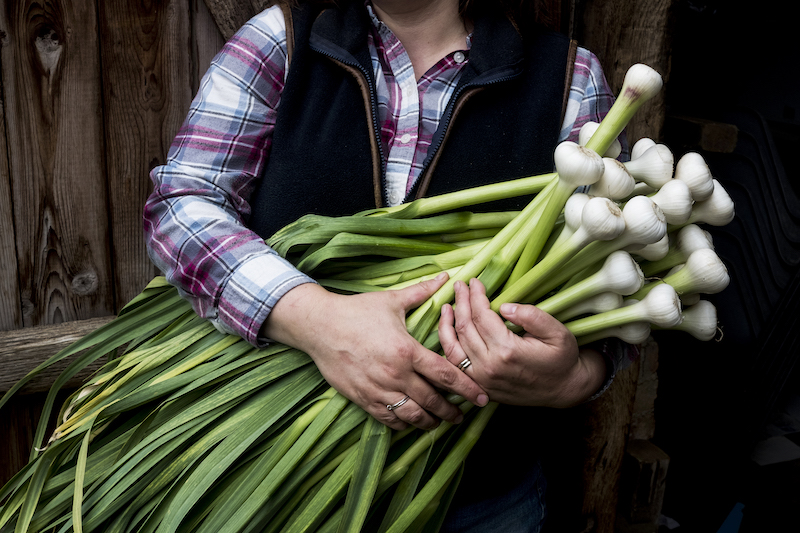
Garlleg is a plant in the winwns (onion) family, like cennin syfi (chives), sibols (shallots), and of course Wales’ very own cennin (leeks). It grows from a bwlb (bulb) into a tall coes (stem, also leg) which produces dail (leaves) and pink and purple blodau (flowers).
Mae’r reis yn dda, ond mae angen ychydig mwy o arlleg ar y stiw.
The rice is nice, but the stew needs a little more garlic.
But it is the bwlb itself that is used in cooking. It is split into its ewinedd (here cloves, but also nails or claws), which you can then torri (chop), gwasgu (press / crush) or gratu (grate) and add to your meal to produce that delicious blas garllegaidd (garlicky taste). It’s used to season cig (meat), to add flavour to cawl (soup) or cyri(curry), in cawsiau (cheeses) like Boursin, and of course for beloved bara garlleg (garlic bread).
Not only is it blasus iawn (very tasty), it’s good for you too. It’s been used in traditional meddygaeth (medicine) for centuries, and for good reason – it boosts the system imiwnedd (immune system), lowers pwysedd gwaed (blood pressure) and cholesterol, and may even prevent dementia. Not to mention warding off fampirod (vampires)…