
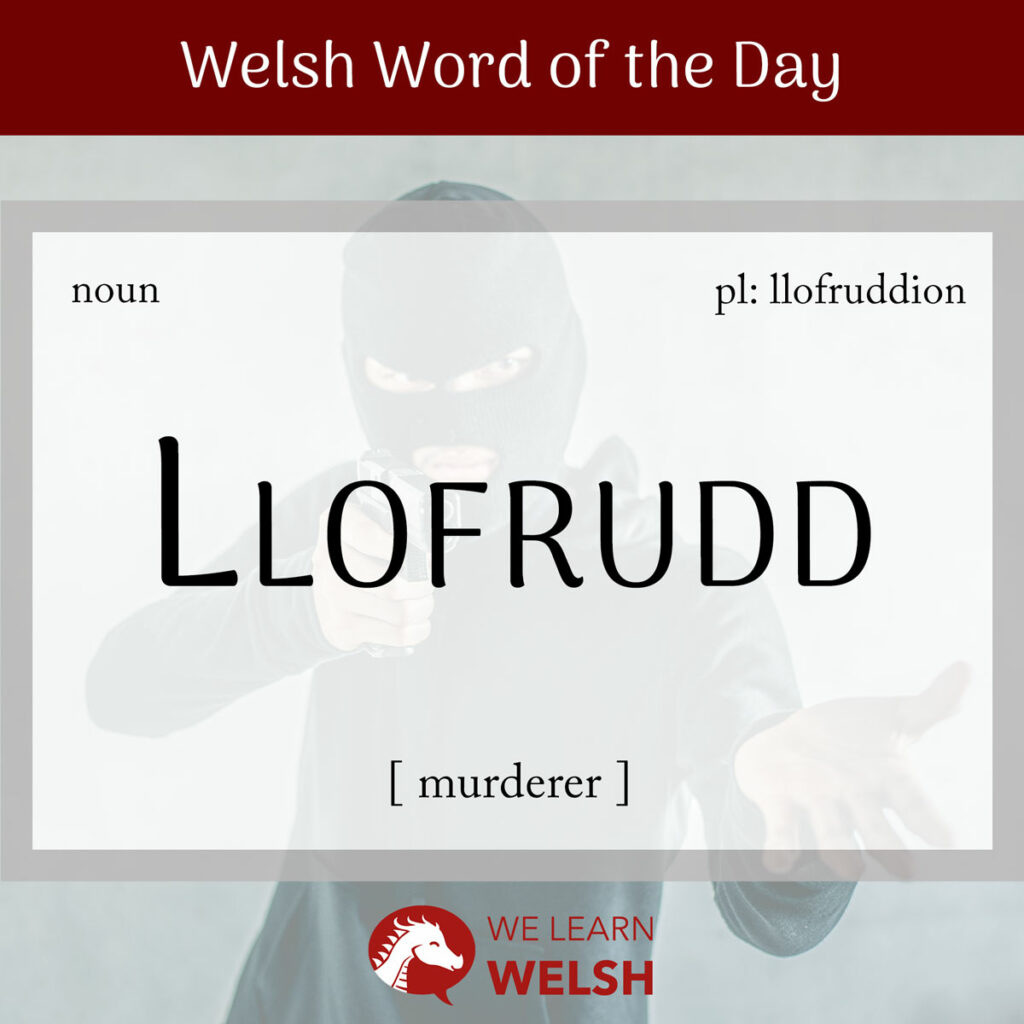
Our Welsh word of the day today may not be particularly pleasant, but it’s useful to know as it’s often found in the newyddion (news), in llyfrau (books), and on teledu (television). Llofrudd means murderer or sometimes assassin.
The plural of llofrudd is usually llofruddion. Occasionally in older literature you may see llofruddwyr or llofruddiaid instead.
llofrudd
murderer
llofruddion
murderers
Llofrudd has quite a vivid etymology, as it literally means red-handed. The first part, llof, comes from the Old Welsh lau, the same as the modern word llaw (hand). The latter part is a soft mutation of rhudd, an old-fashioned and literary way of saying red or crimson. There is another, archaic, version of the word where the root is more obvious, llawrudd.
Other related terms are llofruddiaeth (murder) and llofruddio (to murder). As you can see the linguistic family is opposite to English; llofrudd, the person who commits the act is the root and the other words derive from it, unlike murder as the root in English, which refers to the act itself.
Because of this, a common mistake Welsh learners make is to say llofrudd for murder and llofruddwr for murderer – this misinterpretation is something to watch out for!
Though this is a masculine noun, it also has a feminine form, which is llofruddes (murderess). This is quite normal for Welsh words; think athro and athrawes for teacher.
Soft mutation
lofrudd
Nasal mutation
N/A
Aspirate mutation
N/A
In a way, the construction of this word makes it seem quite old-fashioned and literary, but it doesn’t sound this way when used in a conversation. Although many similar words have fallen by the wayside, this one is still commonly used.
But that doesn’t mean that there aren’t other options too. Mwrdrwr is heard colloquially – this is obviously borrowed from the English murderer.
There is also lleiddiad, which is a synonym of llofrudd, but much less common. It comes from lladd (to kill) and is also the word for an orca / killer whale.
Then you have more generic words, like lladdwr (killer). The form lladdwr celain, with celain meaning dead body, used to be employed to indicate reference to murder specifically, but it is getting very old-fashioned.
Finally, even more broadly, there is troseddwr (criminal). Like its English equivalent, troseddwr doesn’t have to refer to someone who has engaged in trais (violence) or hurt anyone. It just means that someone has broken the cyfraith (law) by committing a trosedd (crime).
So what is the difference between lladd and llofruddio? Legally, it’s a big difference, and clearly defined. Llofruddio is a specific kind of lladd which is bwriadol (intentional) and anghyfreithlon (illegal).
But the distinction can be more blurry in terms of words than it is in terms of the law. Some phrases which use murder in English would actually use lladd in Welsh, or just mwrdwr, perhaps because llofrudd or llofruddio sounds even more serious and extreme than their translations do. For example:
- gweiddi mwrdwr = to cry blue murder
- mwrdro cân = to murder a song
- mi’i ladda i o! / fe’i ladda i e! = I’ll murder him! (jocular)
To bring llofrudd or llofruddio into any of these expressions would cause them to lose their joking, unserious tone. But in more serious contexts these are the words that would be appropriate – as in ymgais i lofruddio (attempted murder).
Darganfododd pobl y pentref bod Tom yn llofrudd.
The people of the village discovered that Tom was a murderer.
Notice that in the example above, llofrudd hasn’t mutated to lofrudd, even though it’s following yn. This is because although nouns and adjectives do mutate after yn, this is only what’s called the ‘limited soft mutation’, so it doesn’t affect words beginning with rh or ll.
Another word related to llofrudd is hunanlofruddiaeth. This literally means self-murder, and it refers to suicide. However, in modern Welsh, the form hunanladdiaeth (self-killing) is considered more sensitive.
But for some reason even hunanladdiaeth is not as commonly used as it is in English: the language often finds ways to ‘get around it’, especially outside of formal contexts.
An interesting example of this is the film Y Llyfrgell, an excellent Welsh-language thriller set in the National Library in Aberystwyth. The film’s title in English is The Library Suicides, but the word isn’t used in the Welsh form. But the title of the llyfr the book is adapted from is different again – it’s called Y Llyfrgell in Welsh still, but The Library Murders in English.
These twists and turns of titling are reflected in the stori (story) itself, which I’d definitely recommend giving a watch or a read. But they also reflect something interesting about iaith (language). While some words, like murderer and llofrudd, have seemingly identical meanings, if their homes are different languages, it’s likely that they’ll still be used in very different ways.