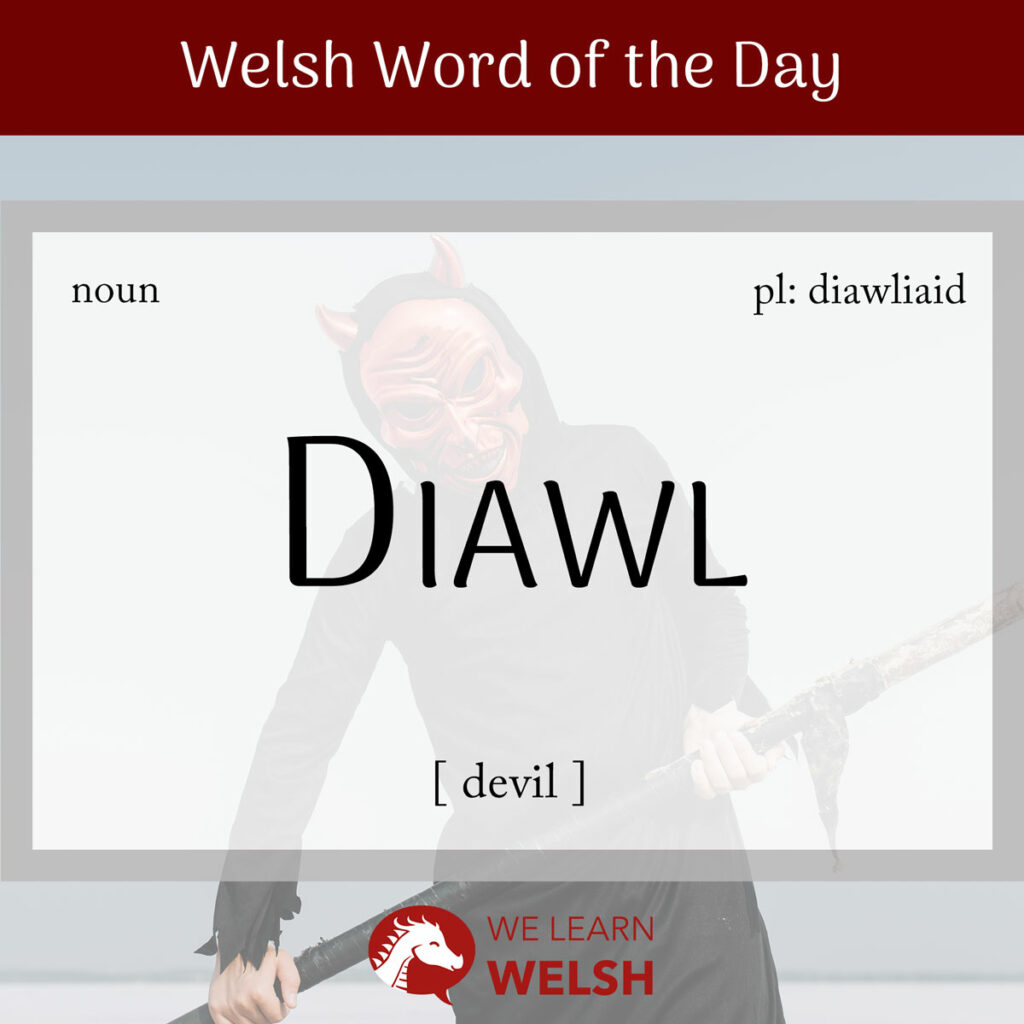
There are three main words you’ll hear used in Welsh to describe the devil, or, more generally, a demon: diafol, diawl, and cythraul. Of these, diawl, is our main word of the day today.
The plural of diawl is normally diawliaid, although some people say diefyl. The word is pronounced very quickly, all in one syllable, which can lead to it sometimes being said (or even written) jawl.
diawl
devil
diawliaid
devils
It is a masculine word and can take the soft or the nasal mutation.
Soft mutation
ddiawl
Nasal mutation
niawl
Aspirate mutation
N/A
Diawl and diafol both come from the proto-Brittonic *diaβl, a Latin borrowing of the same diabolus that gave English the word diabolical. Also in the same etymological family is dieflig (devilish).
Because they’re doublets, diawl and diafol are pretty much identical in meaning – often used to refer to the Devil of Christian mythology but also in idioms, for other demons, and as curse words.
You’ll hear people claim that diawl is more common in the North of Wales and diafol in the South, and then you’ll hear the same argument made the other way around. You’ll also hear it said that y diafol is the Devil and diawl is a demon but both words can be, and are, used to refer to either.
The only consistent difference is that diawl is more common in spoken Welsh and diafol is more common in written Welsh, but again, it’s not much of a difference. It is perfectly fine to say diafol or to write diawl.
Cythraul also comes from Latin, but unlike diawl and diafol it’s less closely associated with Christian mythology, although it can be used in that sense. Some druidic writings define it as spirit of chaos – more like a devil of indigenous Welsh folklore than Christianity’s Satan, which might also be called an ellyll (goblin, spirit, or demon), an ysbryd (ghost or spirit), or a bwbach (bogeyman).
Perhaps because cythraul is less religiously loaded as a term, it appears often in the name of animals, like cythraul Tasmania (the Tasmanian devil) and cythraul môr (angler fish).
Cythraul and diawl are also both used as affectionate insults, so you might say yr hen ddiawl! (the old devil!) about a friend or y cythraul bach! (the little rascal!) about a child.
Mae’n hen foi da, ond mae ganddo ddiawl o dymer.
He’s a good old lad, but he’s got a devil of a temper.
Y diawl (the Devil) himself is usually imagined by modern Cristnogion (Christians) as presiding over uffern (Hell), although in y Beibl (the Bible) itself it is said he is actually only undergoing cosb (punishment) in it, while attempting to drag more pechaduriaid (sinners) down with him.
The word uffern is another interesting one in Welsh. As you can see it is normally not capitalised, and neither is y nefoedd (Heaven / the heavens). Duw (God) is capitalised in Christian, Jewish or Islamic texts but the word duw can also refer to a god in the generic sense. Diafol and diawl more often than not remain uncapitalised, even in reference to the Devil, but this isn’t universal.
Uffern not being capitalised is perhaps because as a concept it’s not really indigenous to Welsh culture, which traditionally talks instead of Annwn (usually translated as the Otherworld).
Annwfn doesn’t correspond exactly to uffern or to y nefoedd. It was historically portrayed as a paradisical gwlad (country) of eternal youth, either under the ground or on an ynys (island). So uffern was borrowed into proto-Brittonic from the Vulgar Latin *iferna (Hell) to refer to the concept of uffern that is discussed in Cristnogaeth (Christianity) and Islam (Islam).
Some common expressions involving diawliaid include:
- gweithio fel y diawl = to work like the Devil
- diawl mewn cnawd / diawl mewn croen = the Devil incarnate, literally a devil in flesh / a devil in skin
- fel diawl dan garreg = always grumbling, literally like a devil under a stone
- a rhoi chwarae teg i’r diawl = to give the Devil his due, literally by giving fair play to the Devil
- angel pen ffordd, diawl pen pentan = a saint abroad and a devil at home, literally an angel at the road, a devil at the hearth
- fydd ‘na hen chwarae diawl = there’ll be Hell to pay, literally there’ll be old devil’s play
- gwneud drwg rhwng y diawl a’i gwt / gwneud drwg rhwng y diawl a’i gynffon = to play tricks on the Devil, literally to make bad between the Devil and his tail
- sonier am ddiawl, fe ymddengys y cythraul = speak of the Devil and he shall appear, literally a devil is spoken of, the Devil appears
As you can see, some of these depict y diawl as the Devil, and in some a diawl is just any old devil. The last is quite interesting because in this one diawl is a devil and cythraul is the Devil, breaking the rule that cythraul is less religiously loaded – this goes to show just how interchangeable the three words usually are.
Dyna ddiawl! Pam ‘nest ti ‘na?
You’re a right devil! Why did you do that?
Diawl and forms of it such as diawch, jawl, or jawch are common, gentle insults or affectionately mocking terms for someone who’s cheeky or mischievous – like in the phrase I mentioned earlier, yr hen ddiawl. Here diawl is mutated to ddiawl after hen (old).
But the word diawl can also actually be a form of profanity. Welsh is a pretty old-fashioned, traditional language, and one of the biggest factors in its survival has been in its use in religious contexts. So a lot of our swear words and phrases are religious. A good example of this is that in many contexts where the English would use the f-word, the Welsh say yffach, a form of uffern. You can read more about this here.
How does diawl come into this? You might tell someone to cer i’r diawl or dos i’r diawl, which means go to the devil. It’s like saying f-off in English but not quite as rude. A ruder version would be cer i grafu (literally go to scratch).
Or you could say i’r diawl ag e (to the Devil with it) to express in a profane way that you don’t care about something.
Other expressions include diawl a’m byto (the Devil eat me), myn diawl (by the Devil), and sut ddiawl (how the Devil…), and ar y diawl (on the Devil). Diawlio is even one way to say to swear itself!