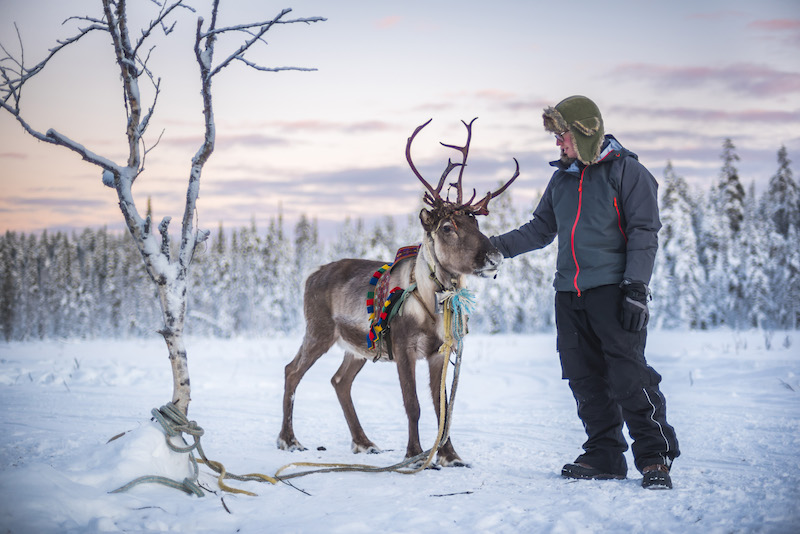
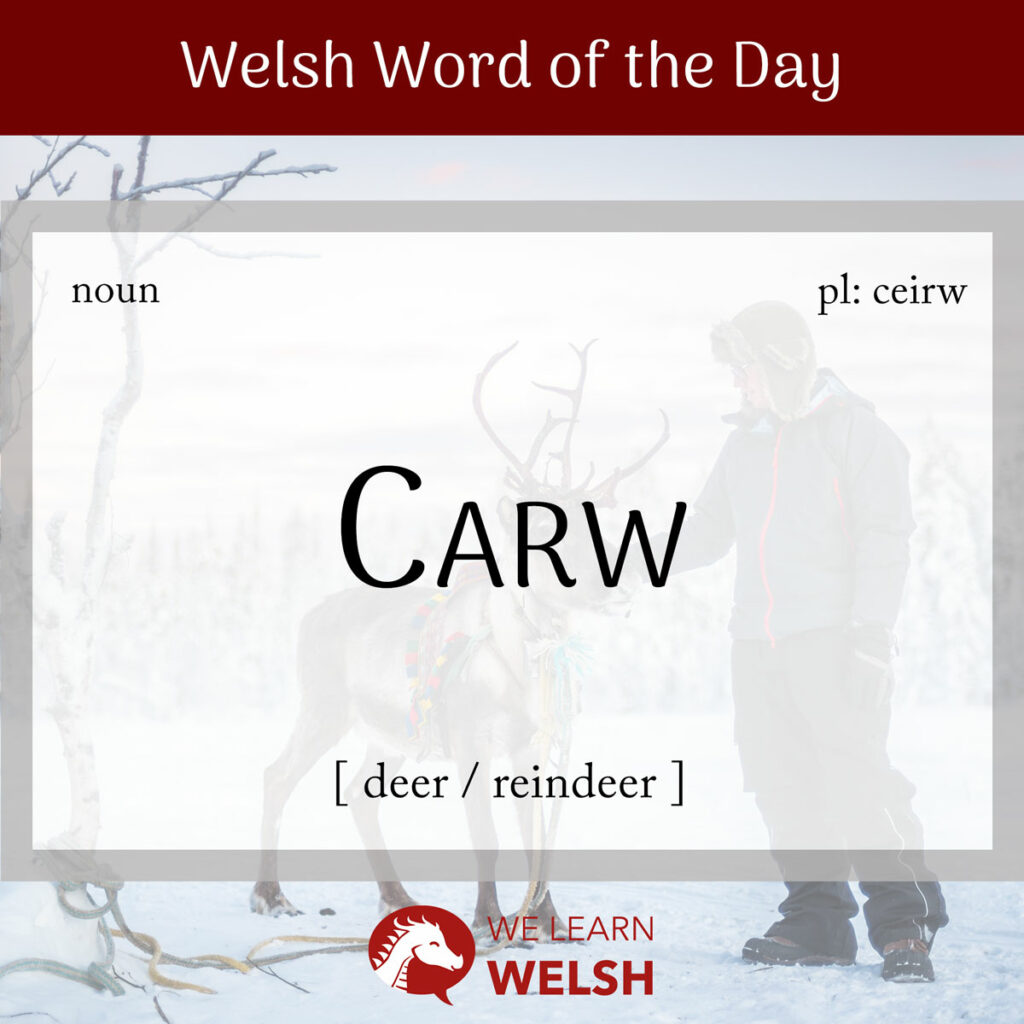
Today’s word of the day is carw (plural: ceirw) which is the Welsh word for deer or reindeer. This is a masculine noun that is susceptible to all three mutations.
carw
deer / reindeer
Soft mutation
garw
Nasal mutation
ngharw
Aspirate mutation
charw
At this time of year, you’re probably hearing quite a lot about ceirw Siôn Corn (Santa’s reindeer), especially Rwdolff (Rudolph)! The other reindeer don’t have established names in Welsh as far as I know, but I think it’s high time they got some, so I’ve had a go translating them below. Maybe we can get them to catch on!
| SAESNEG | CYMRAEG | NODIADAU / NOTES |
| Dasher | Gwibiwr | gwibio = to dash gwibiwr = dasher |
| Dancer | Dawnsiwr | dawnsio = to dance dawnsiwr = dancer |
| Prancer | Pranciwr | prancio = to prance pranciwr = prancer |
| Vixen | Cadno (fox) | There are a few Welsh words for Vixen specifically (e.g. cadnawes) but they don’t fit the two-syllable pattern of the song, and they don’t work so well as catchy reindeer names. |
| Cupid | Dwynwen | Why not replace Cupid with the Welsh patron saint of love? Dwynwen also rhymes with Mellten, so this also makes it easier to rhyme the names like in English! |
| Comet | Seren (star) | Comet in Welsh is seren gynffon which again doesn’t fit the two-syllable pattern. |
| Donner | Taran | Donner means Thunder in German, so I translated it to Taran (thunder clap). |
| Blitzen | Mellten | Blitzen means Lightning in German, so I translated it to Mellten (lightning bolt). |
Mae gan Siôn Corn naw carw hud.
Father Christmas has nine magic reindeer.
Happily, there is a Welsh translation of the first verse of Rudolph the red-nosed reindeer available, thanks to Cymraeg i Blant. Have a listen here and read along with the lyrics!
Rwdolff y carw trwyn-goch
Yn gweithio’n galed trwy y nos.
Rwdolff y carw trwyn-goch
Ef sy’n helpu Santa Clôs.
Rudolph the red-nosed reindeer,
Working hard through the night.
Rudolph the red-nosed reindeer,
It’s him that helps Santa Claus.
You might be wondering if there’s a specific term in Welsh that means only reindeer and clears up the ambiguity with deer. If so, good news! You can use the term carw Llychlyn (Scandinavia deer). It’s less common, and tends to be used in more formal contexts, so you’re unlikely to hear it used in a conversation about magical flying reindeer.
Llychlyn with a priflythyren (capital letter) at the start is the Welsh name for Scandinavia (although you can also use the rather less exciting Sgandinafia). It is derived from the word llyn (lake) and possibly also llwch (dust). Other Celtic languages have similar terms, such as Lochlann in Gwyddelig (Irish), which can also be used to refer to Norwy (Norway) in particular. On the other hand, llychlyn, when not capitalised, refers to a narrow body of water such as a gulf or strait. It also shows up in the Welsh name for the Baltic Sea: Y Môr Llychlyn.
Mae bleiddiau yn hela ceirw.
Wolves hunt deer.
As you’ve probably noticed, carw has quite an irregular plural: ceirw. Quite a few Welsh plurals involve changing the vowel pattern of the singular word (take a look at my other article here for more information). The same pattern appears in the plural of the word car (car), which is ceir (cars). If you’re reading quite an old Welsh text you might also see this pattern appear in the plural versions of adjectives, which aren’t used in modern Welsh:
| UNIGOL / SINGULAR | garw (rough) | marw (dead) |
| LLUOSOG / PLURAL | geirwon | meirwon / meirw (can refer to the dead as in dead people) |
| ENGHRAIFFT / EXAMPLE | Ar y creigiau geirwon Mae’r hen afr yn crwydro. – Cyfri’r Geifr (traditional Welsh song) | Derwen Adwy’r Meirwon (Oak at the Gate of the Dead, the name of a famous oak tree near Wrexham) |
When talking about ceirw, you’re likely to encounter a few more irregular plurals, which can get quite confusing. For example, do you know the difference between carn, corn and cyrn? Carn means hoof, and it has a regular plural: carnau (hooves). By contrast, corn means horn and has an irregular plural: cyrn (horns). We don’t have a separate word for antlers in Welsh, but if you want to avoid confusion, you can say cyrn ceirw (deer horns/reindeer horns).
I hope you’ve learned something new today. Keep an eye out and you might see a couple ceirw yn llusgo sled Siôn Corn (reindeer pulling Santa’s sleigh) if you’re lucky!