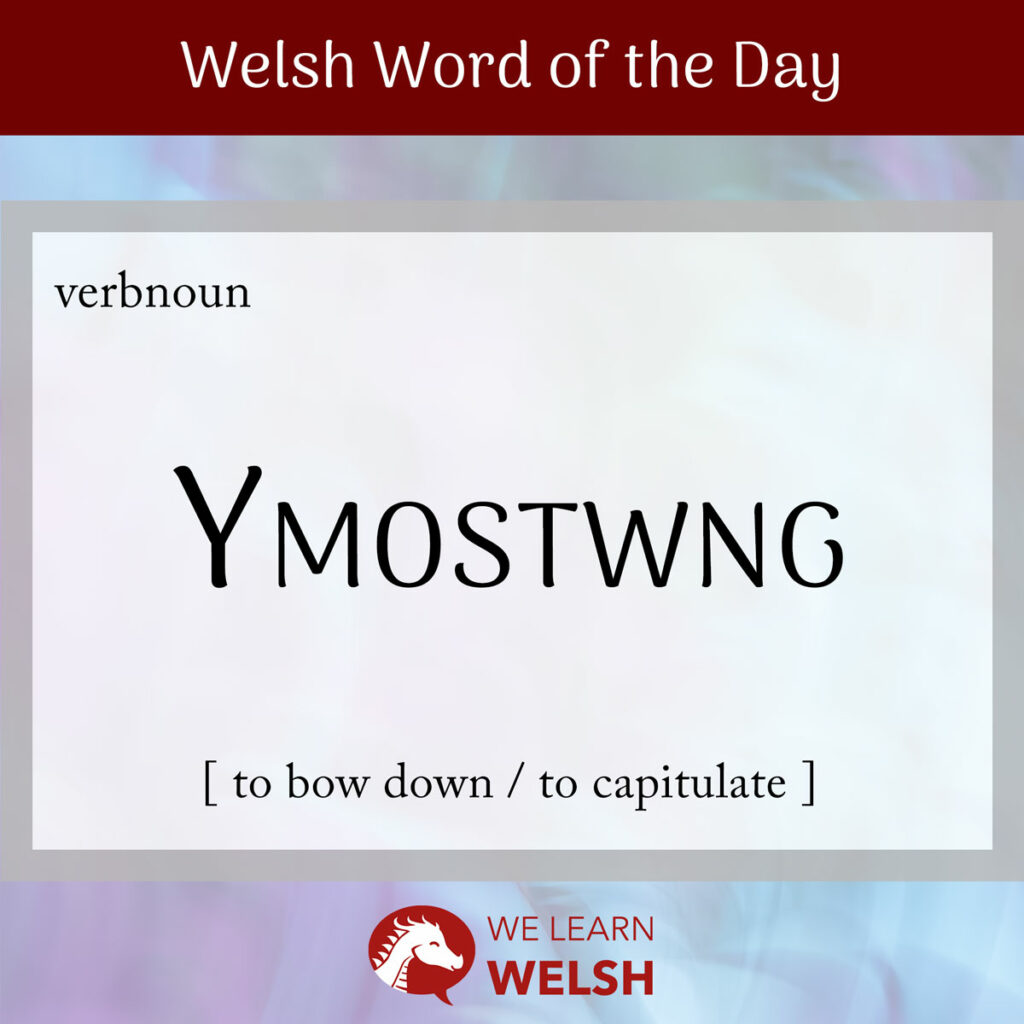
Today’s Welsh word of the day is ymostwng. It has two meanings, one of which is a literal version of the other – it means either to bend down, or, more figuratively, to submit oneself / to capitulate.
As with most Welsh words that begin with y, that first vowel is sometimes clipped off in speech, rendering the word simply mostwng.
ymostwng
to bow down / to capitulate
Ymostwng is a special form of gostwng, which in itself is an interesting word. It roughly translates to to lower, but depending on the context could be better rendered as to let down, to reduce, to descend, or to diminish. It is also an irregular, dialectical way of saying to bow or to curtsy.
Gostwng has been altered with the addition of the prefix ym-, which is used in Welsh to signal that a verb is being done to oneself. So, in this case, the subject is bringing themselves down or lowering themselves – which makes sense, doesn’t it, for the meanings we’ve discussed.
Ymostwng is just one of many, many children-words of the prolifically important gostwng:
- gostyngedig = humble
- gostyngeiddrwydd = humility
- gostyngiad = a reduction
- ymostyngiad = surrender, as a noun
- darostwng = to subdue or to humble (usually someone else)
- ymddarostwng = to abase oneself
Then there’s one that will be painfully familiar to anyone who did TGAU Ffiseg (GCSE Physics) in Wales, the newidydd gostwng (step-down transformer) that is essential to both the functioning of the country’s trydan (electricity) and the lesson plans of its high-school gwyddoniaeth (science) teachers 😂
So unlike its close equivalent ymddarostwng, our word of the day ymostwng can be used in a literal sense – it can be as simple as bending down.
In this case the most relevant synonyms to be aware of are plygu (to bend), usually in the form plygu i lawr (to bend down), and crymu (to stoop), sometimes in the form ymgrymu (to stoop oneself). In the phrase plygu i lawr, the construction i lawr is a commonly used in Welsh to mean downwards or down. Literally, it means to floor, because lawr is a soft mutation of llawr (floor). In my opinion this is a pretty sensible way to describe the direction down!
Plygu and crymu would also be the way in which most people would translate the act of bowing to someone to show parch (respect). You may also hear ymgrymu here or the colloquial borrowing from English bowio.
Although it is correct and acceptable to use ymostwng, words like plygu and crymu are more the norm in casual speech to talk about ymostwng as literally bowing down. Our word of the day becomes more common when we move into the metaphorical dimension.
For the other meaning of ymostwng, we could translate it variously as to surrender, to submit, to capitulate, or to abase oneself – and which one is right really depends on the context.
Ymostyngodd i godi’r papur oddi ar y llawr.
He stooped down to pick up the paper from the floor.
As you can imagine, this use of the word comes up very often in poetic literature that talks of hanes (history) and brwydrau (battles), though remember it strictly refers to a person ymostwng (surrendering) themselves, not to surrendering a castell (a castle) or some tir (land).
It is uncommon to use ymostwng to mean surrender outside of a military sense, unless you were writing barddoniaeth (poetry) and were intentionally invoking the military connotations for effect. For example, when we are discussing surrendering assets in a legal case, we use the word ildio – which we’ll talk more about now.
Ildio is a very useful word that is partially synonymous with ymostwng. It was borrowed from the Middle English word yielden that gave English to yield. Ildio is a less flowery, less dramatic way of saying to concede or to surrender.
It is sometimes rendered gildio. This is a common phenomenon in Welsh; words that begin with a vowel have a g affixed to the start of them, probably because of a sub-conscious assumption by speakers that they were originally spelt and said that way and lost the initial g through soft mutation.
A second interesting non-literal meaning for ymostwng is to condescend: think of the phrase I will not stoop to that. The same metaphorical use of stoop in English that we see in that sentence can be used in Welsh too, as in ymostwng i wneud rhywbeth (stooping to do something).
Ymostwng conjugates in a slightly irregular way, but it’s nothing to be too anxious about – the last vowel, w, simply changes to y in all the conjugated forms. I’ve used submit as the translation in the table to keep it simple but any of the conjugations could be used with any of the meanings we’ve discussed.
| Singular | Plural | Past | |
| First person singular | Ymostyngaf i I will submit | Ymostyngwn i I would submit | Ymostyngais i I submitted |
| First person plural | Ymostyngwn ni We will submit | Ymostyngen ni We would submit | Ymostyngon ni We submitted |
| Second person singular / informal | Ymostyngi di You will submit | Ymostynget ti You would submit | Ymostyngaist ti You submitted |
| Second person plural / formal | Ymostyngwch chi You will submit | Ymostyngech chi You would submit | Ymostyngoch chi You submitted |
| Third person singular | Ymostyngith o/e/hi He/she will sleep | Ymostyngai fo/fe/hi He/she would submit | Ymostyngodd o/e/hi He/she submitted |
| Third person plural | Ymostyngan nhw They will submit | Ymostyngen nhw They would submit | Ymostyngon nhw They submitted |
As ever, remember that you will often hear dialectical variations on the conjugations above.
Rwy’n ymostwng i’ch barn arbenigol ar y pwnc hwn.
I submit to your expert opinion on this matter.
To finish off, here are some simple phrases in which you could hear or use the word ymostwng:
- ymostwng i awdurdod = to submit to authority
- ymostwng i safonau isel = to stoop to low standards
- ymostwng i orchymyn = to submit to an order
- ymostwng i ddyfarniad = to submit to a judgement
- ymostwng i’r drefn = to bow to the inevitable (literally to bow to the order)
- ymostwng eich hun = to surrender oneself
Had you come across the word ymostwng before today, or is it new to you?