A lot of Welsh words are borrowed from English. Stereotypically, we imagine this as having happened very recently – the younger generation adopting English slang, or people taking English words for new technologies.
But it’s actually been happening for hundreds of years, and many Welsh borrowings of English words have transformed in such a way that you wouldn’t even necessarily recognise them as loanwords today.
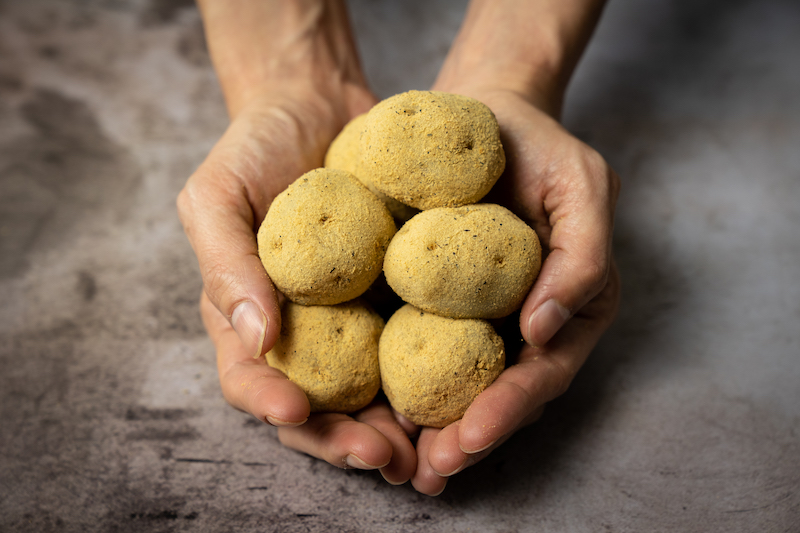
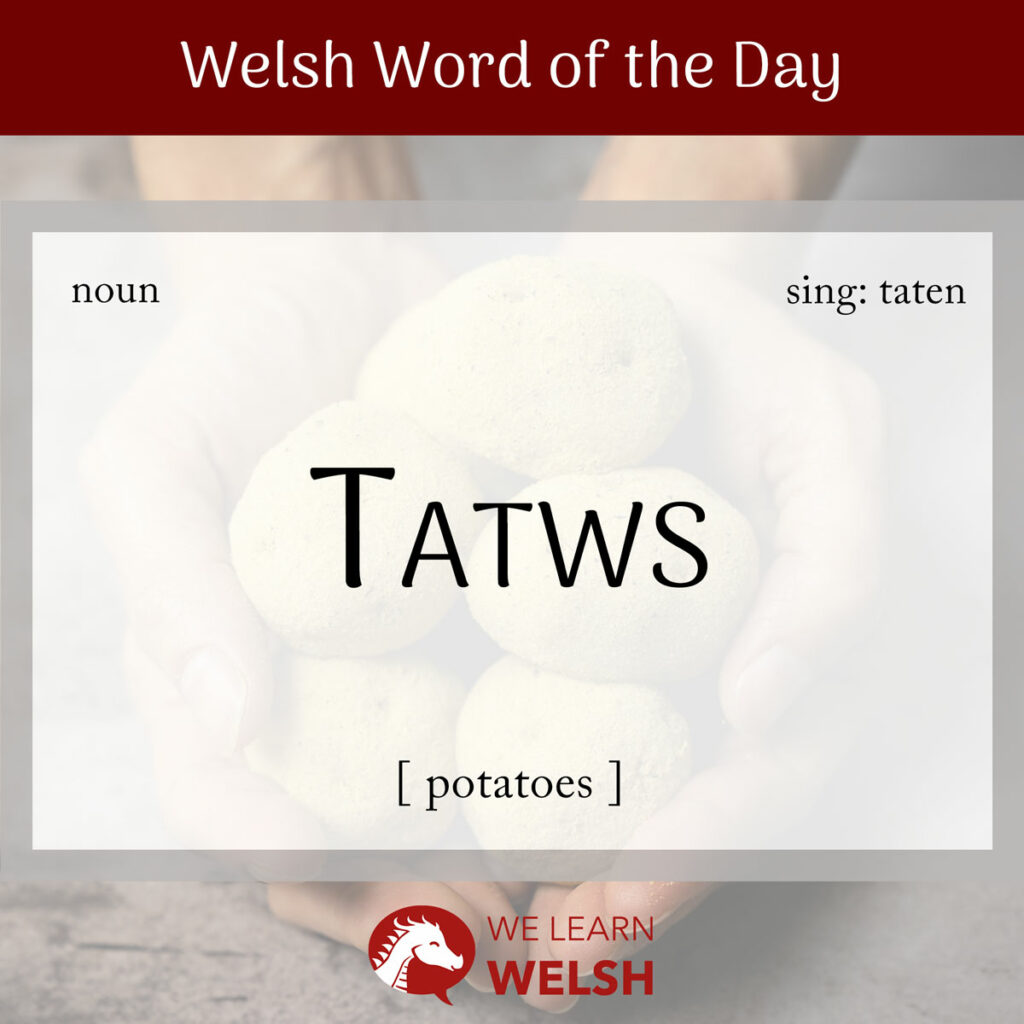
Tatws is an example of this – it’s a ‘clipping’ of pytatws, which of course comes from potatoes. From this comes the standard singular form, which is taten (a potato), a feminine noun. However, as is the case with many nouns in Welsh which follow the collective-singulative pattern (where the plural is the default form), plenty of native speakers use the plural to refer to the singular, though this is not strictly considered correct.
tatws
potatoes
taten
a potato
There are alternative versions of this word. Tato is another possible plural, as is tatw. Some North Walians use tysen or tatan for the singular. And cloronen, with plural cloron, is used in literary contexts – most people colloquially are more likely to use this to mean tuber though. Tatws, overall, is the most common word you’ll hear and learn.
Here is how tatws mutates:
Soft mutation
datws
Nasal mutation
nhatws
Aspirate mutation
thatws
Tatws are a kind of lysieuyn (vegetable), specifically gwreiddlysieuyn (root vegetable), native to the Americas. They’re a good source of startsh (starch) and even contain some fitamin C (vitamin C, the C is pronounced ec, unlike the English pronunciation see).
After being introduced to Ewrop (Europe) in the 1600s they quickly became very popular, and now feature in a lot of traditional British dishes. One example of this is of course cawl Cymreig (in English just cawl), a cawl (soup / stew) made of tatws, moron (carrots), cennin (leeks), and often cig oen (lamb) or cig eidion (beef).
Dydy hi ddim yn lico sglodion, ond mae hi’n hoff iawn o datws pob.
She doesn’t like chips, but she really likes baked potatoes.
Other very popular ways of enjoying tatws include:
- tatws pob = baked potatoes
- tatws stwnsh = mashed potatoes – there are a lot of fun regional variants too!
- tatws rhost = roast potatoes
- tatws newydd = new potatoes
- sglodion / tsips = chips
- creision = crisps
- crwyn tatws = potato skins
There are tatws-based ryseitiau (recipes) unique to Wales too; anthropologist Sara Tibbott recorded tatws stêm for a specific saig (dish) made of tatws berw (boiled potatoes), bacwn (bacon), and nionod (onions) in her 1983 ethnography of Welsh cuisine. Another unique rysáit (recipe) she recorded was tatws llaeth – which just meant tatws cooked in llaeth enwyn (buttermilk).
In the same book, she noted that in many regions of Wales, tatws cooked without plicio / crafu (peeling) were referred to as tatws trwy’r crwyn / tatws trwy’r pil (potatoes through the skin) whether they then underwent berwi (boiling) or pobi (baking).
And of course, all of these could also be done with tatws melys (sweet potatoes), swêds / rwdins (swedes), iamau (yams), or maip (turnips) instead of regular tatws for a bit of extra variety 😉
Allet ti dorri’r madarch a’r tatws? Diolch yn fawr.
Could you chop the mushrooms and the potatoes? Thanks very much.
Did you know that when sglodion – in particular pysgod a sglodion (fish and chips) –began to become popular in the UK, the first siopau sglodion (chip shops) established in Welsh seaside towns were called tafarnau tatws (potato pubs)?
I gave this a Google to see if the term is still used by any establishments, and it did come up in one siop (shop) in Aberystwyth called Y Dafarn Datws (The Potato Pub), so I’ll definitely have to check that out next time I’m there. Notice that because tafarn is a feminine noun, it soft mutates after the definite article, and it also causes tatws to mutate to datws. That didn’t happen when I first introduced the phrase, because I gave it in its plural form, which negates any need to mutate.
Mae swper yn barod heblaw am y tatws.
Supper is ready except for the potatoes.
Before we finish up, let’s look at one last fun fact about tatws. Did you know that in Welsh, blodyn tatws (potato flower) is actually used as a term of endearment? So don’t just leave it at boring old cariad (love) or annwyl (darling) – switch things up and start calling your loved ones blodyn tatws. After all, who wouldn’t take it as a compliment to be compared to the wonderful taten?