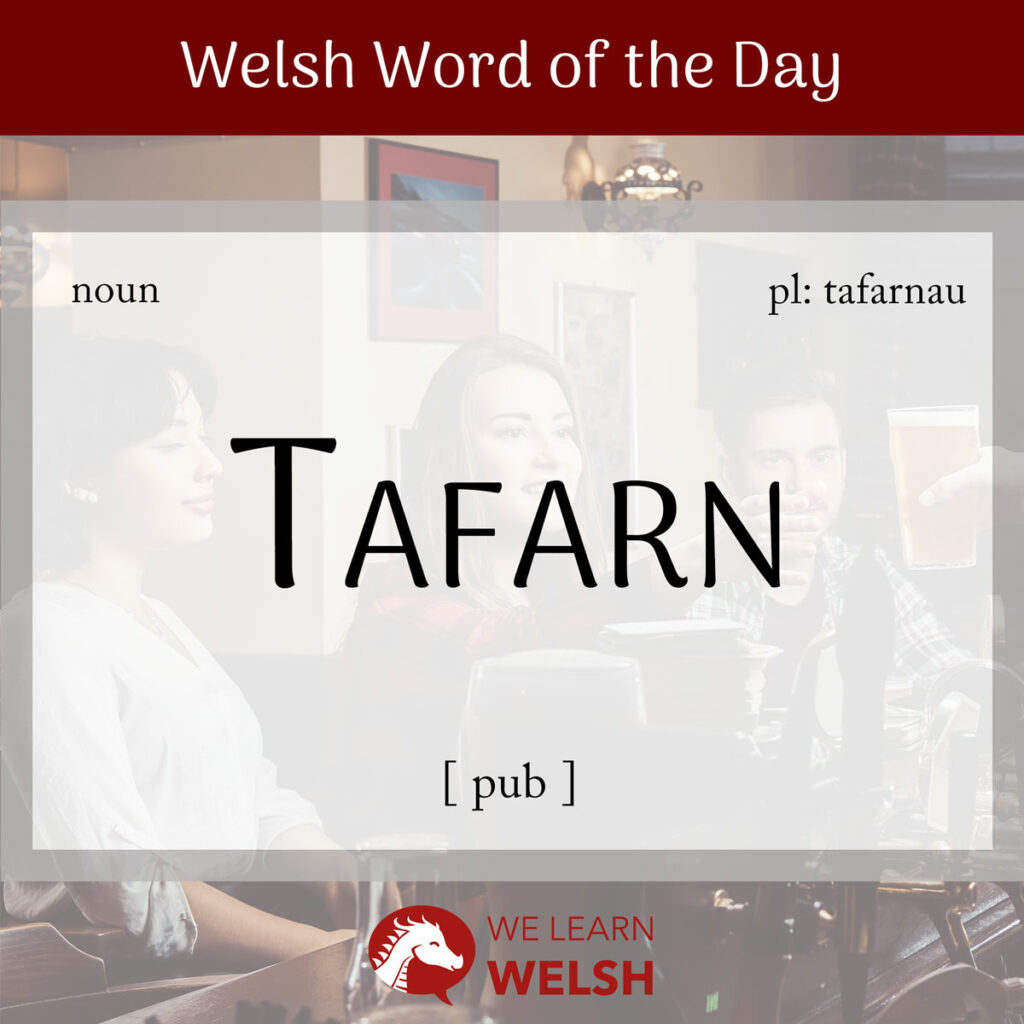
From The Queen Vic in Eastenders to Y Deri in Pobol y Cwm, the prominence of tafarnau (pubs) in British TV is just one clue to how important they are to this little island’s culture. The Welsh word for a pub is tafarn.
tafarn
pub
tafarnau
pubs
This is how tafarn mutates:
Soft mutation
dafarn
Nasal mutation
nhafarn
Aspirate mutation
thafarn
Whether or not it takes the soft mutation after y (the) does differ throughout the country. This is because the noun is usually considered feminine in North Wales and masculine in South Wales. So the phrase the best pub, for example, would be y dafarn orau in the North and y tafarn gorau in the South.
You’ve probably guessed that tafarn comes from the same root as the word tavern, which is Latin’s taberna, meaning a shop or an inn. Indeed, there’s considerable overlap between the concepts of a pub, an inn, and a tavern. Luckily, in Welsh, the word tafarn will do just fine for any of these – though an inn that is bigger and busier may instead be called a gwesty or llety (hotel).
And the word used to be even more versatile than it is today! Terms like tafarn (g)win (wine bar), tafarn coffi / tafarn goffi (coffee house), and even tafarn tatws / tafarn datws (chip shop, literally potato bar) are recorded in the nineteenth and early twentieth century. Today they may be used in the names of establishments if they’re trying to portray a homely, quirky or old-fashioned image, but are not most people’s first choice in a conversation.
Dw i’n taro draw i’r dafarn i weld Lleucu.
I’m popping to the pub to see Lleucu.
Tafarndy and tŷ tafarn, both literally meaning tavern-house, were older variants on tafarn, more likely to describe places where one might stay the night. They are also not very common nowadays.
The most important vocabulary you’ll need when visiting a tafarn is how to order a diod (drink)! You can’t go wrong starting with ga i (can I have / may I have). Then you’ll probably want to gofyn am (order, literally ask for) one of the following:
- cwrw = beer
- gwin coch = red wine
- gwin gwyn = white wine
- jin = gin
- seidr = cider
Alternatively there’s nothing wrong with going for a diod feddal (soft drink) like sudd (juice) or lemonêd (lemonade)!
Remember that ga i will cause a soft mutation to whatever follows it – which, in this phrase, will probably be you specifying what measurement you want, such as a gwydr (glass), peint (pint), or potel (bottle).
After these will come o (of) and then the name of the drink you want. O also causes a soft mutation. So you’ll end up with a phrase like one of these:
Gawn ni botel o win gwyn ar gyfer y bwrdd?
Can we have a bottle of white wine for the table?
Ga i hanner-beint o gwrw, os gwelwch yn dda?
Can I have a half-pint of beer, please?
Historically in much of the UK, tafarnau have been seen as gathering places for the cymuned (community), a pillar of tref (town) and pentref (village) life just as much as the eglwys (church) or ysgol (school).
Though today in big dinasoedd (cities) they’ve been slightly usurped by the more international phenomenon of the bar (bar) and clwb (club), in smaller locations, many tafarnau (pubs) still play this role. And wherever you live, your tafarn (l)leol (local pub)can carry a lot of teimladrwydd (sentimental) and community spirit. Plus, the good old tradition of the helfa dafarnau (pub crawl) doesn’t seem to be going anywhere any time soon!